
Lunna, Scalloway and the Shetland Bus
The Shetland Bus
The Shetland Bus was a World War II resistance movement taking wireless operators, armaments and combatants into Nazi occupied Norway and returning with refugees and members of the resistance. It was originally based in Lunna but later moved to Scalloway. We visited both.
Lunna
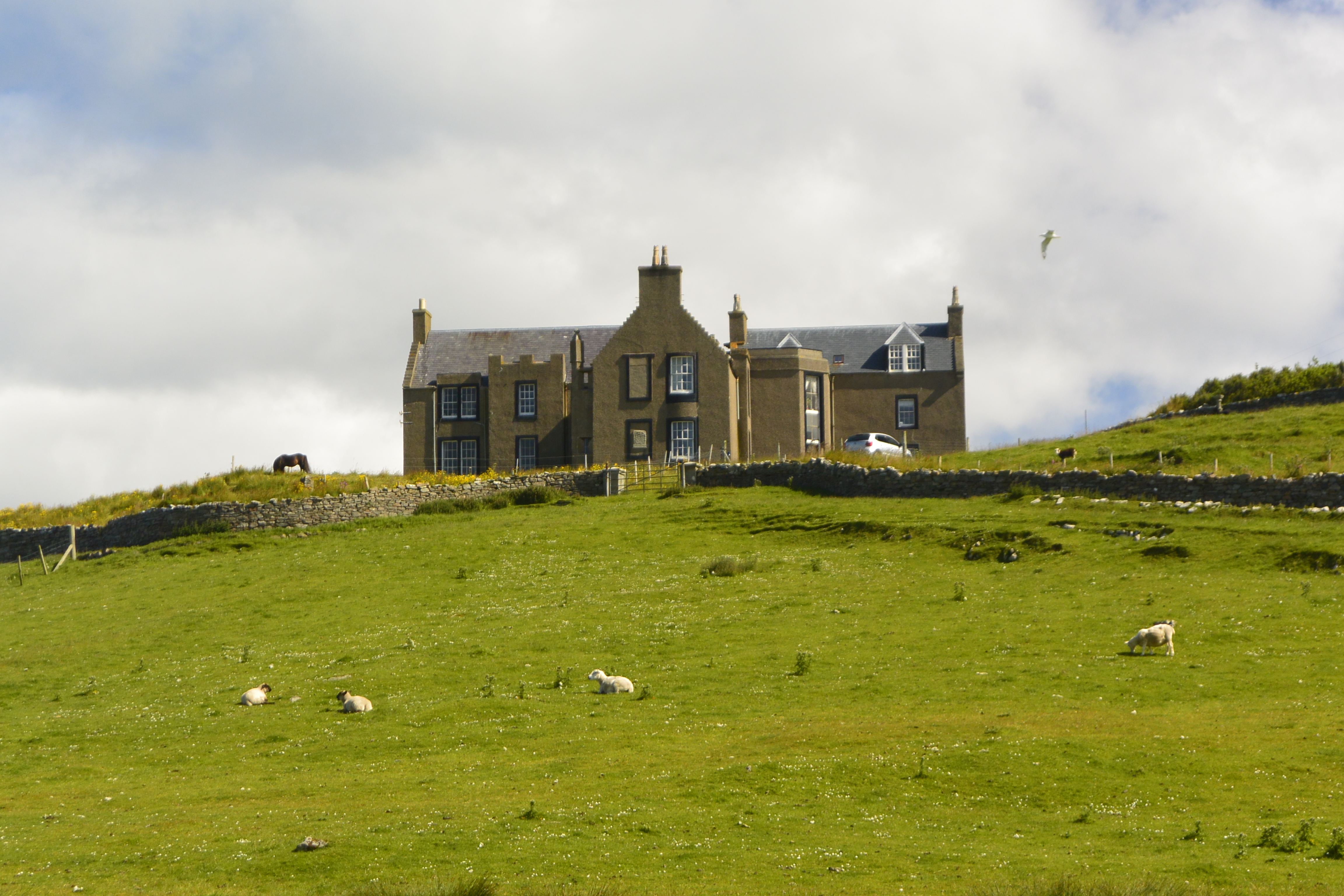
Lunna House was the original HQ of the Shetland Bus from the invasion of Norway in 1940 until 1942. It housed 30-40 agents who set out in all conditions in little fishing boats to perform their heroic deeds. Today it’s a B&B, so not open to the general public, but the church (1753 – the oldest still used in Shetland) is worth a look, as is the pretty harbour and beehive-shaped limekiln. The modern gravestone is inscribed: Calum Forbes Mackenzie. Died January 27th 2012. Aged 54. Doctor in these islands he loved. I found that touching on many levels.


Scalloway

In 1942, the Bus moved to the more central location of Scalloway, with better communications and a purpose-built slipway for repairing the boats. Dinapore House was the new HQ – it and the slipway can both be seen today.


In almost 100 missions using the small fishing vessels, 10 boats and 44 men were lost. Later, the American Navy donated three American sub-chasers which undertook a further 115 missions without loss. In 2003, these brave men were honoured by a memorial in Scalloway and the excellent museum has a large, and very moving, display devoted to them.
Scalloway is Shetland’s second largest settlement after Lerwick and was once the capital. It’s a pretty little town to wander round and has a ruined castle to visit too. This was built by forced labour in 1600 for the infamous Patrick Stewart, Earl of Orkney, Lord of Shetland and a half-brother of Mary Queen of Scots. We’ll meet him again on our travels. Stay tuned. In the meantime, here’s a Scalloway Gallery.


 The Glasgow Gallivanter
My uncle, Audun Mjaatvedt from Bergen, Norway, must have stayed at Lunna House when he fled from the Gestapo on the ‘Shetland Bus’ boat M/B Jan, arriving in Lerwick on October 7, 1941. He and his cousin, Arne Røthe (who was also onboard), were part of the Norwegian resistance group called Kristian Stein. When the group was infiltrated by German spies, they had to flee for their lives. Their comrades who weren’t able to reach safety were tortured, imprisoned, and many executed. My uncle died two years later near Edinburgh, but I am grateful to the Shetland people for sheltering and embracing him, Arne, and the rest of the Norwegians who fought so valiantly against the Nazi occupation.
LikeLike
That’s an interesting and moving story – thank you so much for getting in touch.
LikeLike
Anabel,
Google is a wonderful tool and found your article on the Shetland Bus. I thought you might be interested in a little bit of history on Dinapore House.
It was built by my great-grandfather in 1909 when he was the parish doctor. Adding to the story, he was originally from India and moved to Scotland to study medicine.
There is an interesting article in a Shetland magazine which can be found at http://www.shetland.org/site/assets/files/3186/60-north-autumn-2014.pdf, with a picture and short story on Dr De Sylva.
LikeLike
Thank you for getting in touch. It’s really interesting to “meet” a descendant of someone connected to the story. I shall certainly read the article.
LikeLike
I’d never heard of the Shetland Bus, how interesting.
And what a beautiful place to visit. 🙂
LikeLike
Thanks, it was both interesting and beautiful.
LikeLike
I had no idea about the Shetland Bus. It must have been harrowing to be part of those missions. I had a great grand uncle in the Arctic Convoys, who died when his ship sank in the Barents Sea in 1942. It was a converted whaler, so probably not dissimilar to the boats of the Shetland Bus. I’ve read the official report into the sinking at the National Archives in Kew. There were three survivors, and their testimony is incredibly sad.
Thanks for this post. It’s fascinating reading — and I love the church. It is beautiful.
LikeLike
Thank you. We came across some history about the Arctic Convoys later in the holiday. Still to come!
LikeLiked by 1 person
I’ll look forward to it. The more I learn about them the more in awe I am of those men.
LikeLiked by 1 person
Schöne Fotos. Freundliche Grüße von uns. Wolfgang
LikeLike
Danke!
LikeLike
Didn’t know about that WWII story. Thanks so much for sharing 🙂
LikeLike
I didn’t know either till I went to Shetland the first time. True heroism.
LikeLike
This seems like a lovely trip. The B & B looks great to stay in but probably not cheap. You are right that gravestone is touching and I love that gate! Nice and bright. I only know of one Patrick Stewart (he can talk to me anytime:)) so I will be interested in what you write about this other not so nice guy
LikeLike
Ha ha, not THAT Patrick Stewart! I haven’t checked the B&B but it’s maybe more like a hostel because it doesn’t have en-suite facilities. I don’t do sharing bathrooms these days!
LikeLike
I’d never heard of this piece of history, either.
Also? Those sheep in the first picture really make the picture for me. Apparently, I think all buildings that have a certain look should come with a field of sheep. And that house has the look!
LikeLike
Sometimes hard to take a picture without sheep in Shetland! Downside: picking your way through a field of droppings…..
LikeLiked by 1 person
I think it is a price I would pay!
LikeLike
And it’s smelly! Choppy could be in heaven at that though….
LikeLiked by 1 person
She would enjoy that aspect immensely! I suspect there would be some rolling in it involved.
LikeLiked by 1 person
I did not know about this piece of history. I can only imagine how terrifying it must have been to cross over in those fishing boats! I love the carving of the bird.
LikeLike
I know. I was very subdued after visiting the museum. Yes, the bird is beautiful. Also, there were very few headstones in the new part of the graveyard and it really stood out. I felt the doctor must have been held in very high esteem.
LikeLiked by 1 person