
Fife Coastal Path
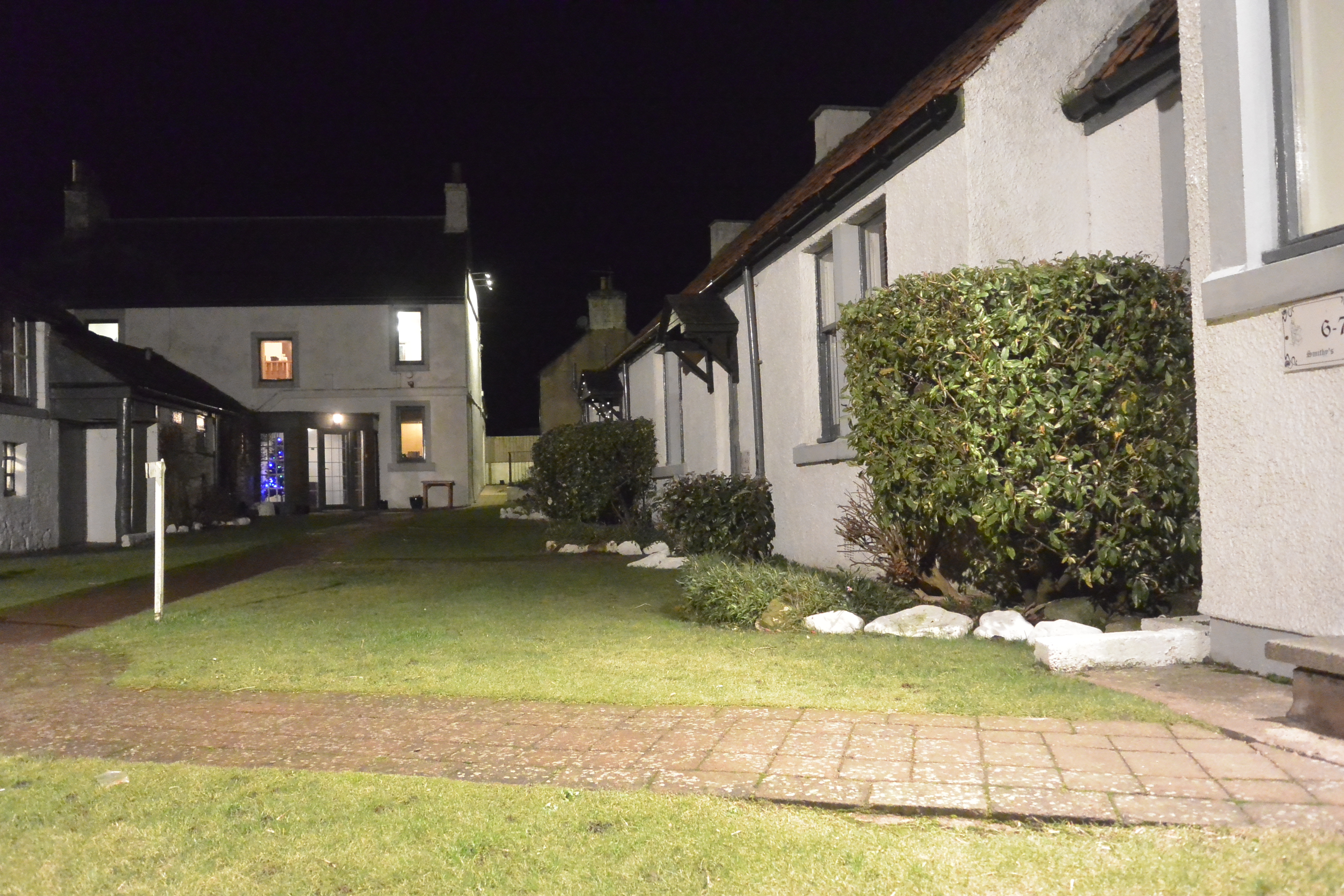
Between Christmas and New Year we stayed a few nights at the Inn at Lathones, just outside St Andrews, with the intention of walking a few stretches of the Fife Coastal Path. It’s our third time at this historic hotel where we enjoy the cosy atmosphere and good food. This time, we had a room in the Old Forge with access to the deck overlooking the farmland at the back. This would be lovely for sitting out in warmer weather but not in December – however, it did mean we always had something to look at.


Day 1 – Crail to Fife Ness
On our first full day, we headed for Crail, a traditional fishing village with a 17th century harbour.


Although we’d been to Crail many times before, we had never taken the path to Fife Ness which we now set out to do. Near the edge of town, we passed the 16th century doocot (used to harvest doves for meat), then a children’s playground and a very large caravan park. After this it became more interesting as we entered the Kilminning Coast Wildlife Reserve where seabirds, such as shag, eider, cormorant and guillemot can be seen.


Some colourful cottages appeared above us, then we rounded a corner to the lighthouse at Fife Ness – a squat building rather than the usual attractive white tower.


Fife Ness is the most easterly corner of Fife. Its harbour dates from the sixteenth century and was used for fishing until the end of the eighteenth. It was then converted into a sea beacon construction yard, hence the circular grooves in the stone, and lightships were also built here to guide shipping before the lighthouse was constructed in 1975.


The next part of the path skirted a golf course, and then we came to Constantine’s Cave. Local legend has it that King Constantine I (one of the early Pictish Kings) was killed in this cave following a battle with the Danes in 874.


At this point we decided we had gone far enough and retraced our steps back along the coastal path.


North Berwick Law and the Bass Rock were just visible across the Firth of Forth.


In Crail, we took time to admire the buildings before heading back to the hotel.


We were particularly impressed with Penman the butcher’s Christmas window!


Day 2 – St Andrews and Pittenweem
The following day, we didn’t do so much walking. John’s cousin, Lindy, lives in Anstruther and they kindly asked us to lunch which we thoroughly enjoyed. Beforehand, we had a quick stroll around St Andrews.


Afterwards, we visited Pittenweem, Fife’s only working fishing harbour, and the site of a cave used by St Fillan in the 7th century. The light was already starting to fade when we got to the harbour.


It gave the buildings a pleasing glow.


We saw several decorated bicycles – but only one decorated bench.


As we climbed away from the sea, it got darker and darker.


By the time we walked back down past the cave it was very dark indeed.


And the harbour looked even more beautiful with the lights shimmering in the sea.


Day 3 – Dysart to West Wemyss
On our last day, we decided to stop in Dysart, a Royal Burgh dating from the 7th century, to walk the coastal path to West Wemyss. The old Harbourmaster’s House, on the deliciously named Hot Pot Wynd, now houses the Coastal Centre Exhibition and the Harbour Bistro. Great – a coffee before we started. Wrong! Despite the notice outside, and having looked at the website before we left, the place was closed. This was 31st December so not a public holiday. I know a lot of places close for the whole period between Christmas and New Year but some information would be nice. Shame on you Fife Coast and Countryside Trust!


Undaunted, we spent some time wandering round the harbour. Donald Urquhart’s Sea Beams represent the colours of the sea at different times and in different lights.


The start of the walk took us along the shore past the 13th century St Serf’s Tower and the restored Pan Ha’ red tiled cottages, then up Hie Gait.


From Dysart the path climbs to the Frances Colliery memorial and preserved winding gear, testament to the former importance of the coal industry in the area. The colliery, with so many others, closed in the 1980s.


From Blair Point you can look down on West Wemyss.


From here, the path takes you past a walled chapel garden, the private burial ground of the Wemyss family, and some pretty mosaics.


West Wemyss originated as a planned town for workers on the Wemyss estate. At one time, it was one of the most important ports in Fife, trading in coal and salt with the Continent. It is certainly picturesque, but was almost deserted and once again everything was closed despite the local pub being listed on the coastal path information boards as a “Welcome Port”. We’d had a large hotel breakfast, so there was no danger of starving, but the wind was biting and somewhere to warm up would have been nice.


There was nothing for it but to turn round and head back to Dysart where The Man i’ the Rock was able to serve us a late lunch. After a quick look around it was back in the car and home to Glasgow for New Year.


I love this part of the coast: beautiful views, historic towns and villages with some industrial history thrown in. We’ll be back. In the meantime, I’m linking up to Jo’s Monday Walks. She’s in another of my favourite places this week, the Yorkshire Dales, and her cyber friends are walking all over the world. Please take a look!


 The Glasgow Gallivanter
What quaint and charming villages and harbors, though everything looks quite deserted, as you said. I would enjoy the coastal walks too. What a fun outing; I’m glad you finally found an open place to eat some lunch and warm up! 🙂
LikeLike
I’m enjoying these random blasts from the past you are leading me to!
LikeLike
Haha! I have thousands of emails I’m finally in the process of cleaning out and I’ve saved all the email notifications of your posts. I hope to get to them all eventually. 🙂
LikeLiked by 1 person
What beautiful places! I never tire of seeing these little villages that seem to be stuck in time. These are my favourite places to visit, because you can almost breath history in. It’s like being there, ‘at that time’ rather than in our own times.
Sorry I’ve been silence so long, Anabel. I was without my laptop for two weeks and then, I cought a cold and I’m still fighting it. I’m so tired of this annoying companion, but I suppose I have to be patint.
Thanks so much for sharing your experience 🙂
LikeLike
Sorry to hear you’ve been unwell – hope things improve soon.
LikeLike
Your pictures are incredible and I love the details you provided. I’ve been wanting to visit Scotland because of the history and charming towns like this…❤
LikeLike
I hope you make it some day!
LikeLiked by 1 person
I am so jealous of your captivating village walks! (no rain?? – so you really did send it my way?)
LikeLike
It did rain a little bit on the last day! But yes, the rest must have gone to you…..
LikeLiked by 1 person
Absolutely amazing walk. I love the buildings, all so different and beautiful, and the shop window decorations.
LikeLike
Thanks, we had an amazing time!
LikeLiked by 1 person
I love all those little details on the buildings, like those dates and initials (I’d love to know the story behind TA & SH, or is it TS and AH?), and I particularly love that cat (I think?) mosaic!
LikeLike
I’m not sure what way round that would be! I’ve not noticed one with hearts like that before – very sweet. I find all these details fascinating too. And yes, there’s a cat in the mosaic.
LikeLiked by 1 person
This is a wonderful walk and such a beautiful part of the country. I like those sea beams . . such a clever idea and I’m not sure I have ever quite seen a dovecote like that doocot. English ones never seem to be quite as interesting!
LikeLike
I liked the Sea Beams too. Simple but effective!
LikeLiked by 1 person
What a lovely area Anabel!
LikeLike
It’s very beautiful! We love walking there.
LikeLike
Looks really beautiful there, Anabel. I do love the butcher’s window. 🙂
LikeLike
The window was very impressive!
LikeLiked by 1 person
Lovely post Anabel! Have very much enjoyed reading and looking at your beautiful photos. Looks like the perfect break 🙂
LikeLike
Thank you – it was!
LikeLiked by 2 people
Hi Anabel – I don’t this part of the world at all – I had a brief visit to St Andrews … but only brief – so your photos and notes have opened my eyes -I’ll avoid the cold! Frustrating re the lack of a coffee or a pint and perhaps a scone to tick you both over … still sounds a lovely visit and then at least the New Year was waiting! Cheers Hilary
LikeLike
Thanks Hilary. Glad to have opened your eyes to the beauties of Fife. It was certainly frustrating to walk there and back with no sustenance at all!
LikeLike
Those are some “funny” names of places! Lots of water, which I love and so much history. We have been in the same situation of wanting to go out for a drink or dinner on New Year’s Eve and finding closed doors.
LikeLike
I suppose they are funny! I know them so well now. To be fair to the pub it was open in the evening, but it was annoying that all the places advertised for that part of the route were closed when we wanted them!
LikeLike
I’m homesick! The little bit of childhood I had in Scotland was spent in Dysart, where whole branches of my family have lived for generations, working in the pits and the potteries, and later at Nairns. Even my NZ-born baby brother did a stint at Nairns in the ’90s.
LikeLike
I knew you had a Fife background but I didn’t know it was precisely Dysart. Glad we had some pictures of it for you!
LikeLiked by 1 person
I love these pictures that show not only the old but some of the modern buildings or art pieces. The one home with the windows…is it a home or some art centre? I’d love to go to that cave where the King died. The night pictures turned out really well. Great looking place to visit.
LikeLike
Thanks, Birgit. Not sure which you mean, but no art centres there.
LikeLike
Maybe it is the lighthouse? It is the picture on the right underneath the pic of the birds on the rock
LikeLike
Oh yes, that’s the lighthouse.
LikeLike
Another beautiful place to visit. When I hear golf course and St. Andrews, it’s definitely something familiar (I did look up the path to see what golf course it went by, just in case you were wandering the familiar course down the road from where you were).
LikeLike
No, this was not the famous course! But there are loads of courses round there.
LikeLiked by 1 person
That’s what it looked like when I was looking at a map. I know this is somewhere in Scotland I could easily convince Paul to visit!
LikeLiked by 1 person
I really like Fife, The Coastal Path and the Eastern seaboard in general. If you can find a copy of Ken Follett’s bestselling paperback ‘A Place Called Freedom’ set in Fife in the mid 1700s it really is worth a read. Not only a great historical adventure and romance but also a vivid and accurate account of the ‘white slaves’ (local miners) who worked down the pits for the rich landowners from the age of six or seven years old until they died. Makes you realise how lucky we are today like no other book I’ve read but not depressing- just inspiring and wonderful.
LikeLike
Interesting! I do find the history round there fascinating. It looks so tranquil these days.
LikeLike
I wonder if there is a cave anywhere around the British coast that hasn’t been the home to a King or Priest or similar ne’er do well!?
LikeLike
Unlikely! They all seem to have a history – or myth.
LikeLiked by 1 person
Such an interesting post Anabel! We went that way many years ago, it’s lovely to see your photos and stories of a beautiful area.
LikeLike
Thanks Debbie, it is such a gorgeous place, we love it.
LikeLiked by 1 person
Bet it was bracing at that time of the year, but looks like the weather was OK for a walk.
I’d have been disappointed if I’d missed out on an anticipated brew too!
LikeLike
Disappointed hardly covered it! Still, the pub back in Dysart was basic but cosy and cheered us up.
LikeLiked by 1 person
Love a coastal walk, Anabel, and there are such nice villages up that coast. I thought we were going on an evening walk when we started out. Makes a nice change 🙂
I don’t think your pingback is working. I came over ‘on spec’ to see if you had written your walk yet. I’ll check spam, just in case! Thanks for the mention.
LikeLike
Thanks Jo. How odd about the pingback, the link from my post is definitely working and I don’t know how it works its magic after that!
LikeLike
Me neither! I just know I haven’t been ‘pinged’ 🙂 🙂
LikeLike
😦
LikeLike
I really enjoyed this walk, especially as it’s so hot here at the moment and your photos look decidedly chilly. Is there a reason for the unusual shape of the lighthouse?
LikeLike
I think just because it’s relatively modern with a powerful light so they don’t need to have the light at the top of a tower any more. That’s my guess anyway!
LikeLiked by 1 person
And it was definitely chilly – I’d take a bit of your heat right now…..
LikeLike
You might change your mind when you hear it’s been up to 40 degrees C 😮
LikeLike
Um – maybe! Perhaps we could add our temperatures together and divide by two. 22 sounds good….
LikeLiked by 1 person
Today is supposed to be 28…positively chilly after the last week. 😊22 seems like a dream.
LikeLiked by 1 person
Looks absolutely lovely. I so love Scotland and it has been too long since our last visit (2004)…we really need to plan another trip soon. (Suzanne)
LikeLike
Thank you – it was indeed lovely. 2004 is a long time ago so I agree, your visit is overdue!
LikeLike
They look really interesting places to visit and very picturesque too. I love fishing villages especially. Need to get to the coast again soon!
LikeLike
Yes, I love a good, bracing coastal walk – and they are nearly always bracing in this country!
LikeLiked by 1 person
They sure Are! I don’t mind though.:)
LikeLiked by 1 person
I absolutely love (and regularly look forward to) the travel, adventure, history, walks and photos on your posts. Thanks for the reminder about Jo’s Monday Walks–I’m off to her site next.
LikeLike
Thanks Donna! We do have an abundance of history – as well as beautiful scenery.
LikeLike
Some good walking there. I love little fishing villages and Crail looks like it would be very pretty when the sun is shining. I love the last photo of the harbour lights under the darkening sky, and the cave looks amazing 🙂
LikeLike
It’s a beautiful part of the country. I’m sure you and the dogs would love those walks!
LikeLike
Love those photos of the distant Bass Rock across the sea!
LikeLike
We were lucky, it was cold but bright so the views were great.
LikeLike
When we were in Pittenweem in 2013, we enjoyed a stroll around the habour and the village, but couldn’t find a place to eat. So we drove on and had a fantasic supper at the Upper Largo Hotel & Restaurant.
LikeLike
Anstruther is also good if you like fish and chips – award winning chippy!
LikeLiked by 1 person
OK, next time I’ll be in Scotland! 😉
LikeLiked by 1 person
That looks amazing, Anabel. It’s a part of Scotland I’ve always just gone through (or past) on the way further north. I’d best take a while to stop and stare sometime!
LikeLike
The East Neuk, where most of this is, is particularly gorgeous.
LikeLiked by 1 person