
Arran – the walks
Machrie Moor
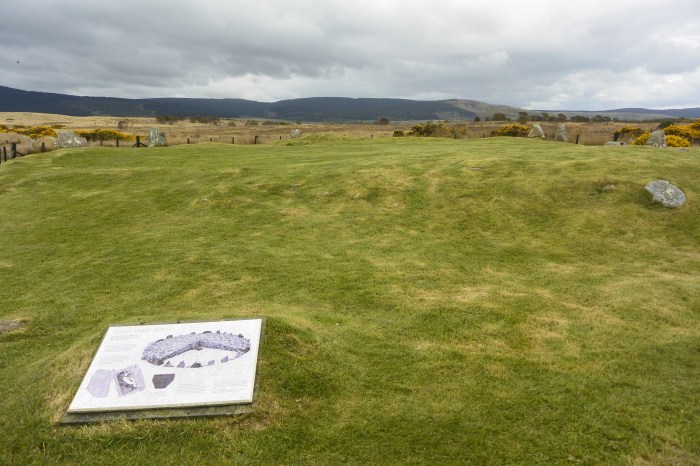
The trail to Machrie Moor Stone Circles is an out-and-back walk of 4km. Before we got to the main event, we passed Moss Farm (above), the burial cairn of a powerful person who lived about 4,000 years ago, and Fingal’s Cauldron Seat (below), named after the legendary warrior Fhionn / Fingal.
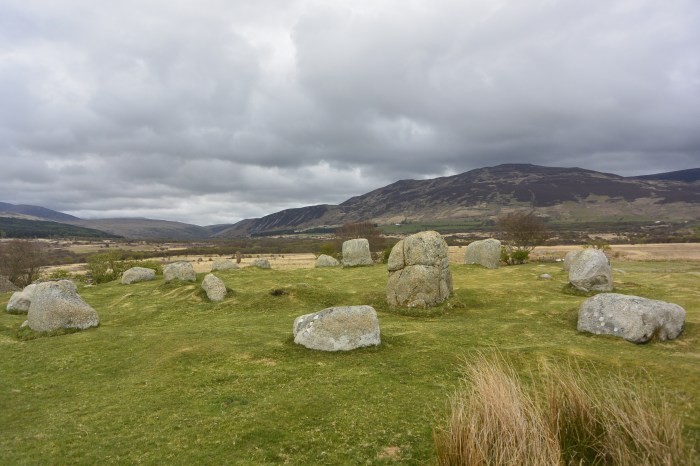
We stepped through a gate just beyond this onto open moorland and the sight of five separate stone circles – the tallest standing stone is over 5m high.


Kilpatrick Preaching Cave


A coastal walk took us to the well-hidden Kilpatrick Preaching Cave. After the Highland Clearances in the 19th century, when the Earl of Arran evicted many of his tenants to make room for more sheep, local people showed their disapproval in the only way they could by rejecting the Earl’s choice of minister. The Preaching Cave provided a suitable meeting place for the congregation. A sad story, but a beautiful setting.


String Road Viewpoint
Returning to Brodick on our last afternoon in Arran, we crossed the island via the String Road (B880) from which a short trail led to a beautiful viewpoint. Ayrshire was just visible on the horizon.


And behind us were beautiful mountain panoramas.
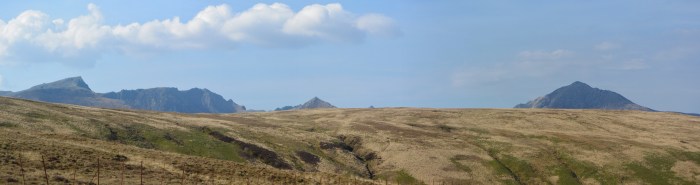
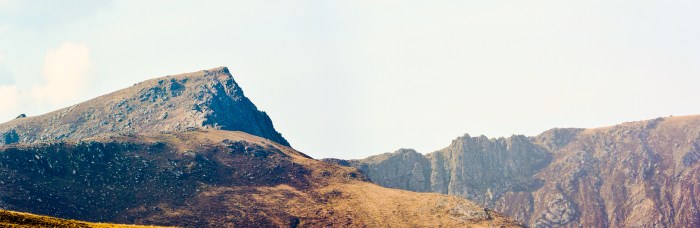 The next morning, we took the ferry back to the mainland while hoping to return to Arran soon.
Linked to Jo’s Monday Walks – today she’s taking us to Bolton Abbey, and her cyber-companions are walking all over the world.


 The Glasgow Gallivanter
Ooooh, wonderful photos. I’m definitely going to visit those standing stones. And thank you for explaining the significance of the Preaching Cave.
LikeLiked by 1 person
A very nice walk. Those stones and cave are so interesting. They look very ‘pagan’
LikeLike
Thank you! The stones certainly are.
LikeLike
The landscape is so breathtaking, Anabel. A pitch-perfect place for hiking! When’s the best time of the year to explore this place?
LikeLike
Thanks, when we were there was good but very busy. I’d love to see it in the winter too!
LikeLike
I haven’t yet been to Arran, this looks really beautiful.
LikeLike
Well worth a visit, very accessible from Glasgow! We even went for the day once by train and ferry.
LikeLike
Those caves are pretty cool. I find the history so fun to read about and would love to take these walks
LikeLike
History in beautiful scenery – win win!
LikeLike
I love the view across the sea, it looks gorgeous 🙂
LikeLike
Thanks Eunice, it’s a stunning place.
LikeLike
Thank you for taking us on these wonderful walks, the pictures and words brought me there. I love the moors having lived many years in West Yorkshire and visited many further north.
The stones are amazing, always make you wonder….
Didn’t know about the Preaching caves, fascinating and what a good place to meet.
miriam
LikeLike
Glad you enjoyed! Thanks for visiting and commenting.
LikeLike
Lovely photos. The preaching cave is quite sad and people moved out to make room for sheep,how awful.
LikeLike
Thanks Anne!
LikeLike
Interesting trail and that cave 😊
LikeLike
Thanks for visiting! Glad you enjoyed reading about the trail.
LikeLike
What a beautiful walk . . . but hate the horrors of the land clearance. A period in our history in Scotland, Ireland and England that most are unaware of.
LikeLike
Seem to come across evidence on walks so many times here. I think people are becoming more aware of the clearances now as there are often info boards, or trails round whole lost villages, in the highlands which is a good thing.
LikeLike
You are surrounded by beauty. I don’t think you’ll ever run out of scenic pictures—your adventures are so gorgeous!
LikeLike
Thanks – and still so many places on my list to visit!
LikeLiked by 1 person
Another place that’s on my list!
LikeLike
Hope you get there someday!
LikeLike
The area looks mystical. All the cloud formations are beautiful – probably the reason you are all wrapped up in jackets – but still gorgeous 🙂
LikeLike
Yes, gorgeous but cold!
LikeLiked by 1 person
It all looks rather bleak and windswept, though in a magnificent way, of course. Probably quite chilly though, judging by your attire!
LikeLike
I rather like bleak! And yes, even the sunny day was on the chilly side.
LikeLike
Anabel, everythign in beautiful in these photos, but… do I see standing stones???? My heart is melting.
LikeLike
Yes, lots of standing stones!
LikeLike
What a great story behind the Preaching Cave. That would have been fascinating to see.
LikeLike
It is a great story, but a sad one. Clearing people off land for sheep – appalling.
LikeLike
What gorgeous wide open landscapes. It looks positively blissful. I love the stone circles. Something very compelling and dramatic about them!
Peta
LikeLike
I love their mystery! We can never really know exactly why they are there.
LikeLike
Some lovely walks and magnificent landscape! It must have been a harsh life back in the day. The story about the “Preaching Cave” intrigues me – they must have been very determined folk! My mum used to knit Arran sweaters – you’d certainly need them to keep warm here!
LikeLike
It is beautiful – but, yes, I can’t imagine living in those days. Arran sweaters would definitely be a boon in the winter!
LikeLiked by 1 person
I never liked wearing them much as a child but they certainly kept you warm. Now I think they are rather stylish!
LikeLiked by 1 person
What lovely pictures! Once again I have to say that you live in a beautiful area!
LikeLike
Thank you! And, as you know, we love it.
LikeLike
Aren’t they just, Anabel? Walking all over the world! 🙂 🙂 I’m holed up in a very nice apartment in Church Stretton while the rain tipples down but I’ve walked and am fed. Lookng foward to tomorrow. Many thanks for the link. Love the standing stones.
LikeLike
Hope you are having a nice time despite the weather. Just settling down to do some blog reading now so will catch up with you soon.
LikeLiked by 1 person
It’s stark but beautiful.
LikeLike
Sums it up well!
LikeLiked by 1 person
Well, you certainly had some grand walking weather. Looks beautiful.
I always get Arran and Aran mixed up! Both islands but Arran in Scotland and the Aran islands off the coast of western Ireland. Both places I want to visit.
So many places to visit and so little time 😞
LikeLike
So true! And I’ve not been to the Irish Aran either.
LikeLiked by 1 person
Such rich history and beautiful photos (especially the panoramas). I absolutely love your adventures, Anabel!
LikeLike
Thank you – there’s a story under every stone it seems.
LikeLike
I’m fascinated with the role that sheep have played – even, indirectly, in religion. And the photos are beautiful- atmospheric indeed.
LikeLike
Sheep were more important than people at that time. Shameful! 😦
LikeLike
Hi Anabel – what a delightful island to visit … and with a wealth of alternative sites to walk to and visit, or to see vistas … amazing to see your photos … cheers Hilary
LikeLike
Thanks, Hilary. Arran is known as Scotland in miniature for those very reasons!
LikeLike
Fine impressions, Annabel. What I can see is the fact, that Arran is not far away from Islay. A travel destination I would like to visit in the next few years. Thanls a lot for the pictures.
Best regards
Achim
LikeLike
I’ve not been to Islay for some time, but it is beautiful too. You would travel to it from a different port though. My great-grandfather came from Islay – his family wanted him to be a preacher so he ran away to the mainland to work on a farm!
LikeLike
Thanks, Annabel, for taking me around with you,
Pit
LikeLike
A pleasure, as always!
LikeLiked by 1 person
Makes us feel rather insignificant when amongst such grand spendour. Enjoyable read Anabel.
LikeLiked by 1 person
It does. Amazing to think how old those stones are and how many generations have touched them before me.
LikeLiked by 1 person
Standing stones and that cave… two places on Arran I’ve not yet visited despite dozens of trips over decades and yearly coastal walks during summer holidays.. Just shows you how much interest is to be found on one relatively small island..
LikeLike
The standing stones are particularly good to visit – both times we’ve been it was very atmospheric, half the charm might be lost in bright sunshine!
LikeLike
Coming from Ireland as I do, the stone circles (fairy forts) are not so surprising to me, nor the Dolmans and preaching caves. In Ireland, it was the Catholic clergy forbidden to say the Mass by the English rulers that led to the use of caves or, more often, ditches, in which to preach. I loved your pictures of wild, open spaces, so seldom seen these days.
LikeLiked by 1 person
It’s so intolerant – but sad to say, the world doesn’t seem to have moved on too much. Just different victims 😦
LikeLiked by 1 person
Stone circles are so interesting and even more so when you are able to go right up close.
LikeLiked by 2 people
Yes, there’s no restrictions here at all so we could wander round to our hearts’ content.
LikeLiked by 1 person