
Glasgow Gallivanting: September 2018
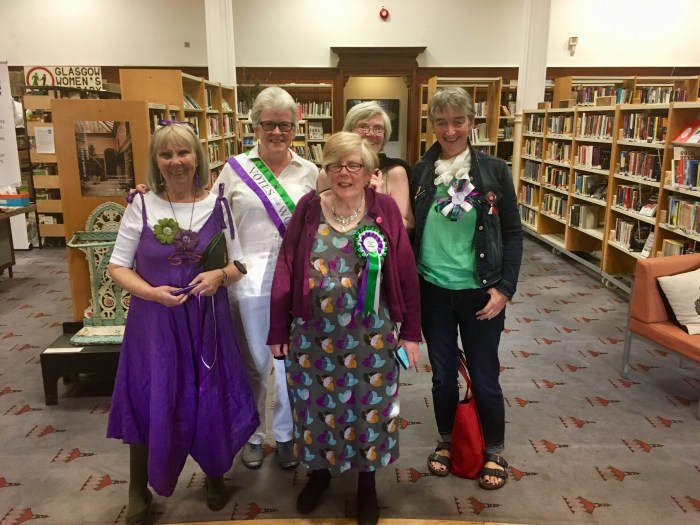
The photograph above was actually taken on 31st August and so, strictly speaking, should have been in August’s Gallivanting post. However I’d already published it by then so – my blog, my rules – here it is in September’s. Glasgow Women’s Library held a quiz night (dress code green, white and purple) with all the questions based on women’s achievements. Our team of library volunteers, The Book Besoms, didn’t win, but we weren’t last either. The librarian’s secret is not that she knows lots of stuff, but that she knows how to look it up – which, unaccountably, wasn’t allowed. That’s my excuse and I’m sticking to it!
An East End walk
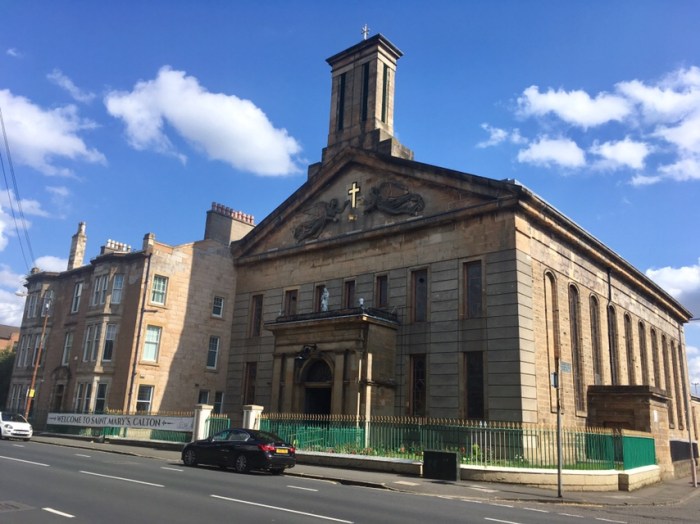
I had already been to a meeting in GWL that day and didn’t have time to go home and back so, given that the sun was shining, I decided to go for a walk and return for the quiz later. From the library’s home in Bridgeton, I headed along Abercromby Street, passing the church above, before turning west along Gallowgate towards the city centre. In Graham Square are the remnants of the old Meat Market which I thought were an interesting example of façadery. Usually modern flats are built directly onto an old façade. This one sits out in front attached by struts. Bizarre!


I continued to High Street and its junction with my end destination: George Street, and the latest gable-end mural by Smug depicting an infant St Mungo (Glasgow’s patron saint) with his mother St Enoch. Opposite is a nice garden area with benches bearing the city’s motto, Let Glasgow Flourish.


Opposite that is another garden, Greyfriars, built on the site of a 15th century friary. It wasn’t open, but I could peer through the fence and admire the poetry and other plaques adorning it. The one in the gallery below is Glasgow’s coat of arms.


Walking back down High Street to Glasgow Cross, I then headed east again along London Road passing the corner of Charlotte Street, where number 52 is the last remaining of eight late-18th century villas, and another colourful gable-end.


From there, I cut through Glasgow Green, admiring my old friends the People’s Palace and the Doulton Fountain.


Almost back at the library – the two buildings below on Greenhead Street were both once schools. The white building was built as a private residence in 1846 before becoming a school for destitute boys, the Buchanan Institute, in 1859. The extension on the left with the scholarly boy was added in 1873. The red sandstone building educated girls between 1893 and 1936 as the Logan & Johnson School of Domestic Economy. If you zoom in on the sculpture underneath the middle chimney you will see that it is a beehive representing the industry of the girls within. Both buildings are now converted to flats.


Doors Open Day
Glasgow’s Doors Open Days go on for a whole week, but I only managed to take part on the Saturday – and that was mostly as a provider. I led a canal walk and a building tour at Maryhill Burgh Halls, then just had time to dash across the road to The Engine Works. As Clarkson’s, and later Craig and Buchanan, this was an engineering workshop right into the 21st century. It figures in one of the Halls’ stained glass windows showing the trades of Maryhill – you can see what is probably Mr Clarkson in the green coat bottom left in our sale of postcards and in a poster on the Engine Works’ walls.


As I’ve led people on walks along the canal, which runs behind the Works, I’ve watched restoration taking place and assumed it was to be more flats. But no, a young couple has bought it to turn into a combined office / events space. I was delighted to get a chance to see what progress they have made, and to find out that they are keeping the electrically powered crane designed by Sir Henry Royce of Rolls-Royce fame. It’s going to be an amazing space when it’s finished.


The nights are fair drawing in
We’ve passed the autumn equinox and the nights are fair drawing in, as we say in these parts. Time to think of booking tickets for indoor events! This month’s highlights were Garbage at the iconic Barrowland and a one-man play about Charles Rennie Mackintosh at the equally iconic Panopticon.


Women’s history
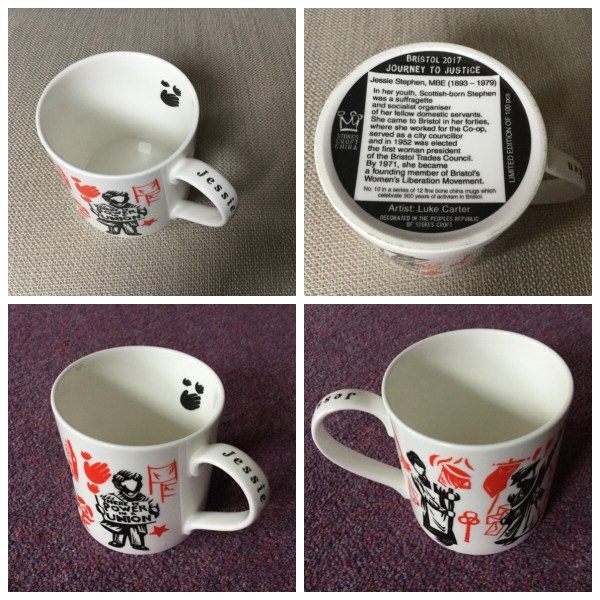
You might remember Jessie Stephen, the Suffragette I am promoting this year. Two developments this month: I discovered you could buy a Jessie mug as part of a set produced in Bristol, the city where she spent the latter part of her life.
 Even more exciting – I knew that Jessie took part in the post-box protests in Glasgow in 1913 (Suffragettes dropped ink or acid into post-boxes to destroy the mail). I’d read that this was in Kirklee, near where I live, but hadn’t given it much thought until I was asked if I knew which post-box it might have been. I now have access to a copy of Jessie’s unpublished autobiography in which she details some of the houses she worked in as a domestic servant, and one of them is just across the road from the current Kirklee post-box. When I looked at this box more closely, I found the insignia was ERVII – Edward the Seventh who died in 1910. This is probably the very box that Jessie used!

I also attended a really interesting exhibition at my local library on women of the West End (of Glasgow) in the First World War. Institutions that you wouldn’t necessarily expect to shed light on this did so. For example, application forms from women to join the Arlington Baths Club showed they had moved into male occupations when the men were away fighting. The red costume is what they would have swum in – ugh! I’m surprised they managed to stay afloat.


The last bit


Back to St Mungo, aka St Kentigern, Glasgow’s patron saint. I’d read that a new statue of him was in place at City of Glasgow College’s City campus, and made a short detour to inspect it the other day. The campus has recently been rebuilt and its location, Cathedral Street, makes the addition particularly apt. It’s a very traditional statue, created by former stonemasonry student, Roddy McDowall.
Nearby on campus is another sculpture, Spirit of St Kentigern, which is very different in style. It represents the bird in one of Mungo’s four miracles (I think). Commissioned from Dundee art student Neil Livingstone as part of the pedestrianisation of much of the city centre, this stood on Buchanan Street from 1977 until 2000 when it was deemed no longer in keeping with the city’s image. It’s now been hauled out of storage and loaned to the College. It’s definitely dated, it says “1970s” very strongly to me, but I also think the new statue is rather too traditional to be entirely successful. What do others think?
Finally, to Scottish word of the month: remember The Book Besoms? A besom is a broom made of twigs tied round a stick, but in Scotland the word often refers to a woman with attitude – one might be called a cheeky wee besom, for example. That’s what we chose for our GWL quiz team name, but having checked the definition just now I see it originally referred to a woman of “loose character”. With the other connotations of broomsticks, and therefore witches, maybe I’ll make a different choice next time!
I hope you had a good September. Enjoy October!


Hi Anabel! I know, I’ve disappeared from the comment section of so many friends lately. It’s been a very crazy year and Octobler was the craziest of all months. But now I hope things are calming down (they might be). In any case I’ll be trying to catch up with everyone.
I’m alwasy so impressed by how many things you’re involved with in just one month. All so intersting. I envy you!
What most picked my interest in your post (maybe because of my dieselpunk heart ;P ) was the restored factory. Such a fascinating place! I’ve alwasy been fascinated with old buildings, especially ancient ones, but recently I’ve discovered the beauty and fascination of industrial era buildings.
Fantatic post!
LikeLike
Hi Sarah! No worries, I know how life is. I’ve also been commenting less as WordPress asks me to sign in every time now and, well, life is too short! I think it’s an iPad issue as it happens with Blogger too 😟
LikeLike
Oh my heart skipped a beat when I recognised that Smug wall. We have two of his works in Waterford, they stand out, you don’t even need to read the signature 🙂
LikeLike
They do stand out. We have several in Glasgow too.
LikeLiked by 1 person
He is so talented.
LikeLiked by 1 person
Late getting around to reading blogs as I’ve been away but enjoyed this, as usual. That bathing costume! Glad they no longer exist although in parts of S.E. Asia not yet ‘developed’ you will find local women going swimming wearing their outdoor clothes, as swimming costumes are considered unladylike.
LikeLike
It must have been very heavy to swim in! I hope you had a good trip.
LikeLike
Interesting explanation of the meaning of “besom” as related to twig brooms. I especially like the phrase “cheeky wee besom.”
LikeLike
Frequently heard in my childhood!
LikeLike
You looked great at your quiz.
I’m determined to take a walk to see the mural of St Mungo as an infant when I’m next in Glasgow.
Cait @ Click’s Clan
LikeLike
Thank you! The one further up towards the cathedral with the adult St Mungo is good too.
LikeLike
Glasgow has such wonderful architecture. I like when they incorporate the old into the new, although having that facade sit off on its own, only attached by struts seems a bit odd.
LikeLike
I thought that was weird! I would have investigated further but there were a couple of police officers discussing something with two guys and I didn’t want to get too close, or be too obvious taking photos …
LikeLike
That’s a great mug! I just bought a suffragette mug for myself a couple of weeks ago at the Museum of London. I also love your team name, though not being familiar with the Scottish usage, I did initially think of witches when I read besom. I think that’s what I like about it though!
LikeLike
I’m ambivalent about it now – but I’m a sucker for alliteration! I wanted Book Belles because it alludes to my name but my delusions of grandeur were overruled.
LikeLiked by 1 person
I think your blog might have sent me to spam 😟 I’m having trouble commenting everywhere at the moment.
LikeLike
I don’t think so. I’ve got a comment from you.
LikeLiked by 1 person
Interesting to see some other parts of Glasgow – I was there recently but only in the city centre and we walked out to the Clydeside distillery (don’t ask about the names of places we passed, lol) but that’s about it.
That wall painting of the mother and baby is simply – WOW.
LikeLike
Oh yes, we went to that distillery a few months ago, it’s really interesting. Thanks for visiting.
LikeLike
What a great look at some Glasgow landmarks! Thanks for sharing them, and for the interesting history as well.
LikeLike
Thanks, Ann – there’s always so much more to find out.
LikeLike
what a nice walk!
LikeLike
Thank you, it was!
LikeLike
😊
LikeLiked by 1 person
Anabel, I have missed my dose of Scottish eye candy, as in your photos and blog posts. Love the murals!
LikeLike
Thank you Suzanne! The murals are great, especially the Smug ones. He has a few across the city.
LikeLiked by 1 person
I agree with Bob — your September has been very action-packed. I especially liked the gable-end murals. “Book Besoms” is a very cool name. Thank you for the continued Scottish lessons!
LikeLike
You are welcome! I will try to think of more words …
LikeLike
An action packed time by the looks of it. Those murals are new to me and a lot of the info but I do remember that sculpture from Buchanan Street from a time when Glasgow didn’t really do public art very well.
LikeLike
I remember it too, but didn’t notice it disappearing. Apparently it was rediscovered in a gritting depot in Maryhill!
LikeLike
My gran always referred to me as a “cheeky besom”, but as I was also quite wee, I’m guessing she wasn’t referring to my morals. Given how “morality” (as constructed by men) is used as a way to oppress women, I’d be happy to be called a besom no matter what the speaker intended.
As always there is so much in you gallivanting posts that’s interesting and thought-provoking. I’m not keen on the new statue of St Mungo. So many modern “realist” statues seem to fall into a sort of technical wasteland of neither being as detailed as earlier representations of the human form, nor as pared-back as the more stylised, modernist ones. I vastly prefer the bird, though as you say, it is quite dated.
The Big T is a huge Garbage fan; you’ve reminded me it’s a while since we listened to them.
Thanks for sharing your gallivanting Anabel. Hope October is a great month for you.
LikeLike
Yes, it was a refrain of my childhood too! You’re probably right, we should reclaim these insults with pride. Agree about the statues, new Mungo is very bland. Garbage were amazing! I quite liked them before – the gig was John’s choice – but after seeing then live I am a huge fan too. Shirley gave a marvellously political speech at one point too.
LikeLiked by 1 person
They have played here twice since we moved back to NZ. Both times we’ve been out to of the country 😦
LikeLike
How inconsiderate of them!
LikeLiked by 1 person
🙂 hehe.
LikeLiked by 1 person
Interesting places and themes! Cool to find the post box.
LikeLike
I thought so! I was very pleased with that discovery.
LikeLiked by 1 person
I’m into murals painted on buildings. The bright one on the side of a villa is really something. Beautiful and cheerful.
Bye till next time, Anabel.
Neil
LikeLike
I like them too, and we are getting more and more.
LikeLiked by 1 person
You sure remain a busy bee, Anabel! And, I can’t believe how you keep finding new areas, buildings and architecture to explore in cities you have visited frequently. That mural of the woman and child is spectacular.
What an amazing discovery about the mail box. That is just awesome!
I was wondering about the name of you quiz group, The Book Besoms. We have two similar words in Belgium: bezem (which is the broomstick) and boezem (which means bosom) . But, as it happened, there are other definitions apparently. 🙂
LikeLiked by 1 person
It surprises me too, Liesbet! Always something new in Glasgow.
LikeLiked by 1 person
Good point Liesbet, as I too am impressed with how Anabel sees something new in her local area.
LikeLiked by 1 person
Hi Anabel – wonderful set of photos and ‘news’ about them all. How great you were/are able to read Jessie’s autobiography … that must be so amazing to read, Love the architecture … and yes I still confirm I probably should have gone into librarianship – but obviously never did! Loved reading the history and your stories around your area – that new space looks to be amazing … while the engineering works looks fascinating – love the postcards. Cheers Hilary
LikeLike
Thanks Hilary – I am alwaysxsurprised at hoe much Heritage I have covered when I tot it up at the end of the month.
LikeLike
What would happen to me I wonder if I was caught pouring acid into a post box? Was this ever acceptable? Let’s call it what it was – terrorism and destruction of property. Sorry but I don’t get the glorification of the suffragettes. I have more respect for the Chartists, the real heroes of the extension of the franchise!
LikeLike
Well, they’d spent decades playing nice and getting nowhere. The Suffragettes were actually a minority, but obviously got more publicity because of their activities: most campaigners were Suffragists ie they believed in constitutional methods. It’s arguable what finally won the case – Suffragettes, Suffragists or women’s war work from 1914 on. Probably a combination I would say.
LikeLiked by 2 people
I agree, I just don’t condone extremism!
LikeLiked by 1 person
What a busy fabulous month. So wish we’d made it up to you. Instead MrB spent most of it moving thousands of books, and of course you know what I was up to!! Happy October xx
LikeLike
There’s always next year!
LikeLiked by 1 person
Thank you for the tour, Anabel. I spent most of my formative years in and around Glasgow so it’s lovely to see places both familiar and new. Coincidentally, I was reading recently about witch persecution in Europe. It seems the ‘witches-as-women’ stereotype has its roots in a combination of religious beliefs about women and the domestic nature of most accusations of witchcraft, a sphere of course where women had primary responsibility. Women accounted for around 80% of known witch trials and executions.
LikeLike
Thanks for visiting and for adding interesting new information. I’m glad to have shown you more of Glasgow.
LikeLike
I’ve been to your blog now but can’t get it to accept my comments! Maybe I have gone to spam 😟
LikeLike
You’re as busy and interesting as ever Anabel. Always enjoy following your adventures and learning stuff along the way.
LikeLike
Thank you Helen, that’s very kind of you to say so!
LikeLiked by 1 person
What a lovely way to spend some time waiting for your quiz night.
LikeLike
Always something new to learn in Glasgow. And the weather was with me!
LikeLiked by 1 person
You had a lovely walk and I love those stained glass pieces..I’m assuming, being restored? Those cups are really nice. You always show great pics and walks
LikeLike
Thanks Birgit! The glass has been restored, yes.
LikeLike
My first reaction was wow – you really covered a lot of ground when you took a walk to kill time before the quiz!! My second wow was in reaction to your comment that you had access to an unpublished autobiography. My respect for librarians continues to grow and grow!!
You’ve had a busy and eventful month, Anabel, and I’m glad you tossed in the explanation of the word besom. I was wondering 🙂. Wasn’t it typical of the time though to broad-brush any unconventional woman as having a loose moral character?
LikeLike
Well, I don’t wish to detract from your view of librarians, which of course is correct, but I got access to the autobiography through relatives of Jessie not because I am a librarian! Agree about the women – that’s how so many witches got burned at the stake. It didn’t pay to be unconventional 😦
LikeLiked by 1 person