
Islay: Finlaggan and Ballygrant

Finlaggan Castle is a ruined fortified house on the isle of Eilean Mór on Islay’s Loch Finlaggan. It was once a residence and stronghold of the Lords of the Isles, semi-autonomous rulers of the Hebrides and Kintyre from the 12th century until 1493 when the lands of the Lordship were forfeited to King James IV. The title Lord of the Isles was annexed to the Crown in 1542 (and is now one of the titles of the present Prince of Wales). The castle appears to have been demolished around that time.
 In truth, there’s not much to see of the ruins, but we enjoyed our visit all the same. We started in the small visitor centre which has an interesting display of artefacts discovered during archaeological excavations, along with a fabulous new virtual-reality reconstruction of the settlement in the early 15th century. You can see John totally immersed in it above.
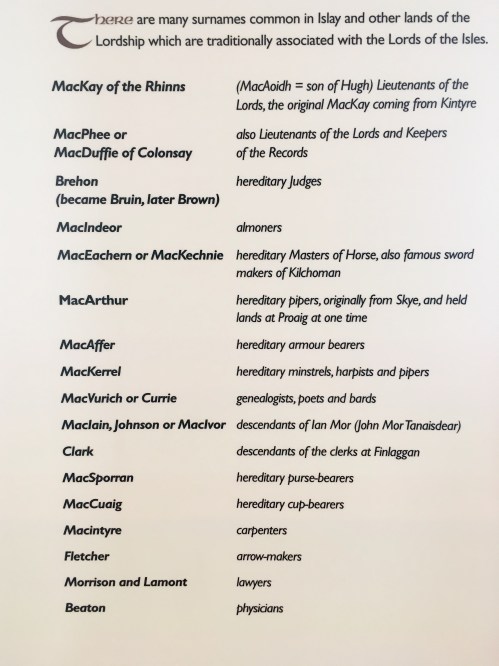
I was also, if you remember, looking out for references to Sinclairs (my great-grandfather’s name) and MacAffers (the family his sister married into). Sinclair is a relatively common name in Scotland and we found many in the graveyards around Islay, but the only reference to MacAffer that I found was at Finlaggan. The MacAffers were hereditary armour bearers to the Lords of the Isles – see below.
 From the Visitor Centre, we took the path down to the site, crossing the reed beds of the loch on duckboards.


On the island, interpretive panels explain the ruins and fill in the gaps of what was no longer there. We also visited Finlaggan in 1989 when it was quite overgrown, and I think you can tell from the pictures below that it is now much better maintained.


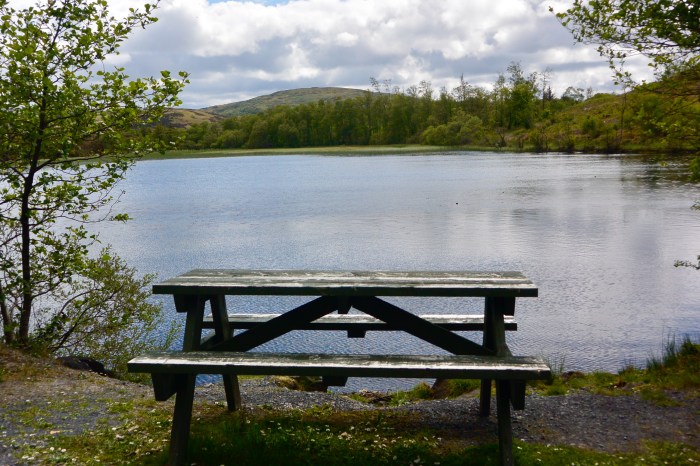
After a quick lunch in Port Askaig, we drove back to a little village called Ballygrant from where we planned to walk to Lily Loch. This was a pleasant, if unspectacular, walk through woods and farmland, and the loch was pretty – although we were there too early to see waterlilies.
 From the loch, we crossed an area of open moorland to take a parallel track back – this took us through the village of Keills. The name derives from the Gaelic for church, Cill, and the graveyard here contains the ruins of an old chapel attributed to St Columba. I can never resist an old graveyard, especially one with a view like this. Headstones which caught my eye included one for a father and son who died a fortnight apart, and the memorial to Piper Lily MacDougall aged 100 years. There must be interesting stories attached to both of those.


From the graveyard we headed back to Ballygrant where we caught Labels, the local café, just as it was about to close. Coffee at an outdoor table was a pleasant end to a round walk of 9.5km.


(In my last post, I mentioned that I had been called for jury duty and might therefore be out of action for a while. That turned out to be an anti-climax. I called the helpline three nights in a row to find out if I was required – I wasn’t and was “released from my citation” on the third call. Whoopee!)


 The Glasgow Gallivanter
The VR headset is a brilliant idea to give visitors a sense of what it would have been like. I hope more historic attractions start doing that, my favourite thing about visiting old places is wondering what it would’ve been like for the people who would’ve lived and worked there.
Cait @ Of Needles and Noodles
LikeLike
We saw another VR display when we were on the east coast later in the year, though this time it was joystick operated rather than a headset. The headset was better.
LikeLike
The list of family names associated with hereditary roles with the Lords of the Isles was interesting. Of course it makes sense, but I hadn’t thought of that type of history that a family might have.
Jude
LikeLike
I hadn’t thought of that either, it is a very interesting concept.
LikeLike
Love the names and their meanings which i always find fascinating. I love cemeteries and always love looking at the tombstones. I wonder if the father and son were in some accident and succumbed to their injuries. How wonderful that lady lived to be 100 years old
LikeLike
I was writing my next post this afternoon and discovered I had a picture of the lady who lived to be 100! Though long before she was 100.
LikeLike
What a beautiful walk, and how interesting that you found out that the MacAffers were hereditary armour bearers to the Lords of the Isles. I love the scenery here. The photos are marvelous.
LikeLike
Thank you! I thought the hereditary armour bearers were a nice touch – who knew such a thing existed?
LikeLike
Yes, who would know? 🙂
LikeLiked by 1 person
Stunning scenery. Thank you for sharing your trip with us 🙂
LikeLike
Thank you, I’m glad you enjoyed it.
LikeLike
What a fabulous day out, and huge yay about the jury service!
LikeLike
Yes, huge yay on both counts!
LikeLike
A 10 km walk that includes great scenery, family history and outdoor coffee sounds great to me.
Congratulations on your release from Jury Duty. That’s great news!
LikeLike
Thanks, it was a very interesting day. And I was so relieved to get out of jury duty!
LikeLike
Another lovely walk, we love looking around graveyards too. Seems a little odd sometimes but some of the older stones, like those you saw, are so interesting. Glad to hear that you escaped yet another jury service too.
LikeLike
I used to think it was odd – until I started doing it myself!
LikeLiked by 1 person
That’s exactly what we’ve always said. Seems strange until you find yourself wandering around looking at the old stones and realising how fascinating it all is.
LikeLiked by 1 person
Glad to hear you made it out of jury duty! I’ve never been called, but I suppose I run the risk of it in two countries. Hope the US would at least accept non-residency as an excuse, though they’re not exactly known for being reasonable…
LikeLike
You could always ask them for your fare home!
LikeLiked by 1 person
I bet that’d go over well!
LikeLike
It might put them off …
LikeLike
So glad you aren’t going to have to do jury duty! And thanks for sharing this walk with us…it looked just lovely. Someday I’m going to visit Scotland, and when I do, I’m going to re-read most of your posts to get an idea of what I want to see the most.
LikeLike
And by then I should have a lot more! I hope you get here one day.
LikeLike
Wee cemeteries are always a magnet for me too, and I couldn’t resist finding out what happened to McDougalls jr and sr.
The death record for Archibald McDougall lists quite a complicated cause of death. I’m not totally sure of the hand-writing on some of the words, but it looks like:
“Acute lobar pneumonia. Emphysema with chronic bronchitis and bronchospasm following blast injury from explosion of a mine.”
Alexander’s cause of death looks like “influenzal broncho pneumonia.” The death certificate says he was a retired lighthouse boatman.
Records always raise more questions than they answer, and now I’m wondering if the mine that exploded was a coal mine, or a weapon?
Lily MacDougall (Piper) I think was the wife of Archibald’s brother. Both Archibald and Alexander’s death certificates show Dugald McDougall as the informant.
The address on both certificates — Yellow Rock cottage, Portaskaig,– is now a holiday cottage. The website says it was owned by Lily McDougall until her death at 100.
Alexander’s wife, Annie died in 1948 but it looks like Dugald lived into his 90s. I can’t help thinking what a terrible experience it must have been for Annie and Dugald, losing the two men so close together — and with a war going on at the same time. Who knows if there were other sons away in the military.
LikeLike
My goodness, Su, you are a marvel! I look and wonder, you act. Emphysema is certainly a miner’s disease, but there are no coal mines on Islay, though he could have worked away. I hadn’t even thought what the connection between the two stones could be. Thanks for all that information!
LikeLiked by 1 person
Thanks Anabel 😀
I have Scotland’s People credits so it was easy to search and download the records.
I’m perplexed about the mine explosion too, but I’m not sure how to dig further into that.
I hadn’t connected the two headstones either until I found the Yellow Rock Cottage website – and that was just because I was checking that I had read the address on the death certificates correctly.
There were so many interesting little snippets to be gleaned from the records — and so many questions! Now I’m feeling a bit guilty I haven’t given much time to my own family history for a while 🤨
LikeLike
Perhaps this little side-trip will spur you to go back to it!
LikeLiked by 1 person
I just had a look at the Yellow Rock Cottage site. Its header image must be taken from Jura – we took some pictures looking over from Jura to the distillery you can also see and I wondered if we’d captured the cottage, but we hadn’t. It looks a great place to stay: the views must be stupendous.
LikeLike
I hope so!
LikeLiked by 1 person
Loved your episode on Islay – and loved the MacSporran mentioned on the list of names. Who’d have thought it was a real surname?!
LikeLike
Hereditary purse bearers – of course they have to be MacSporran 😀!
LikeLike
I like your picture of John with the VR set. Us boys love our toys!! 😉
LikeLike
He enjoyed it! I just watched the screen as he moved his head.
LikeLiked by 1 person
Love ancient ruins!
LikeLike
So interesting, aren’t they? Thanks for visiting.
LikeLiked by 1 person
Absolutely love reading about them!
LikeLiked by 1 person
Am I right in thinking if it’s an hereditary role you are born into it and don’t have a choice? Too bad if you wanted to be a minstrel instead of a cup bearer.
LikeLiked by 1 person
Yes, it seems to be just that. Everyone knowing their place I suppose!
LikeLiked by 1 person
Hi Anabel, Interesting how the titles are carried forward to each generation. I think the word is juxtaposition with the ruins and then the virtual reality. All of the photos are interesting and fun. I really enjoy living vicariously through you and your husband, Anabel. Whoopee on the jury duty says it all:)
LikeLike
Yes, I was very relieved about the jury. The juxtaposition of VR and ancient ruins is interesting – we came across it again recently. It really helps you imagine what it must have looked like. It’s not always quite how we expected.
LikeLiked by 1 person
Looks a good trip. You might like Nigel Tranter’s Lord of the Isles, a great book I read years ago about Somerled, the half viking, half Celt chieftain who started the title, built the chain of castles, and ruled West Coast Scotland from the Outer Hebrides to the Isle of Man with his fleet of warships yet most Scots have never heard of him. It’s a cracking read.
LikeLike
I’m not sure I had heard of him till we went to Islay the first time. Mind you, my education was all in England. I’ve never read any Nigel Tranter, though I’m very familiar with his books from working in libraries. They were popular.
LikeLike
Ok, you know my favorite was the graveyard! I love the stories the grave markers can tell. Beautiful countryside!
LikeLike
They’re always intriguing, aren’t they? Why did the father die so soon after his son – coincidence or a broken heart? Or where they both involved in some accident? I can wonder for hours.
LikeLike
I remember growing up and being fascinated by stories of Somerled, Lord of the Isles. Annabell was called to Jury duty once and she and a friend had to drive the 80 klms to the district court at Port Augusta. We used to have a court here but that was closed down in 1980(ish) and moved to Port Augusta. We still have a Magistrate Court and a Youth Court and that’s about it.
LikeLike
At least I would just have had to catch the Subway into town!
LikeLike
So many islands aimed for, so few achieved! It’s a different world, Anabel 🙂 🙂
Are you on Instagram?
LikeLike
So many islands, so little time! I’m not on Instagram, no. Too much stuff to keep up with as it is.
LikeLike
I know the feeling, hon 😊.
LikeLiked by 1 person
I love the sound of the Scottish names you list in your Post, they sound so ??? I can’t think of a word, it’s not ‘musical’, would rhythmic be OK? They seem to have a beat to them when spoken aloud. Quite a few of them are like the Irish ones, not surprising as we share the Gaelic tongue even though there are stark differences. I take it Mór means the same in Scottish as in Irish – Big? And would that then be Big Eilean?
As usual, interesting and fascinating.
LikeLike
Thanks Mari – yes, rhythmic would fit the bill! Mor is big so Eilean Mor is the big island. It sounds like a character in a comedy show, now I come to think of it! Big Eileen, she’s a feisty type.
LikeLike
I have an Aunt Eileen who was always called Big Eileen by her sisters as she was the eldest. Eilean Mor is a much kinder way of referring to the late departed lady. I shall have to remember that.
LikeLike
😀
LikeLike
I think I would find a graveyard like that irresistible, too!
LikeLike
I’m sure you would!
LikeLiked by 1 person
Hi. I’m pretty sure that I am not required to serve on a jury in my locality because I am over 70. If it’s true, it’s one of the very few good things about getting old.
LikeLike
Yes, that’s the case here too – I have a few years to go! I wonder how many times they will try to catch me before then?
LikeLiked by 1 person
Great photo’s, Scotland is such a beautiful place. The VR looks interesting and so very clever in helping understand about the history. Lucky escape on the Jury duty! 🙂
LikeLike
It was a very lucky escape! The VR is a great idea.
LikeLiked by 1 person
Anabel – Virtual Reality among the ruins! It’s a bit of fantasticality 🙂 – Susan
LikeLike
It is, when you put it that way! It seems to be the in thing at the moment.
LikeLiked by 1 person
No jury duty! 🙂 So keep the posts rolling!! 😀
LikeLike
I’m doing my best! Been busy this afternoon.
LikeLiked by 1 person
Hi Anabel – so glad about the jury service – saved by lifting your arm to the phone!
Beautiful area to visit – now VR … interesting – I can imagine the wait if there’s more than one person around … but that technology is definitely arriving in our world.
Also good you found some reference to the family – while the image about the Scottish surnames linked to the Lord of the Isles is just wonderful to read …
Cheers Hilary
LikeLike
Fortunately, we were the only people there first thing in the morning so we had no competition for the VR. But yes, I can imagine it being a problem at busy times.
LikeLike
Good to hear you were released from doing Jury Duty…
The Isle of Islay is beautiful and your photos make me want to go there… Scotland is such a beautiful place. (Suzanne)
LikeLike
It was a relief, Suzanne! Islay is absolutely beautiful. I’ve been trying to write another post this afternoon and I keep getting lost in the photos.
LikeLike
I got called for jury duty earlier this year but got discharged as I had a funeral to go to – first time I’d been called and was relieved not to have to sit on a case. Great photos – very atmospheric! Hope you can trace your ancestors – would be fascinating if they had a connection to this place. I am descended from the Maxwell clan on my paternal grandmother’s line but no one knows where they came from originally only that they came down to London from Scotland in the late 18th century. I know they had links to Edinburgh but the story was they came from the Highlands originally. I thought it would be relatively easy to find the lineage for an Alexander Maxwell – well no chance there are so many of them and it’s impossible to work out who is who!
LikeLike
That’s why i’m only looking in a very half hearted way! Too much hard work otherwise. I liked to see the names and imagine a connection. If you go far enough back i’m sure there is always a connection …
LikeLiked by 1 person
Yes it does get very confusing as the names were all so similar back in the day and it’s hard to work out who is who! That said I do a lot of research – it is a bit like solving a very complicated crossword puzzle so I reckon it’s good brain gym!
LikeLike
Good for you!
LikeLiked by 1 person
It does consume a fair bit of time though! I have to take breaks then go back to it after a while.
LikeLiked by 1 person
Looks lovely, so looking forward to my visit to the northern isles next year even more now!
LikeLike
Lucky you!
LikeLiked by 1 person
Looks/sounds wonderful – very envious. We have long wanted to do a bit of island hopping and haven’t managed to get there yet. One day!
LikeLike
Definitely keep it on the list! The islands are all beautiful.
LikeLike
Great photos, I love the view from the graveyard and the one of Lily Loch – I can imagine that would be really pretty with water lilies. I went to a section of the Lancaster Canal a week ago (future post) and there were several parts of the water with large areas of yellow water lilies 🙂
LikeLike
Yes, it was probably amazing a few weeks later. We did see water lilies on another trip last month.
LikeLike
I’m seeing many more museums using VR nowadays – I used it to feed a dinosaur at the Yorkshire Museum the other week!
Some lovely photos of the Loch.
Glad to hear you weren’t called up for jury duty. More adventures await!
LikeLike
That sounds cool! We saw another VR reconstruction in Eyemouth last week, another tiny museum. There are obviously grants and projects around for it at the moment. Very relieved about jury service.
LikeLiked by 1 person