
Eglinton: a castle, a tournament and a country park
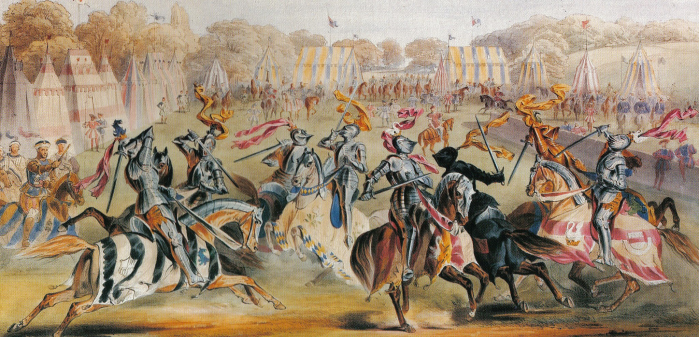
I had never heard of the Eglinton Tournament until I watched an episode of Scottish Television’s People’s History Show which billed it as Scotland’s most expensive and worst party. I was intrigued!
When Queen Victoria came to the throne, the country was in dire economic straits and she was given a scaled-down coronation ceremony which was ridiculed as ‘The Penny Coronation’. One of the fiercest critics was Archibald, 13th Earl of Eglinton, who decided to throw his own party over three days in August 1839 in the form of a grand medieval tournament on his Ayrshire estate. He invited a couple of thousand of his rich mates and thought he might let in a few thousand of the lower classes too. However, ticketing procedures and crowd control were woeful and some estimates suggest that in the end over 100,000 people attended the Tournament. Local transport and accommodation were overwhelmed, and the knights themselves created gridlock on the estate with the opening parade taking three hours longer than expected. And, of course, you can’t rely on the Scottish summer weather – the heavens opened on the first day and flooding meant that the entire audience, apart from Eglinton’s personal guests, was stranded without transportation. They had to walk miles through the rain and the mud to nearby villages, where only a few people found any food, drink, accommodation or transport. Even the personal guests missed out on the medieval banquet and ball that evening because banqueting tents had also been flooded. The middle day of the Tournament was cancelled, but the third day went ahead as planned with the overall winner judged to be – guess who? – Lord Eglinton himself.
After learning this story I wanted to see Eglinton myself, so on a sunny August Sunday, almost 180 years to the day since the Tournament, we set off – it’s less than an hour’s drive from home. There isn’t much left of Eglinton Castle itself, and it was difficult to get pictures of what there was because of all the picknicking families and children joyously leaping off the ruins.


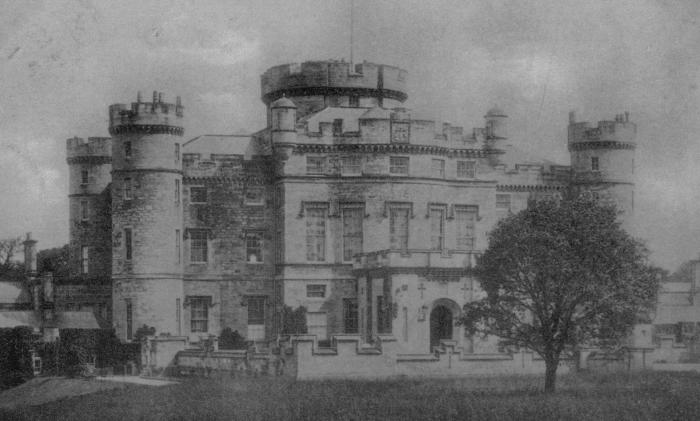
You can see below what it looked like in its heyday before the Eglintons lost all their money and abandoned it. In 1925 the roof was removed so that the walls could be used for target practice by the military, and most of the rest was pulled down in 1973.
There are several other interesting structures in the park. The ornamental Tournament Bridge, which crosses Lugton Water a short walk from the castle, might seem to be a remnant of the events of 1839, but actually dates from 1845. It has recently been beautifully restored.


The old stable block has been converted into a café, and the gardens and grounds of the estate surrounding it are very attractive. Interesting objects include some colourful benches and a double headless statue. I have no idea who they are or where their heads have gone, in case you are minded to ask!


The garden also contains war memorial benches and a cairn commemorating those who died in the 9/11 attacks.


There are several trails round the park, a mixture of woodland …


… and open countryside. We wondered about these stones on top of Cairnmount Hill. They were obviously not ancient standing stones, but we thought they might be a folly placed there by one of the Earls. Googling them later, I found that they are much more recent than that. An opencast mine was established nearby in 1983, and when extraction finished in 1986 it was filled in and these large boulders discovered in the process were erected on top of the restored hill. The stones effectively mark the closing of the last coal-mine on the land attached to Eglinton Castle after a period of at least 400 years of continuous production.


Finally, a small loch attracted walkers, such as ourselves, as well as those who just wanted a peaceful spot to read.


We enjoyed our day out at Eglinton: the trail we followed was pleasant, if not spectacular, and fairly quiet once we got away from the café and the picnickers at the castle. I think the park caters mostly for that audience and not so much for those interested in its history – a few more information boards would have been helpful: the only one I can recall was at the Tournament Bridge. I’m pleased to have seen the site of the Tournament, and certainly recommend the park to anyone who happens to be in the area, but for me it is one to file away as a once-only visit – I don’t feel a strong need to go back.


 The Glasgow Gallivanter
I’m curious about the current location of James Henry Nixon’s (1802-1857) watercolours of The Eglinton Tournament. I believe they were purchased by the North Ayrshire Council through the Art Fund in 2009, and I think the intention was display them at Dean Castle. I have written to the Council inquiring about this, but never received a reply.
LikeLike
That’s interesting, I didn’t know that, though I see from the Art Fund site that’s correct. I’m sure they would not be very impressed to know they were not on display 12 years later.
LikeLike
I’m curious about the meaning of the inscription on the bottom of the double headless statue.
Jude
LikeLike
Well, as luck would have it, an earlier commenter was driven to do what I hadn’t and look it up! See below.
“I had to look up that quote on the headless statue “ye maunna tramp on the Scotch thistle laddie” although it does actually say thristle (I had to look twice). It is apparently a statue of an old man, and a young boy who has stood on a thistle, the old man is trying to take the thistle out of the boys foot. Maunna = musn’t as you will well know 🙂
The statue was commissioned around 1888 by the Kelvingrove International exhibition by Paisley soap manufacturer Isdale and McCallum to advertise their Thistle soap. The statue sat on their factory’s roof until about 1971 when the building was demolished and it was then brought to Irvine by an Ayrshire business man. It was later taken to Eglinton Park where it now sits.
Apparently the heads and leg were damaged by vandalism!”
LikeLike
What a story about the Eglinton Tournament; it doesn’t seem surprising that after that, the Eglintons lost all their money and had their castle dismembered! I’m never crazy about places that cater to picnicking families; I guess that’s because all my kids are now grown and I’m happy to be past that time in my life! Looks like a lovely day out though. 🙂
LikeLike
No, they don’t sound all that careful with their money! I know what you mean about the picnicking, but we usually find you don’t have to stray too far from the carpark to lose most people. Most of the park was really quiet.
LikeLike
I’m glad you were able to get away from the hubbub. 🙂
LikeLiked by 1 person
It’s surprising what we sometimes find close to home.
LikeLike
Isn’t it? I’m glad to have discovered this one.
LikeLiked by 1 person
This looks like a lovely place to visit, although I’ve never heard of it before. I must say it’s shocking how we used to treat some of our old buildings!
LikeLike
I know – target practice! Disgraceful.
LikeLike
I’d never heard of the Eglinton Tournament, either: what a a fascinating tale. Your photos of Eglinton are wonderful: it looks as though you had far better weather for your visit than did poor old Archibald for his Tournament!
LikeLike
We certainly did! Archibald would have been most envious of our weather – although jousting in heavy armour in that temperature might have been uncomfortable.
LikeLiked by 1 person
An interesting billing, Anabel. A great comparison to show the photo from 1906. The headless statue would make me wonder, too. The word “peaceful” truly comes to mind. Living vicariously through you and your husband, Anabel:) (just returned from 2 weeks camping unplugged – enjoying my catch up reading posts:)
LikeLike
Two weeks camping! That sounds adventurous. I hope you got good weather and had a lovely time.
LikeLiked by 1 person
A mixed bag. We expect all sorts of weather conditions and are prepared……….with the special hot drinks:)
LikeLike
👍🏻
LikeLike
An interesting looking place with an interesting history. Love the decorated benches and the refurbished bridge, but the kids jumping on and off the ruins would have annoyed me. Maybe they should have been taken to the top of that tower and made to jump off there! 🙂
LikeLike
Yes, I found it very strange that their parents allowed them to do that. The painted benches were lovely.
LikeLike
I’d never heard of the Eglinton Tournament either, but I appreciate the enlightenment! What an interesting historical tidbit!
LikeLike
When I saw it on that TV programme it was jaw-dropping! Such a great story.
LikeLiked by 1 person
I joined you on your walk and enjoyed it but I loved the story of the tournament. I somehow get more pleasure out of reading about things going wrong in the “entitled” life and your tournament takes the biscuit!
LikeLike
Well, we still see the same sense of entitlement and expectation that things will go their way without putting the effort in! A certain BJ …
LikeLike
I enjoyed reading this and the history of this place. What a shame that the building was torn down. I kinda giggled when the Earl decided to have his own party even if it was washed out. It looks like a nice place but I don’t like the fact that the kids and all can climb all over the ruins.
LikeLike
I think the Earl was big on ideas but maybe not with the ability to see them through! As for climbing all over the castle, that was bizarre. Most places i’ve been don’t allow it.
LikeLike
Hi Anabel – I’ve always wanted to visit this castle … and the park … in fact way back in 2011 I wrote about Garden History … and copied over some wonderfully descriptive paragraphs about the Pleasure Gardens in the 1840s at the height of their brilliance – and the Earl’s inventiveness … heated walls et al … it impacted on me – so much so I remembered … one day if I get up to Bonny Scotland – it’ll be a place I visit – cheers Hilary
LikeLike
Sounds wonderful! I didn’t know about the heated walls. He seems to have had lots of ideas.
LikeLike
It does look an interesting place to visit. And I bet that headless statue gets lots of photos taken of it! X
LikeLike
I bet it does! It’s quite bizarre.
LikeLike
Hi, Anabel – I’m good with interesting ‘once only’ walks. My list of new places to see is so long, I become a bit conflicted when there’s a place that I am compelled to visit multiple times! 😀
LikeLike
Exactly! We can’t go everywhere (unfortunately). And the beauty of having a blog is that I can document it and look at it again if I need a reminder.
LikeLike
What a great story. Poor Archibald, except for his win at the end he must have been disappointed with how it all turned out.
LikeLike
He must have been! But I guess he had plenty of money left to cheer himself up with …
LikeLiked by 1 person
That’s true. Shame his descendants lost it all.
LikeLike
Very careless!
LikeLike
😆
LikeLiked by 1 person
It looks like a pleasant place for a wander and especially so in good weather. We have visited many places where I thought “once and done”. It balances out all of the places I would love to return to I suppose.
LikeLike
It was a lovely walk, one I’d probably do multiple times if I lived locally, just not special enough to go out of my way for. I’m happy to have seen the site of the infamous tournament though.
LikeLiked by 1 person
What an interesting story! Not having any castles close to my Southern California home 🙂 I’m always when you share pictures of the ones you find. I love the painted benches and the headless statue too!
LikeLike
It was all very pretty – and surprisingly close to home for a castle I’d never heard of.
LikeLiked by 1 person
Wow never heard of Eglinton before but it looks a fascinating place. We love a bit of history on a day out, makes everything seem more relevant and alive.
LikeLike
Yes, I like to know the history too, which is why I found the lack of information a bit frustrating.
LikeLiked by 1 person
Really enjoyed that history as I had no idea 100,000 folk attended a tournament there. It’s not a well populated area so God know’s where they came from in 1839… before the network of railways and roads existed presumably? I have cycled to the Country Park a few times from Saltcoats on the bike trail which is good and enjoyable but the park itself was not that special, just a handy destination on a sunny day. You have managed to capture the best of it though.
LikeLike
They must have come from all over the area! the railway had apparently just opened. I thought you would probably know the place.
LikeLike
Seems a nice enough place for a stroll on a sunny day. The bridge is quite lovely, but I am somewhat taken aback that children are allowed to play on the ruins. As for the tournament! Sounds like someone should have been better at planning!
LikeLike
I found it a bit shocking as well – the parents didn’t seem a bit bothered. I think the earl learned his lesson form the lack of planning and extravagance – I read somewhere that he became quite careful after this debacle!
LikeLiked by 1 person
It looked the way a castle should look.
Even its ruins look good!
LikeLike
The ruins do look good, and must be very well maintained – nothing was fenced off to stop the kids climbing on it. Though had I been a parent I might have wanted to curtail them from casting themselves into space from some of the higher walls!
LikeLiked by 2 people
Interesting story and place. I agree with you that there are places that you wish to visit but once there you think that once is enough. It doesn’t take anything from the place but it doesn’t have the charm to bring you back. Though I am like you and I am curious so I would like to visit everywhere at least once… but that isn’t feasible. (Suzanne)
LikeLike
I think if I lived nearby I would use it for regular walks, but I’ve satisfied my curiosity about the castle now. I would like to everywhere too – we can but try! After 30+ years in Scotland I’m still finding new places, so even covering my own small country is challenge enough.
LikeLike
What an interesting story, thanks for sharing it.
LikeLike
It is interesting – and I’m amazed I’d never heard about it before.
LikeLike
I take it this is where “Eglinton Street in Glasgow comes from? Are these two statues meant to be headless? The estate looks like a nice place for a walk and a picnic.
LikeLike
I guess so. And no idea about the headless statues. This is where a few information boards would have been nice to tell you what you were looking at!
LikeLike
I had to look up that quote on the headless statue “ye maunna tramp on the Scotch thistle laddie” although it does actually say thristle (I had to look twice). It is apparently a statue of an old man, and a young boy who has stood on a thistle, the old man is trying to take the thistle out of the boys foot. Maunna = musn’t as you will well know 🙂
The statue was commissioned around 1888 by the Kelvingrove International exhibition by Paisley soap manufacturer Isdale and McCallum to advertise their Thistle soap. The statue sat on their factory’s roof until about 1971 when the building was demolished and it was then brought to Irvine by an Ayrshire business man. It was later taken to Eglinton Park where it now sits.
Apparently the heads and leg were damaged by vandalism!
LikeLike
Ah, I love it when readers do the research I’m to lazy to do! Thanks, Jude.
LikeLiked by 1 person
it was the quote that intrigued me!
LikeLiked by 1 person
An interesting tale – bread and circuses in times of economic difficulties turning into a fiasco. Just like Brexit!
LikeLike
It was certainly a circus! Though not very amusing for the poor people who got stranded by the floods.
LikeLiked by 1 person
Yes indeed. It’s always the poor who bear the burden.
LikeLiked by 1 person
For me “Eglinton” means a major east-west artery running through the middle of the city. I worked in an old (by Toronto standards) building on Eglinton for several years before I retired.
Toronto’s version of Eglinton isn’t even remotely as charming as the site of this old 19th century castle. I LOVE that bridge. It’s a shame that an old beauty like this castle would be left to ruin.
LikeLike
We have an Eglinton Street in Glasgow too, quite a major road south of the centre, culminating in Eglinton Toll. Probably all called after the same old dukes and earls!
LikeLiked by 1 person
It is however one of those words that is chronically misspelled and mispronounced. I cringe every time I hear or read ‘Englington”.
LikeLike
Yuck! I haven’t heard that here.
LikeLike
Consider yourself lucky. It’s not a major offence but just enough to pick at your brain every time you hear it.
LikeLiked by 1 person