
The East Coast Fishing Disaster of 1881
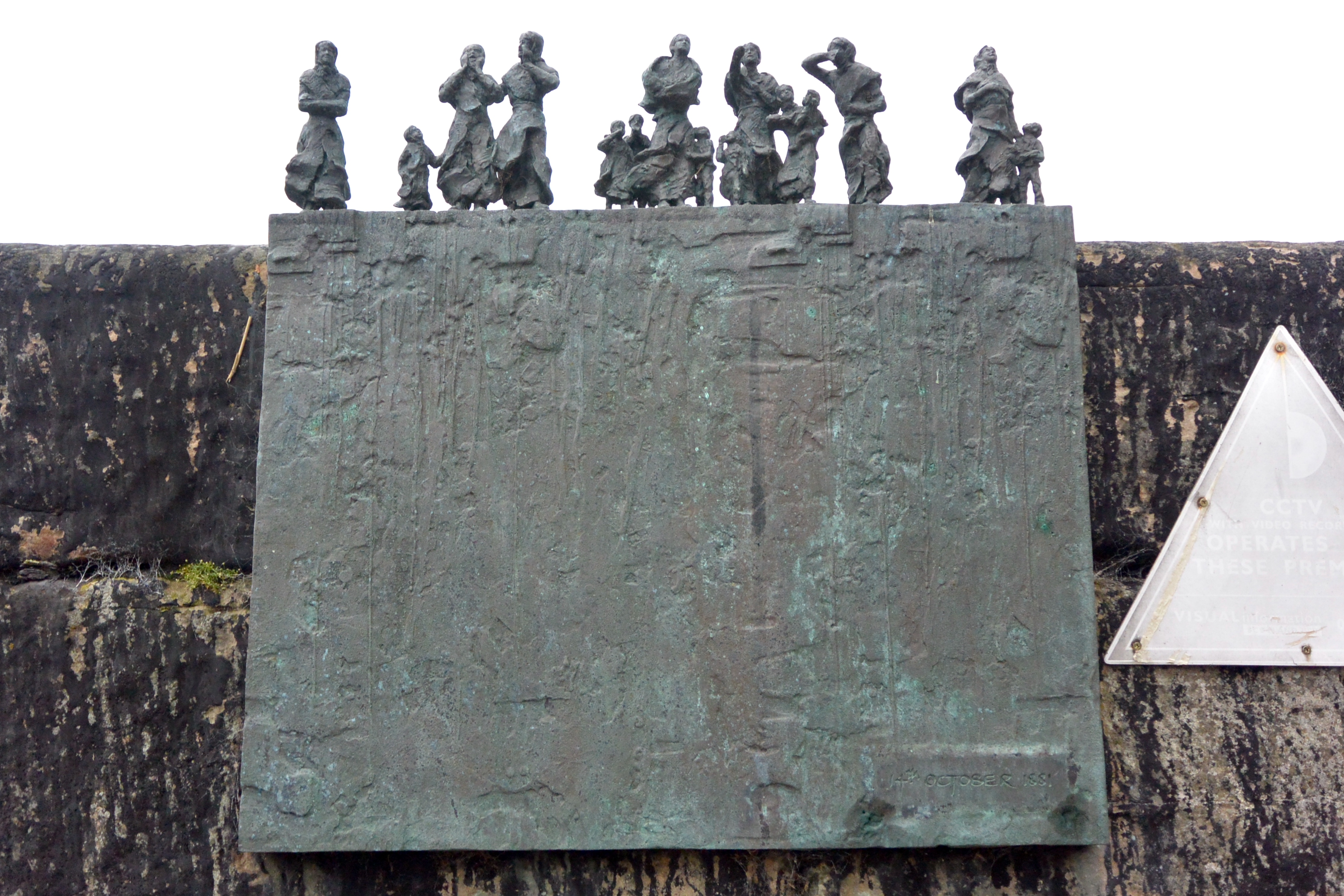
On Friday the 14th of October, 1881, hurricane Euroclydon struck the south-eastern coast of Scotland. Nineteen fishing boats were lost and 189 men did not return, leaving 73 widows and 263 fatherless children. Until our visit to Burnmouth last summer, we had never heard of what some locals still call Black Friday. When we strolled round the village on our first evening, we wondered what this sculpture on the harbour wall commemorated.
A few years ago, Jill Watson was commissioned by the people of Berwickshire to create memorials representing the exact numbers of surviving widows and children in four of the communities affected. These tiny figures represent those of Burnmouth.


Along side them is an older memorial which lists all the men drowned.


Around the village are planters representing each boat lost: Alice, Christina, Excellent, Guiding Star, and Transcendent. We only found the first three.


Throughout our week in Burnmouth, we went in search of the other Jill Watson sculptures. This is Cove:


And St Abbs:


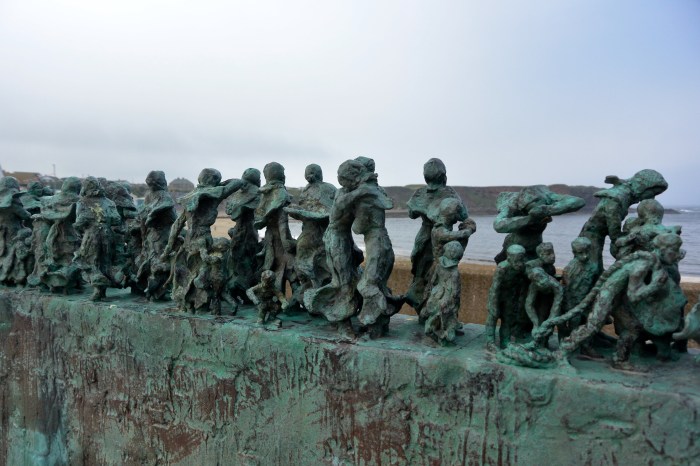
And by far the biggest is in Eyemouth, the main town of the area:

 On a hill overlooking Eyemouth Harbour, there is also a commemorative wall, built in 2017, with each lost man represented by a pebble at the base.
 The town’s small museum has more information and displays about the disaster. (These are all fairly terrible pictures because of reflections in the glass cases.) The poster below has a quote from Alex Burgon, Skipper of the Ariel Gazelle – “We’ll not see Eyemoth today boys”. The men clearly knew what was coming. Pickit Men by Emma Mackenzie (2010) has a figure for each of the 129 Eyemouth men lost, standing together in their crews. Pickit is a Scots word meaning plucked. “Ye wad juist think that they had been pickit” was a frequent comment made about the men at the time.


A remembrance plaque and mourning artefacts:


The Eyemouth Tapestry telling the story of the disaster is displayed in a small, narrow room. It is thus very difficult to photograph, but I hope you can get a small impression below of this wonderful work. Hand crafted by 24 local women, it took two years to complete. I foolishly didn’t note when it was made, and neither the leaflet I took away nor the museum’s online information tells me. However, I recall that it was long enough ago for most of the women who worked on it to be no longer with us.


Poignant facts gleaned from other parts of the museum: during the great storm, there is no record of the lifeboat having been launched. As the lifeboat was manned by the fishermen, it must be assumed that its crew were out there fighting for their lives already. In any case, the wind was so strong and the sea so rough that the boat would have been unlikely to get out of the harbour. The Census of 1881 was taken just before the disaster when Eyemouth’s population was 2935. The town went into decline, and it was almost 100 years (1976) before it reached that level again. Today, the population is about 3420.
We were very glad to learn about this disaster through Jill Watson’s sculptures which led us on to find other commemorations. I hope many more people are made aware of it as we have been. Eyemouth today is a relatively unspoilt town which combines being a working fishing port with tourism. I’ll tell you more about it in my next couple of posts.


Thank u anabel
LikeLiked by 1 person
Hey there iv just had a read up on this i was brought up in burnmouth left years ago now living as a engineer when u read this its so sad, because im a metal worker i wanted too do somthing for the harbour wall the boat u see and the anchor was made by myself somthing i realy loved too do the name tags was so time consuming i punched every letter by hand as u can see the salt has got too it next year im going too re do the boat with all the names of fishermen lost at see i will put my time too put this rite and find a better paint too withstand the salt water i will put.myself out for all the poor souls lost at see from brian bell west midlands
LikeLike
Brian, I am delighted to hear from you! It is such a touching memorial and it’s great to know now who created it. You made a fabulous job of it.
LikeLike
The memorials are very moving and the story is one of much sadness. I had never heard this story and I thank you for sharing it with us.
LikeLike
It’s a tragic tale which I didn’t know either. I think the memorials do it justice. Thanks for visiting!
LikeLiked by 1 person
Very moving sculptures of the women and children desperately waiting. Thank you for sharing.
LikeLike
Thank you, I’m glad you found it moving. So did I.
LikeLiked by 1 person
That tapestry is amazing, and must have been a labour of love. I’m in awe of people who have the patience for that sort of thing!
LikeLike
There have been a few major tapestries made in Scotland over the last few years. I think, like this, they have all been a collaborative effort, so many hands make light work as the cliche goes. But no, I still wouldn’t have the patience – or the dexterity.
LikeLiked by 1 person
Hi Anabel – desperately sad history … life at sea was likely to be very perilous … but add the weather and it became deadly. One can’t imagine the distress the families and villagers felt – and no doubt still do, as many will be relatives. Wonderful sculptures … while the museum gives another reminder and more history. Reminds me of Cornish disasters … all the best – Hilary
LikeLike
It is very sad, so many places around the coast you read about similar disasters.
LikeLike
Very poignant and moving – thanks for sharing the history of these small fishing towns. The memorials are very special – what hard lives those fishermen and their families must have led.
LikeLike
I know, it doesn’t bear thinking about. The memorials are so well expressed.
LikeLiked by 1 person
Tragic story but what wonderful memorials to the terrible losses. They all look so poignant and meaningful too. Really well done.
LikeLike
I thought they were a perfect expression of loss. A great tribute.
LikeLiked by 1 person
oh my 😦 what an awful tragedy for such small communities to suffer. You wonder how on earth they survived afterwards.
LikeLike
Especially the smaller villages, where nearly every family must have lost someone.
LikeLike
The emotional and economic impact must have lasted for generations, no wonder the villages still remember
LikeLike
I know, and replicated in many other places along the coast.
LikeLike
😦
LikeLiked by 1 person
What a sad story! Especially knowing how hard life must have been for the wives and children of the men who were lost. I’m glad they’re still remembered.
LikeLike
Yes, I’m glad they chose to depict the women and children.
LikeLike
Little pieces of local history like this tragedy leave deep, deep scars on a community. Commemorations like this are touching even a 120 years later.
LikeLike
You are so right, Joanne. I found the memorials profoundly moving.
LikeLiked by 1 person
Jill’s work is beautiful and is a lovely way to commemorate the lost men and their families. With such a small population this disaster must have had a devastating impact.
LikeLike
Yes, reading about in the museum in particular brought that home.
LikeLiked by 1 person
What a beautiful sequence of sculptures, Anabel. I’m glad that somebody was moved to create them 💕
LikeLike
I’m not sure exactly what “commissioned by the people of Berwickshire” means, but whoever was behind it did a wonderful thing.
LikeLiked by 1 person
After reading your previous post I looked up the Fishing Disaster myself and was shocked by the
enormity of the disaster and the loss of life. It must have been some storm!
LikeLike
Absolutely awful and tragic.
LikeLike
I have seen the one at St Abb’s and thought it was very good, but the Eyemouth one knocks spots off it. What a terrible event though.
LikeLike
It was indeed. I liked the position of the St Abbs one, above the harbour – though it took us a while to find it as we were looking down below! We had driven past it on the way in without noticing and the people we asked were tourists and had never heard of it. Eventually, a local pointed us back up the hill.
LikeLike
We only stayed up top as we were there in thick fog which created a fabulous atmosphere. There is a post on the travel blog.
LikeLiked by 1 person
Such poignant memorials. Thank you for sharing this with us. So sad.
LikeLike
They are so sad, and I think the sculptor has expressed that very well.
LikeLike
I was impressed by those sculptures as I’ve been to St Abb’s and Eyemouth. When that first photo came up I wondered if I’d been to Burnmouth as well and forgotten it ( this has happened before) so I’m relieved my memory is still intact.
LikeLike
They are very impressive and have captured the desperation and grief very well for such tiny figures.
LikeLike
Excellent photography. Loved the post 🙂 Hope you are doing good
LikeLike
Thank you! We are fine, and I hope you are too.
LikeLike
Nice blog
LikeLike
Thanks!
LikeLiked by 1 person
I have read about this disaster (and the one a little earlier that year in Shetland that claimed the lives of some of my family members) but seeing the memorials with those figures really drives home the loss of life and the scale of the tragedy. They are very poignant and evocative sculptures.
LikeLike
They do. I particularly like that they remember the women and children who were left behind.
LikeLiked by 1 person
Another person who has never heard of this disaster. Such poignant memorials.
LikeLike
They are, and so beautifully executed.
LikeLiked by 1 person
I had heard of this disaster and seeing the memorials brought the tragedy much closer. You’ve done justice to those who lost lives in this terrible bit of history.
LikeLike
Thanks Mari! I assume this is from a new blog identity? Or will be.
LikeLike
A very interesting post Anabel and very poignant memorials of the disaster – I love the tapestry, it’s beautiful.
LikeLike
Thanks Eunice – I was very impressed with the tapestry too.
LikeLike
The sea can really be terrifying. Fishing is a dangerous profession. Good of the towns to keep the memory of the tragedy alive.
LikeLike
It certainly is dangerous, and there are other coastal towns and villages we have visited with memorials to far more recent disasters. It still goes on, unfortunately.
LikeLiked by 1 person
Thanks for that Anabel. I had a similar experience when I saw the memorials in Fleetwood of the 2006 helicopter accident, and the Southport and St Anne’s lifeboats disaster in 1886. I’d never heard of either. It’s very sobering isn’t it, when you come across them.
LikeLike
It is sobering, and good that memorials exist to remind us of the loss of life – and how precarious our existence can be.
LikeLiked by 1 person
I never heard of this disaster and so it is such a good thing that you talk about it here and show the sculptures this lady created around the town. The pictures turned out fine.
LikeLike
Thanks Birgit, a bit rough and ready, some of the pictures, but I’m glad they get the message across.
LikeLike
That’s interesting I hadn’t realised each memorial was different, with a different number of people on top.
LikeLike
Yes, they are very accurately modelled to reflect reality – a lovely commemoration.
LikeLike
It’s so wonderful that the sculptures were created to commemorate this disaster. I love them all, as well as that amazing Eyemouth Tapestry. I think it’s great when a town keeps its history alive and honors its residents from the past.
LikeLike
Yes, I think Eyemouth and the other villages have made a big effort to build awareness of this tragedy.
LikeLiked by 1 person
I have visited Eyemouth but was unaware of this story. Very tragic!
LikeLike
It is, we were very moved to learn about it.
LikeLiked by 1 person