
Fife Coastal Path: Cellardyke to St Monans
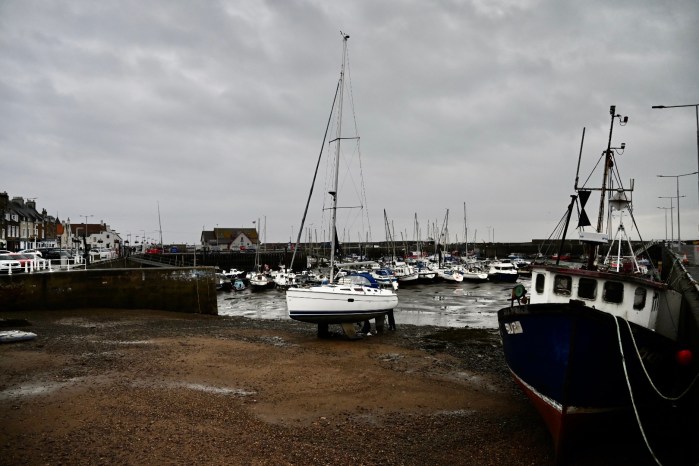
The Fife Coastal Path passes right through Cellardyke, where we spent our October break. Every day, we explored a different part of it. Walking west from our front door we passed through the fishing villages of Anstruther, Pittenweem, and St Monans.
Anstruther
Probably the most notable features of Anstruther (pop. c 3,600) are the Scottish Fisheries Museum and the Anstruther Fish Bar, neither of which we visited. However, the window from which two faces are peering in the gallery below is part of the museum. We did visit the Dreel Tavern (though not on the day of this walk) where a plaque on the wall commemorates the time that James V (1513-42) was carried across the Dreel Burn by a beggar woman because he was frightened of getting his stockings wet!


We also looked at the monument to Thomas Chalmers (1780-1847), First Moderator of the Free Church of Scotland, and later found his birthplace.


From Anstruther, we continued along the coast to our next port of call, Pittenweem.


Pittenweem
Pittenweem, with a population under 2,000, is much smaller than Anstruther. The name is said to mean place of the caves, and you can still see St Fillan’s Cave, dating from the 7th century, though in these strange times you can’t go inside. We admired the pretty houses, had a good lunch in the Clock Tower Café, and examined the poignant new Fishermen’s Memorial by sculptor Alan Heriot, unveiled in 2019. It depicts a fisherman’s wife and child scanning the horizon for the return of their loved one. The plaque reads “This memorial is dedicated to the men and women who make their living from the sea and to those who have lost their lives in so doing”. It is thought around 400 lives have been lost in a 28-mile stretch of the Firth of Forth off the East Neuk since the early 1800s, many of them never recovered.


From Pittenweem, we continued along the coast to St Monans.
St Monans
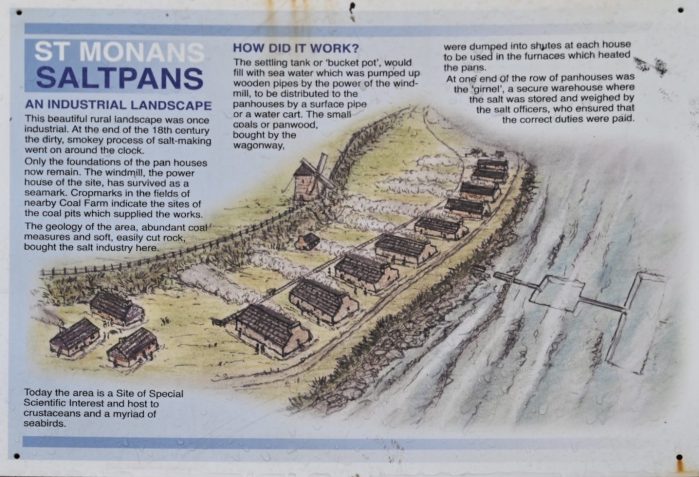
St Monans is even smaller than Pittenweem with a population under 1500. Before you reach the village, a restored windmill and the remains of a few pan-houses are testament to the area’s industrial history: the Newark Coal and Salt Works Company founded in 1771.


It’s hard to tell what’s natural and what isn’t in the rocks! There’s a swimming pool created in the sea, as in many of these villages. Much too cold to try out!


As with the other two villages, there was a harbour and some pretty, colourful houses to admire, this time with the added attraction of a Welly Garden. It was raining quite hard by this time, so stealing a pair might have been a good option!


Rain or no rain, from St Monans we had to turn round and do the walk in reverse to get back to our holiday home in Cellardyke: 7-8 miles in total. In the next post, I’ll turn east from our front door and take you along the coastal path to Crail.
Linked to Jo’s Monday Walk.


 The Glasgow Gallivanter
That’s a great use for old wellies. In Canada, we call them gum boots. Very interesting to read about the salt works.
Jude
LikeLike
Yes, I’m fairly sure only the British will call them Wellingtons!
LikeLike
Really enjoy seeing your photos, they are beautiful!!!
LikeLiked by 1 person
Thank you, I’m glad you enjoyed them!
LikeLiked by 1 person
I love the history of these smaller coastal communities. Hard lives for the residents back in the day though, I suppose. I’d love to do a Scottish coastal road trip when these things are possible again.
LikeLiked by 1 person
Some day! 🤞🏻
LikeLiked by 1 person
Wonderful buildings, especially the church. And I LOVE that windmills. What a great walk 🙂
LikeLike
Yes, these villages are all lovely and just the right distance to walk between.
LikeLike
Your blog inspires me to get out and learn more about the area around where I live….it’s not as historic as Scotland by any means, but there is something interesting and beautiful about almost all areas, and I think I need to learn to appreciate it more. At least until this stupid pandemic is over and I can actually visit Scotland, Ireland and England!!!
LikeLike
That’s very true, Ann. At the moment we’re confined to Glasgow though and, much as I love it, my patience is wearing thin!
LikeLike
I love the Welly Garden; it’s so clever. Such charming villages and a very long walk for you! It looks delightful.
LikeLike
The welly garden is brilliant!
LikeLike
Even with the rain it looks like you had a lovely day exploring these little villages. It’s amazing how even the smallest town has so much history to discover.
LikeLike
Yes, we did have a lovely day, they are such pretty villages and it was great to be by the sea.
LikeLike
I’m just a wee bit homesick reading that Anabel. I love the East Neuk, and have walked parts of the coastal path with my mum. Lovely memories, so thank you.
LikeLike
Aw, I’m glad to bring back memories! Not so much the homesickness, but I suppose that’s part and parcel of the happy memories.
LikeLike
Regardless of the rain it looks like an amazing part of the world, some fabulous photos there. Brings back memories of road trips and visits to Fife. Great.
LikeLike
We love it there, especially the East Neuk.
LikeLike
Hi Anabel – what a fun place to visit … three seaside villages with different overtones – lovely photos and thus enticing. Enjoy the walks … Hilary
LikeLike
Yes, the three villages are all very charming but each with their own distinct character.
LikeLike
Lovely walk, I enjoyed it.
LikeLike
Thanks Andrew! We love that area.
LikeLike
oh so lovely to walk with you along this coastline – so much history and so much charm 🙂
LikeLike
We love it there! I’m going to enjoy looking back to write the rest up.
LikeLiked by 1 person
hee hee you are doing ups within your comments!
LikeLike
So I am!
LikeLiked by 1 person
Hi Anabel – Your photos are amazing. I love the virtual travel. Totally amazing about King Sissy Pants. Kinda makes one wish to slap him!
LikeLike
Thanks, Donna! Glad you enjoyed it. I don’t suppose our current royals would resort to getting a beggar woman to carry them across a stream, but I think the same sense of entitlement remains! (Not a fan, you might guess).
LikeLike
I think those tall narrow houses quite fascinating and so different from our selection of homes in NZ. Anabel, your photos turned out really well considering the low light, not easy to create clear images during the winter months. Many areas down in the lower South Island aren’t swimable in summer much like Scotland!
LikeLike
Thanks, Suzanne, most of the photography ias, as always, John so I’ll tell him. I love the houses too, though I imagine a lot of them are quite cramped inside with small rooms and steep stairs.
LikeLike
The writing is always enjoyable as much as the words. Funny how most people make mention of the images and not the words.
LikeLiked by 1 person
Great photos. I love the Fife Coast. You did not miss much with the fishing museum (ok but not outstanding in any way) and the A fish bar ( always busy with tourists waiting and my local fish and chip shop is just as good with a less than five minute wait each time. When certain things get too well known and popular they can sometimes lose the certain atmosphere that made them special in the first place. Last two times in A we looked at the queue for chips there and went elsewhere which was equally good and a lot faster due to being quieter..
LikeLike
Unless it’s something that really interests me (and fishing doesn’t!) a coastal walk will always win. Even in the damp weather, there was a (socially distanced) queue at the chippie and I don’t eat fish anyway, so I don’t feel I missed out there either. I agree, the Fife coast is wonderful.
LikeLike
These are great smaller towns and I like the boats made into flower beds. I also love that old stone part of a house. That king needed to get dunked in the water.
LikeLike
He should have been!
LikeLike
Well James V does sound like a right Sissy Pants!
The villages all look picture postcard perfect. X
LikeLiked by 1 person
Doesn’t he? What a wuss.
LikeLiked by 1 person
Anabel, love all your photographs especially the ones of those colorful houses, but the architecture in general is noteworthy. I wanted to reach for a hot cup of tea though, while looking through your post of streets that FEEL cold!
Might be fun to go back in better weather to experience that cool swimming pool in the rocks!
Peta
LikeLike
The cup of tea is a good idea! Even in the summer I would never get into that sea. It’s still cold!
LikeLike
St. Monans looks very pretty, I love the little pink cottage sandwiched between the two taller houses and the cottages behind the boat with the shark fin. The welly garden looks very colourful, is there a particular reason behind it or does someone just like using old wellies as planters? 🙂
LikeLike
I’m not sure about the welly garden, there was no-one to ask (sensible people being inside out of the rain). It’s in a public area at the top of a slipway so I suspect it’s a communal effort.
LikeLike
I guess you just have to learn to like the weather, Anabel. I’m not good at walking under grey skies but it’s always nice to be by the sea, and these are characterful villages. There was one very tall house that caught my attention. Many thanks for the link, and happy walking in 2021. 🙂 🙂
LikeLike
Thanks, Jo – happy walking to you too! As for the rain, we just have to brave it, waterproof trousers if necessary. It’s the treacherous ice that’s causing me more problems at the moment.
LikeLike
Not to mention the lockdown! Though that won’t apply in Scotland. Mum still managing ok? 🙂 🙂
LikeLike
We have lockdown too but we can still go out for exercise. Yes, we’re all fine thanks!
LikeLiked by 1 person
The only advantage of a childhood growing up in Glenrothes was access to the more attractive parts of Fife and I used to love our trips to the villages of the East Neuk. It’s a shame you couldn’t experience the fish and chips in Anstruther as, at least in time past, they were reliably the best chippy in Fife.
LikeLike
It’s still a very famous chip shop, but as I don’t eat fish I didn’t try it. Also, socially distanced queueing in the rain to get in would not have been fun!
LikeLiked by 1 person
Yeah, the chips are great but not worth that!
LikeLiked by 1 person
That vividly reminds me of our stay in Edinburgh in 2013. One day we visited Scone Palace, and on our way back drove past St. Andrews, and then along the coast. We stopped in Pittenweem and walked around some. Mary still remembers a sweets shop there where she got som yummy chocolate ice cream. I remember the harbour more, with its colourful fishing-boats. After Pittenweem. we stopped at the Upper Largo Hotel & Restaurant on A915 for a most excellent supper. When I mentioned that to Mary just now, she came up with, “And I had liver there.” Fried liver is one of her favourite dishes. When I looked up the pictures, all our food looked excellent: well cooked, nicely presented, and ever so yummy. I need to look it up in Mary’s diary what all we had. Definitely it was a fantastic chocolate cake for dessert.
Ohhhhhhhhhhhhh, now my mouth is watering. 😉
LikeLike
That’s a very foodie memory! I’m glad your scottish meals were up to scratch.
LikeLiked by 1 person
As you know from my blogs: Mary and I love good meals. 😉
LikeLiked by 1 person
I like the narrow streets in these towns. But maybe that’s not so true for people who live there. It’s hard to find someplace to park your car!
LikeLike
We certainly had parking problems near our accommodation!
LikeLiked by 1 person
I’ll have to come back and reread this post as I have merely skimmed it this morning, too many phone calls kept interrupting and I have still to have lunch although it’s gone 2.00 pm. Lots of lovely photos to look at though so I’ll do that at my leisure. Meantime, we’re all back to normal now and well into 2021. There, first time I’ve written it!
LikeLike
Sort of normal, Mari!
LikeLike
Scottish villages have a very distinct look. We like exploring like this too where there is history and interesting stories to discover. Not a region I know anything about so I enjoyed this post.
LikeLike
These are very typical east coast villages, I love exploring their nooks and crannies.
LikeLike
Nice to see these pretty villages again. A shame the weather doesn’t look to have been in your favour!
LikeLike
Not this day, but we had some lovely sunshine later. Still cold though!
LikeLike
Thanks for showing us this area
LikeLike
Thanks for reading!
LikeLike
There’s some interesting old buildings there in your photos, and some industrial history too, besides the coastal scenery. The sort of place I like to explore.
LikeLike
Yes, we’ve done this section of the path several times and I think of it as beautiful, unspoilt coast. I was surprised to learn on our first visit how industrial it would have looked in the past.
LikeLiked by 1 person
I think there’s very little of our countryside which hasn’t had an industrial past – just think about the Lakes where the landscape has been created by agriculture, forestry, sheep, quarrying and mining. I don’t know about the Scottish highlands and islands. They are probably less affected by human activity – or are they? You’ll know better than me.
LikeLike
You’re right, it’s our 21st century sensibilities which assume the land has always been as it is. The idyllic countryside was probably a very hard place unless you were “gentry”. The Highlands and Islands as they are now were shaped by the depopulation of the clearances so are by no means the unspoilt wilderness they appear to be.
LikeLike
The hand of humanity is everywhere
LikeLiked by 1 person
It’s a beautiful part of the country. Have walked various parts of the coastal path. I enjoy this post very much.
LikeLike
I’m glad you enjoyed it! We’ve walked various parts too: this section we are very familiar with, but later in the week we did some new parts.
LikeLiked by 1 person
Beautiful historic area to visit.
LikeLike
It’s one of our favourite parts of Scotland. (Ok, there are many “favourites”!)
LikeLike
Hoping to return ..I have a lot of Scottish ancestry .
LikeLiked by 1 person