
Glasgow churches: Woodside and Maryhill
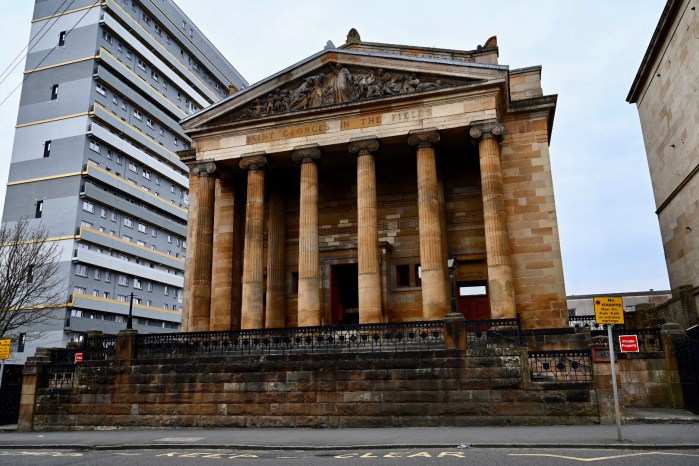
Here’s another selection of church buildings from my lockdown walks, this time in Woodside and Maryhill – not a definitive list by any means, just those which particularly caught my eye. First, the classical St George’s in the Fields which was built in 1885/86, replacing an earlier building from 1824 which would, literally, have been in the fields. The architects were Hugh and David Barclay and the sculpture above the portico, depicting the parable of the loaves and fishes, is by William Birnie Rhind. The church fell out of use in 1979 and was converted into private flats in 1987.


Close by, on Hopehill Road, is St Columba’s Roman Catholic Church. Designed by the award-winning architect Jack Coia, it opened in 1941 and the cost was met by the families of the area, each of whom paid 6d per brick. I like the contrast of the plain brick with the elaborate carving round the door which, to me, looks as though it belongs to a different building altogether.


Moving now from Woodside towards Maryhill, this next church has featured in these pages several times before. Commissioned in 1896, Queen’s Cross is the only church to have been designed by Charles Rennie Mackintosh and now houses the Mackintosh Society.


Queen’s Cross might have been Mackintosh’s only church, but on Shakespeare Street, just off Maryhill Road, you can see his work in Ruchill Parish Church Hall, completed in 1899. The church is of later date (1903-5) and was designed by Neil Campbell Duff in a completely different style.


Finally, this is Gairbraid Parish Church (1858/9) which sits next to Maryhill Burgh Halls. I don’t know the name of the architect, and it’s certainly much simpler than the others I have included. The view of the front is taken from the aqueduct which carries the Forth and Clyde Canal over Maryhill Road, and the back view with the blue door is from Burnhouse Street.


The most popular things in my previous church posts were the grotesques and gargoyles, and there’s not a single one in sight here. Oh dear, I must try to find more for next time!


 The Glasgow Gallivanter
I’m not sure if I like the plainness of St. Columba’s, although something about it reminds me a bit of Dorich House, where I work. I do like the church hall with the tower though!
LikeLike
I don’t think I knew exactly where you worked before, so I looked it up and I see what you mean about the similar plainness (which I rather like).
LikeLiked by 1 person
I don’t like to advertise it directly on my own blog just in case I have a stalker I don’t know about, so I don’t think I’ve come right out and said it before. I do think Dorich is an interesting looking house, but the locals used to refer to it as a Soviet toothpaste factory, and I can see what they mean!
LikeLike
Soviet I can see, toothpaste factory is inventive!
LikeLike
Fascinating post
LikeLike
Thank you!
LikeLiked by 1 person
Don’t worry about the lack of gargoyles, those are still very interesting churches!
LikeLike
Thanks Ann!
LikeLike
That first church looks like it was from Roman times. I hope that some of the interior was saved when it was converted into apartments. That modern looking church with the gothic looking facade looks so thin. It is strange looking. This is quite interesting to see all of these churches. It shows, too, how many are no longer active church goers.
LikeLike
It does look strange from that angle. The facade is higher than the body of the church so you can’t see it from the front. We should have gone round the side too! Here it is on the church website https://stcolumbarc.co.uk
LikeLike
I’d love to see one of the flats which have been created inside St George’s in the Fields. It would be interesting to see how the space has been used. You’re right about St Columba’s – the lovely carving around the door really is in stark contrast to the plain brick wall. I wonder if there’s a story there about how the work on the doorway came about. Perhaps it was originally meant for somewhere else.
LikeLike
I’ve tried to find out more about the doorway, but nowhere – even the church’s own website – hints any other origin. If it was taken from an older church you’d think they might have mentioned it, so I can only assume it was planned that way.
LikeLiked by 1 person
Oh, and I found a couple of links for another commenter to show the flats inside. They don’t look anything special.
https://www.glasgowlive.co.uk/news/glasgow-news/beautiful-historic-flat-under-100k-13631551
https://www.airbnb.co.uk/rooms/35327299?source_impression_id=p3_1623480463_uJEcUmFoZaSY3o3N
LikeLiked by 2 people
Yes, they just look like any other flats, but what a wonderful location. I must remember the Airbnb one if ever we get to visit Glasgow.
LikeLiked by 1 person
Shows you how much religion dominated many people’s existence back then. Thankfully it was never a part of mine although I can appreciate
the art inside and out.
LikeLike
Yes, it was just expected that everyone went to church at one time. I wonder how man6 of the ones which still function as churches are ever full these days?
LikeLike
A lovely selection of churches Anabel.
St Columba’s is fascinating. Is the stonework around the entrance really contemporaneous with the structure? I love that contrast too.
St George’s reminds me of St Martin’s in London — same neo-Classical style “in the (long-gone) field”. I’m always a little bemused by neo-Classical churches; the underlying design philosophy seems wrong somehow.
LikeLike
I have looked up St Columba’s in several places (including its own site) and they all just refer to the carving round the door with nothing to suggest it was from an older building. I was sure when I first saw it that it must have been saved from a previous church, but if so you’d think the church website would tell you. I’ve concluded it must just have been designed that way. St George’s is very like St Martin’s. There’s another similar structure, St Andrew’s in the Square, which might feature if I continue the series.
LikeLiked by 1 person
St. George’s reminds me of a church I looked up recently in New York City – now surrounded by skyscrapers, but in an 1860s engraving clearly fitting in its surroundings. It’s difficult to imagine how the flats fit in – are there enough windows?
LikeLike
The same block shows up behind St Columba’s. Balconies front and back – I think the side elevation windows, which do seem very few, are corridors. And they are duplexes. Many Glasgow high rises have been demolished in recent years. These have won an award for their refurbishment. I didn’t know that before, your question prompted me to investigate! Plans here:
https://www.architectsjournal.co.uk/buildings/getting-warmer-collective-architecture-upgrades-glasgow-tower-blocks
LikeLiked by 1 person
Hmm. I didn’t see anything at that link that looked like the old church. Didn’t see St. George’s mentioned.
LikeLike
Oh, ok, I misunderstood. I thought you meant the tower block flats. Doh, it’s late here!
LikeLiked by 1 person
Oops! Maybe I misunderstood the bit about the church. Sorry!🙃
LikeLike
No, it was me. I think I had temporarily forgotten that the church was flats. Anyway, the windows are all at the side which shows up in this link:
https://www.glasgowlive.co.uk/news/glasgow-news/beautiful-historic-flat-under-100k-13631551
And if you come to Glasgow on vacation, there’s one on Airbnb!
https://www.airbnb.co.uk/rooms/35327299?source_impression_id=p3_1623480463_uJEcUmFoZaSY3o3N
LikeLiked by 1 person
The kitchen’s a little funky, but otherwise they look pretty nice! Thanks for adding the links.
LikeLiked by 1 person
Lovely pics Anabel. Mum r.I.p told me her Uncle Francis came over to Maryhill from Donegal, Ireland to work on the trams. I think this may have been in the 1940’s.
LikeLike
Interesting! Maryhill today is still a place many people immigrate to.
LikeLiked by 1 person
I greatly enjoyed this vicarious walk, gargoyles or no gargoyles! I love how lockdown has nudged us all to (re)explore our own backyards more deeply. Your surroundings are absolutely beautiful!
LikeLiked by 1 person
There are certainly some beautiful buildings around us.
LikeLike
St. George’s sure is classical. It would have fit in perfectly in ancient Rome.
LikeLike
It would! It looks rather out of place in its current setting.
LikeLiked by 2 people
Yes, where are the grotesques and gargoyles. It’s what we expect from you! That said, the churches you chose were interesting and I love the idea of the 6d. a brick one.
LikeLike
I think I have managed to splurge all my gargoyles at once! I can’t see any more in my church file 😟. The sixpenny bricks were a good idea.
LikeLiked by 1 person
What a fascinating selection, Anabel…from the porticoed St George’s to the more humble Gairbraid
LikeLiked by 1 person
Thanks Sue! I found the differences intriguing.
LikeLiked by 1 person
Indeed!
LikeLiked by 1 person