
Summer 2022: exploring Cromarty 1
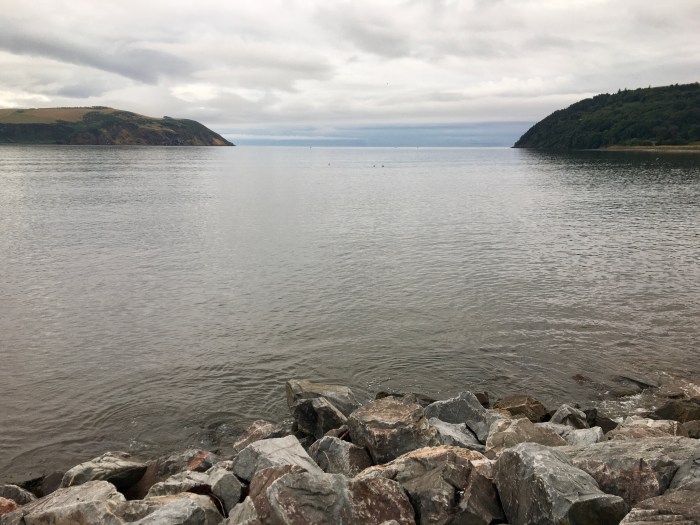
The headlands which create a bottleneck at the entrance to the Cromarty Firth are called the Sutors, the Scots word for shoemaker. Legend has it that two giants used the cliffs as workbenches, tossing their tools to each other across the Firth. On our first morning in Cromarty we climbed South Sutor with great views across the Firth and back to the town.


The town of Cromarty is over 700 years old. As a port it exported grain from the fertile land of the Black Isle and imported flax and hemp to be spun and woven in the town. Fishing was also important, and then the oil industry from the 1970s when oil platforms started to be constructed and repaired in the Firth. Its narrow streets are bursting with historic buildings from fishermen’s cottages to grand Victorian houses. Here are some themed highlights.
Harbour area and lighthouse
A small car ferry runs across the Firth to Nigg in the summer: we were interested to note that the current ferry is the Renfrew Rose, presumably an import from the Glasgow-Renfrew ferry on the Clyde. Nearby is a modern cinema, which we didn’t use, and peeking out behind it the wooden building of Slaughterhouse Coffee, which we did (very good).
The lighthouse was built in 1846 by Alan Stevenson of the famous family of lighthouse engineers. It is now a field station for Aberdeen University where marine biologists investigate the ecology of Scotland’s top three marine predators – seals, fulmars and bottlenose dolphins.


Churches and graveyards
As you will know, I love a good graveyard and an old church! Cromarty is well supplied.
Gaelic Chapel and Cromarty Cemetery
The eighteenth century Gaelic Chapel is surrounded by the Parish Churchyard which has been much extended over the years. The most recent extension contains a War Cross and what seemed a very large number of Commonwealth War Graves for such a small town: over 70. However, Cromarty had a Military Hospital with 226 beds, and in the Channel between Cromarty and Invergordon HMS Natal was wrecked and overturned by an internal explosion on the 30th December 1915, so these two facts would account for that. The hull of HMS Natal marked by two beacons stood out for some years above the water – we would pass the site a few days later on a dolphin watching trip.


East Church
East Church is over 700 years old, although many changes have been made over the centuries. Now in the care of the Scottish Redundant Churches Trust it has been beautifully restored, partly as a result of appearing on the BBC’s Restoration programme.
Outside first – some interesting stones in the graveyard. As usual, there are sad tales of infant mortality – the Hogg and Summers stones. The latter also records the death of a son, Harry, killed at HM Dockyard Invergordon in 1917 when he was just 14. Rev Adam Hall died in 1846 “in the midst of his usefulness” having served as the church’s pastor for just two and a half years. The final image is all that remains of the Forsyth Mausoleum, still in family ownership but sadly broken down.


Moving inside, the wooden furnishings downstairs are clearly not original – the church was modernised by Walter Scott (not that one!) who began his almost 50-year ministry at East Church in 1876.


The gallery is very different with pews still bearing 18th century paint, including the initials of some of their occupants.


There are remnants of panels, dated 1702, showing the coats of arms of Sir Kenneth Mackenzie and his wife Lady Anne Campbell.


Finally, there are interesting memorials – here are my favourites, arranged in order of age. First, the Andersons, with all the traditional symbols of death: skull and crossbones, coffin, and hour-glass. Gilbert and Hugh, father and son, served as ministers in Cromarty for 46 years between them, ending with Hugh’s death in 1704. The brightly painted funeral hatchment hanging in the laird’s loft is for George Ross who owned the Cromarty Estate in the 1700s and invested in its economic development. Features remaining today (the old harbour, the old brewery and the courthouse, now a museum) were part of his vision.


A later George Ross served in the army, but his son Duncan (1851-1887) was a Lieutenant in the Royal Navy which explains the anchor on their memorial. Finally, the aforementioned Walter Scott (1846-1925) who modernised the church is commemorated in a plain and simple tablet.


St Regulus
St Regulus sits on a small hill in Cromarty and is the oldest graveyard we visited, with many 17th and 18th century slabs. It is sometimes called the Pirate’s Graveyard because it has so many skulls and crossbones, but of course it has nothing to do with pirates, despite one stone clearly showing a ship (see last image below). As mentioned earlier, the skull and crossbones is one of the traditional symbols of death, memento mori, along with bells, hourglasses and shovels. There are plenty of all of those here.


Cromarty West Parish Church


This church is not particularly interesting looking but the memorial outside caught my eye. If some of the tributes to ministers in the East Church seemed extravagant, this is way over the top! Rev Alexander Stewart, who died in 1847 aged 53, must have been a real paragon. Here’s the beginning of the text on the memorial:
He was mighty in the scriptures; he had a peculiar and marvelous (sic) eloquence; he could discern with prophetic eye the signs of the times; and the rarest union of wisdom, genius, and Christian faith proclaimed him a Prince and a Master in Israel.
However, poor Alexander had a sensitive nature and shrank from the honours which the church sought to give him, so much so that when he was finally persuaded to move to a more important church in Edinburgh the stress might have been what killed him. Or as the monument puts it:
The Lord, pitying the perplexities of his spirit, put an end to them by suddenly removing him to the Upper Sanctuary.
I seem to have got carried away with all these churches and graveyards, so what was meant to have been a single post about exploring Cromarty will have to be two. Not sure I can top Alexander being removed to the Upper Sanctuary though! More soon.


 The Glasgow Gallivanter
I find all these old churches fascinating Anabel and I have certainly never come across the expression “Upper Sanctuary” before – what a lovely turn of phrase. I had heard of Cromarty before but didn’t realise exactly where it was just that it was in Scotland somewhere. I’ve now looked it up on the map – always so interesting to discover new places 🙂
LikeLike
Yes, it was all new to us – we’d go back, definitely. The Victorians really went to town with their phraseology.
LikeLiked by 1 person
That’s an interesting chapel in the graveyard. Funnily enough, my own latest post features a lighthouse too!
LikeLike
Lighthouses are fascinating! As are graveyards and chapels. Love the old stuff.
LikeLike
Such an interesting place to visit. The graveyard with the skeleton head is a bit creepy.
LikeLike
It was a very common symbol of mortality at one time, and this graveyard was full of them!
LikeLiked by 1 person
I think old churches and graveyards are so interesting. Also sad, (those infant and children’s deaths), but I do love touring them. Thanks for sharing!
LikeLike
Thanks Ann, the old graveyards are always interesting.
LikeLike
I think the skull and crossbones and other such motifs are more common in Europe. I don’t know about eastern states, but I don’t see that sort of thing out west here. The church you didn’t find interesting looking looked interesting to me!😀
LikeLike
Probably, they are more 17C so might have been dying out before they could transfer. That other church might well have been lovely inside, but it wasn’t open. It just looked a very run-of-the-mill 19C church to me!
LikeLiked by 1 person
So much history – you could spend weeks exploring.
LikeLike
You could! Even just in the graveyards.
LikeLike
Heartbreaking to read about the six Hogg children! All too common in those days, but no less painful for the parents, I’m sure. Thank heaven for modern medicine!
LikeLike
It must have caused unbelievable grief. Not just the loss of the children, but so many women died in childbirth (or worn out after having about 14 pregnancies).
LikeLike
I would love to visit these areas and I, too, love going to cemeteries, it is sad to see the children who died so young. I love the old ways they decorated the tombstones.
LikeLike
Cemeteries are fascinating I think. So many interesting stories.
LikeLike
Here’s somewhere else I have yet to visit, let alone explore. I’m glad there’s more to come.
LikeLike
Definitely more. I thought being a year behind might have dimmed my enthusiasm, but it seems not!
LikeLiked by 1 person
Excellent post, Anabel. I so enjoyed reading it. The ” Upper Sanctury” is a new term to me but I sort of like it, it you know what I mean. I always seem late to respond to things these days, but I look forward to the second part of this post.
LikeLike
Thank you – quite an intriguing turn of phrase i thought!
LikeLike
It’s a nice area with varied scenery… and dolphins feeding very close to the shoreline most days a regular sight up there.
LikeLike
We saw dolphins when we went out on a boat but had no luck from the shore.
LikeLike
I liked the painted pews. I have not seen ones like them before.
LikeLike
Nor have I – quite fascinating.
LikeLiked by 1 person
Absolutely stunning! I agree that this would make a great 3-part series!
LikeLike
I have definitely found myself getting carried away!
LikeLiked by 1 person
Please get carried away more often! This post is brilliant.
LikeLike
Thank you! *blushes*
LikeLiked by 1 person
It sounds like they wanted to give Alexander a sainthood.
The gravestones are quite spooky especially with all the skulls and crossbones. ☠️
LikeLike
Alexander seems to have been a paragon of all the virtues! I know they meant it all very seriously, but it comes across as ludicrous to the modern reader.
LikeLiked by 1 person
Very interesting churches and graveyards. I also have a fascination for graveyards; there seems to be something mysterious about them and so solemnly. Very nice pics and story. (Suzanne)
LikeLike
Thanks Suzanne. I agree about graveyards!
LikeLike
The views across the bay are beautiful. Sad to think of seals and dolphins as predators. I don’t even know what a fulmar is, Anabel.
LikeLike
It’s a bird, Jo, a bit like a gull but not a gull. (You can tell my knowledge isn’t much more extensive than yours!)
LikeLike
Where’s Becky when you need her? 🤣❤️ I’m glad that she appears to have had some good news, at last.
LikeLiked by 1 person
👍
LikeLiked by 1 person
Brilliant. Looking forward to the next one!
LikeLike
Thanks! Partially done.Might even extend to three …
LikeLike
Interesting post
LikeLike
Thanks Sue!
LikeLiked by 1 person
😊😊
LikeLiked by 1 person
This post is right up my street! Love a good old church and a good graveyard to go with it. The War graves always inspire mixed feelings in me. Glad that they are remembered for their service, sad for the loss and the grief it must have caused their families.
The Hogg family stone caught my eye. So much loss. I’ve been reading about the murderess Mary Cotton who murdered several of her own children ( plus husbands and pretty much anyone else who got in her way). One of the reasons she got away with murder and mayhem was the high childhood mortality rate of the times. The good old days, eh?
LikeLiked by 1 person
I had to look her up – horrifying! But I can see how she could get away with it given mortality rates at the time, and that she moved around a bit.
LikeLike
The military hospital must have been quite large. 226 beds is a lot.
LikeLike
It is! The horrors of war.
LikeLiked by 1 person
Hi Anabel – what a fascinating post … Cromarty certainly has an interesting history. I love your graveyards and church posts … always a pleasure to see. Cheers Hilary
LikeLike
Thanks Hilary – I just love exploring old churches and graveyards. At one time I would have thought this completely loopy. I’m obviously getting old!
LikeLiked by 1 person
Another interesting post with some great photos, I love the view of Cromarty from South Sutor. Poor Alexander being removed to the Upper Sanctuary – that quote from the monument made me smile 🙂
LikeLike
It certainly amuses me how florid the language on some of these Victorian memorials is!
LikeLike