
Summer 2022: exploring Cromarty 2
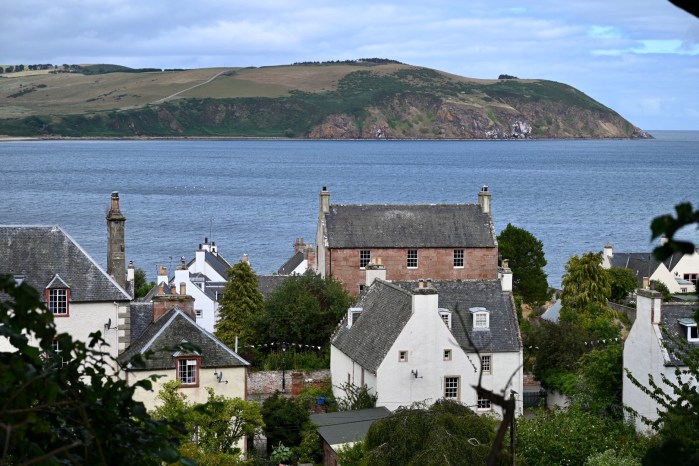
Last time, I showed you Cromarty from South Sutor and explored its harbour and graveyards before running out of steam. This time I’ll start with some general views of this lovely little town, including some pretty doors.


Notable buildings
Now for some specifically named buildings – some of them more serious than others! First, East House with its colourful doors and lettering.


The pleasingly symmetrical Forsyth House.


Cromarty Museum, housed in the old Courthouse, and the Old Brewery, now part of Cromarty Arts Trust.


The repurposing theme continues with The Stables, also part of the Arts Trust, and home to a unicorn. We decided against a ride!


The Byre is an attractive housing development converted from an old hempworks.


In this house James Thomson, a Crimean War hero, was born.


And what about this house? Notable for having a resident with a sense of humour I guess! Though the small brass plaque on the gatepost is very sad (underneath the Nothing Happened sign).


Hugh Miller (1802-1856)
The self-taught geologist, Hugh Miller, was born in Cromarty. His birthplace is now a museum, there is a statue of him overlooking the town, and the Victorian building housing the library, gifted by Andrew Carnegie, is named the Hugh Miller Institute.


Just outside town, but part of the The Hugh Miller Cromarty Trail, is Eathie Haven where the Jurassic era ammonites which Miller found in his youth kick-started his career as a geologist.
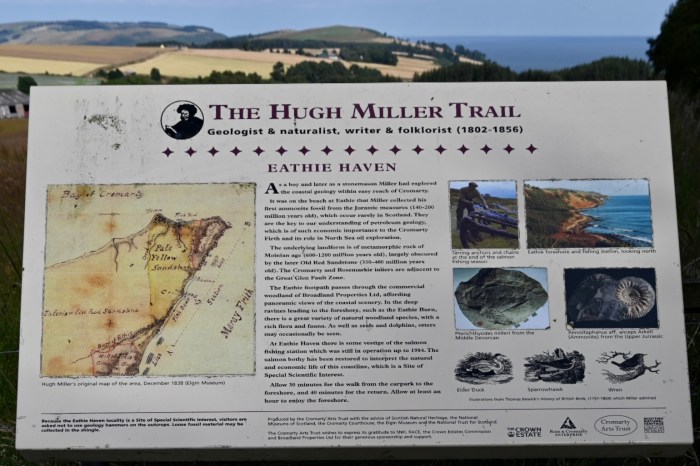
There’s a steep path down to the shore (which feels even steeper coming back up) and two old bothies, one of which has information about Miller, as well as about salmon netting which took place here until the 1980s. This bothy is still used as such, judging by the provisions stashed above one of the boards. It’s not possible to spot any fossils now, they are long gone, but we liked some of the pretty stones.


So that seems to be enough to be going on with – my one post about exploring Cromarty is going to turn into three! Another instalment soon.


Hi Anabel – what an interesting place … I enjoyed finding out about Hugh Miller … and obviously a place to visit. Also seeing that Ian Rankin hides himself away in the village when he’s writing. Lovely photos – thanks … so fascinating – cheers Hilary
LikeLike
Yes, but we didn’t meet him!
LikeLiked by 1 person
I’ve never heard of it before but Cromarty certainly looks like a pretty place.
LikeLike
It is, would definitely go back.
LikeLike
You’re so much more observant than I am, I would have missed so many of these things! The plaques are fascinating. It’s so interesting to learn about the people who once lived in these old buildings.
LikeLike
I think I have become a lot more observant over the years. Also lockdown made me look more closely at things out of sheer boredom!
LikeLiked by 1 person
So much to see!
LikeLike
A lot packed in to one small town!
LikeLike
What a gorgeous town!
LikeLike
Isn’t it just!
LikeLiked by 1 person
That’s high marks for Cromarty if you’ve enough for three posts! It does look inviting.
LikeLike
It was such a pretty little town – so hard to leave anything out!
LikeLiked by 1 person
Looks like a beautiful spot Anabel so much to see
LikeLike
There was. Thought I’d do one quick post, then got carried away!
LikeLiked by 1 person
That was a sad plaque indeed. And obviously a long suffering horse.
LikeLike
Indeed!
LikeLike
The first photo reminds me a bit of the view over Whitby looking form the top of the 199 steps. I like the plaque on 49 Church Street, someone has a sense of humour 🙂 I love the red doors, and East House is apparently the church hall belonging to East Church and is Category C listed.
LikeLike
Thanks Eunice, you are more persistent in your research than I am!
LikeLike
I do like a bit of a mystery Anabel 🙂 🙂
LikeLiked by 1 person
Such a lovely town and so typical of Scottish towns. Lovely set of images. (Suzanne)
LikeLike
Thanks Suzanne! It certainly is lovely.
LikeLike
What a timeless beauty those old houses are. Makes me want to be there right now!
LikeLike
It’s a lovely little town, and seemed to be a good community too.
LikeLiked by 1 person
I wonder if the houses built by the sea were for families to see their menfolk arrive safety from a sea voyage. It is lovely to remember people (Hugh Miller) that have had a significant input into the area. That last stone image; I have one pretty much identical to it.
LikeLike
I love looking for pretty stones!
LikeLiked by 1 person
It is an addiction 😉 Though I had to give it up while travelling in our motorhome.
LikeLike
Yes, I can see they might have been a liability then!
LikeLiked by 1 person
What a great little place!
LikeLike
Yes, it is!
LikeLiked by 1 person
I love houses that run down to the sea 🌊 🤗🩵
LikeLike
The temptation of a sea view is about the only thing that might get me to move from Glasgow!
LikeLike
I can understand that. I can’t remember when I didn’t have one, either here or in the north of England 🤗💙
LikeLiked by 1 person
“The present owner is not quite as old.” —that’s a good one!
LikeLike
Definitely a good sense of humour there!
LikeLiked by 1 person
This looks a lovely dignified quiet land and townscape.
LikeLike
It is indeed, lots to look at.
LikeLiked by 1 person
You find such interesting things wherever you go. I suppose I’m too busy looking at other things!
LikeLike
I do my best!
LikeLike
I used to have summer holidays there, way back in the days before the bridge when the Inverness- Black Isle ferry was still running. Mid 1970s. It’s not changed much though.
LikeLike
No, it has a timeless air about it.
LikeLike
Love the whitewashed cottages, though Hugh Miller’s could do with some TLC.
LikeLike
It could. It’s actually run by National Trust for Scotland so I thought they might have done it up a bit better.
LikeLiked by 1 person
Lovely old houses – the East House looks as if it was once a chapel perhaps?
LikeLike
I think it must have been. I tried to look it up when I was writing this and kept getting directed to the East Church so I gave up after very little effort. Rather unlibrarian-like of me!
LikeLiked by 2 people
Life’s too short sometimes …
LikeLiked by 2 people