
East London and the Museum of the Home
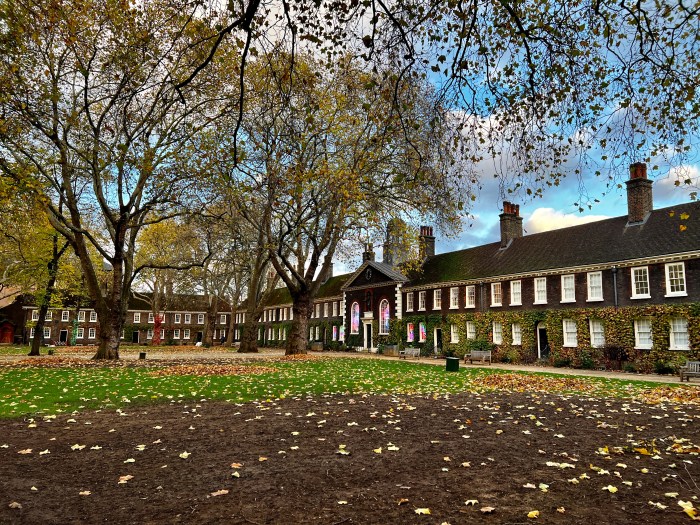
Another excursion from our November 2022 London trip, a walk through East London from Whitechapel Art Gallery to the Museum of the Home following the route in Insight Guides’ Explore London which explains:
Where once were slums, race riots and Jack the Ripper are now art galleries, trendy bars and urban cool, while Canary Wharf, once the docks of Britain’s imperial trade, now houses the power-architecture of investment banks.
Yes, I guess we saw all that! Emerging from Aldgate East tube station from an exit underneath the former Passmore Edwards Library we admired the outside of the 1901 Whitechapel Gallery (into which the library was incorporated in 2009).


We didn’t go in, but set off walking. In this first gallery are a view of London’s Financial District including the building at 30 St Mary Axe aka The Gherkin; a wall sign for Petticoat Lane Market, a centre for the rag trade for almost 400 years; Christ Church, Spitalfields, one of Nicholas Hawksmoor’s churches built between 1714 and 1729; and Ten Bells, the pub where Jack the Ripper allegedly eyed up his victims before murdering them.


We took a short wander round Spitalfields Market, once London’s wholesale fruit and vegetable market, now a much more upmarket creation. We didn’t buy anything, but admired the animal sculptures.


The sculpture of a dog and a rabbit on a Vespa, Together Forever on Wheels, is by Gillie and Marc, as are the elephants. They represent real elephants rescued by the Sheldrake Wildlife Trust. The goat is by Scottish sculptor Kenny Hunter.
The next part of our journey took us down Fournier Street, past fine houses built by Huguenots, originally a group of Protestant refugees from Catholic France, once they had grown wealthy from silk-weaving and silversmithing. We then turned onto Brick Lane, sometimes known as Curry Mile thanks to another immigrant community, this time from Bangladesh. The Old Truman Brewery now houses shops and restaurants.


On Rivington Street we spotted a ghost sign above The Lighthouse Bar and Club. I could make out Cabinet Makers but had to Google for the rest – T & R Hollington. This area, Shoreditch, was the hub of the British furniture trade from the mid-19th to mid-20th centuries. The two little figures are in Hoxton Square, where playwright Ben Jonson killed Gabriel Spencer in a duel in 1598. The sculpture, created in 2020 by Stik, is called Holding Hands – that’s a much more supportive image to hold on to.


We then passed Shoreditch Town Hall before arriving at our final destination.


The Museum of the Home on Kingsland Road (see header photo as well as galleries below) is located in fourteen almshouses built in 1714 to provide free housing for elderly pensioners. The founder of the almshouses was Sir Robert Geffrye who, when he died in 1704, left most of his money to the Ironmongers’ Company to set them up. Much of his fortune derived from the slave trade – he was involved with both the East India Company and the Royal African Company. Perhaps the thought of the almshouses helped to salve his conscience?
The buildings became a museum of interior decoration in 1914 as a resource for workers in the East End furniture trade. Originally named the Geffrye Museum, it became the Museum of the Home in 2021 after over two years of refurbishment. However, Geffrye is still present – he requested that a monument to him and his wife should be placed in their local church after their deaths. This was later moved to the alsmhouse chapel. There is also a statue on the outside of the building which some wish to be removed, at least from the exterior.


The museum’s contents varied greatly from straightforward recreations of interiors of different periods …


… to a variety of exhibits. As you might expect, I was particularly drawn to those which considered the role of women in the home. For example, I rather liked this ironic (I hope!) explanation of What Ladies Do.


I also liked the selection of posters from the See Red Women’s Workshop which operated from 1974 to 1990 as a silk-screening collective to promote the Women’s Liberation Movement. And given my earlier post on Pepys, I was delighted to find a quotation from his diary (though not so delighted with the content).


We toured the period gardens behind the museum.


And when we had finished our visit, we found everything beautifully lit up, including the neon sculpture Laxmi by Chila Kumari Singh Burman depicting the Hindu goddess of wealth and purity.


Handily, Laxmi was at the museum’s Hoxton Station entrance, so it was a quick step from there onto a train and back to our hotel after a very enjoyable visit.


 The Glasgow Gallivanter
great walk
LikeLike
Thank you!
LikeLike
This city never fails to steal my heart. Sharing my journey as well: https://thedumalady.wordpress.com/2024/02/01/safe-passage/
LikeLike
Thank you for commenting! I will check your blog later.
LikeLike
I enjoyed your presentation of the city, I think I will be visiting soon and hope to see the best of it with my own eyes
LikeLike
Thank you, I hope you are able to do so!
LikeLiked by 1 person
I’ve just seen this post Anabel and loved it. We always go back to London when we visit. I was born in Shoreditch and my mum and dad Stepney Green and Bethnal Green
I love those houses in Fournier Street. I haven’t been to that museum so will definitely put that on my list. I’ve also taken many of those photos 😊
LikeLike
You will know the area well then! Museum of the Home was very good.
LikeLiked by 1 person
I’ve wandered around there myself a few times when visiting the Whitechapel Gallery. I love that Arts and Crafts style former Library building now incorporated into the gallery. I usually wander up to Hawksmoor’s Christ Church at Spitalfields, another favourite (as are all his churches – Christ’s Church is less weird than most of them, though) and the market across the road – both in your post.
I’ve never bumped into Jack the Ripper, though.
LikeLike
Another time I would like to go into the Whitechapel Gallery but didn’t have time for everything this day – we’d already been to the Foundlings Museum in the morning! Fortunately we saw no sign of Jack the Ripper either, other than the pub.
LikeLike
There’s always too much to do in the big smoke! I’ve seen some good exhibitions at the gallery, but, as always, it depends whether they’re to your personal taste.
LikeLiked by 1 person
Thank you for sharing this walk with us, it’s been very interesting. The Museum of the Home certainly looks worth a visit.
LikeLike
Yes, it was an unexpected pleasure as I didn’t know it existed before that day!
LikeLike
Fournier Street is one of my favourite streets in London. I love the architecture and have always wanted to take a sneaky peek inside the houses. I hadn’t realised the Geffrye Museum had a new name and had undergone an extensive refurbishment. The previous incarnation was fascinating, but I’ll have to add the Museum of Home to my ever-growing list of places I need to visit in London as it looks great.
LikeLike
Yes, I’m sure those houses would be interesting inside too. A lot of people said that about the museum – that they didn’t know it had changed. I hadn’t heard of it before so it was all new to me.
LikeLiked by 1 person
I love how you find so many interesting places tucked away in an area where I’ve worked for over 30 years and yet missed.
LikeLike
Sometimes a stranger’s eyes are clearer! Looking for interesting things rather than going to work certainly.
LikeLiked by 1 person
London is a fascinating place and one city that keeps a visitor intrigued until they leave. Small museums are far more satisfying.
LikeLike
Totally agree!
LikeLiked by 1 person
I used to work in this area so I recognised the Geffrye museum straight away and was confused by the change of name!
LikeLike
Quite recent, so your confusion is understandable!
LikeLike
Thanks for taking me to a part of London I don’t really know (except Canary Wharf). What a fascinating museum. There’s so much to see in London, it could take a lifetime!
LikeLike
There is! There must be so many of these smaller museums tucked away in less visited areas.
LikeLiked by 1 person
I’ve always wanted to visit the Garden Museum and the Chelsea Physic Garden. One day.
LikeLiked by 2 people
I hadn’t realize how much East London has changed! And I think the museum of the home looks fascinating. Women’s liberation couldn’t have come soon enough….
LikeLike
That part of London has changed a lot I think. And yes, wouldn’t like to go back to the old ways! The patriarchy is still with us though, and I fear some are trying to take us backwards.
LikeLiked by 1 person
I love the sculpture of a dog and a rabbit on a Vespa, Together Forever on Wheels. And the all lit up Hindu goddess of wealth. It looks like you saw a lot in London and enjoyed the beautiful fall weather.
LikeLike
Thanks, we did!
LikeLike
Not sure what’s wrong with what ladies do… am I missing something? Mind you you do hope it’s ironic but probably not.
You certainly picked out some good features on your wanderings. Love the Stik and Lakmi sculptures.
LikeLike
I’m guessing this is Geoff because he liked it at the same time? In which case, I shall suggest that he shows What Ladies Do to the Textiliste and she will put him right, I have no doubt!
LikeLike
Whoever wrote that piece about what ladies do would be horrified if they came back today. I bet the author was a man. Part of Mr ET’s ancestry is Hugeunot. He’d be interested to see those homes.
LikeLike
Yes, it’s very amusing but horrifying to know that we actually were expected to behave like that in the past!
LikeLike
Interesting walk. Large cities always have plenty to see in them away from the usual tourist hot-spots. I always liked the Gherkin when you could still see it sitting in splendid isolation. I still like it but it’s now swamped by all the newer and higher architectural monstrosities clustered around it. Bob. BSS.
LikeLike
Yes, the Gherkin is one of the more interesting of the new buildings. I quite like the cumulative effect though.
LikeLike
Hi, Anabel – This looks like another fantastic visit. Laxmi is fascinating. What a high note to end this portion of your journey!
LikeLike
The museum exceeded expectations, certainly!
LikeLiked by 1 person
What an amazing tour. I’ve only been through London on connecting flights. Would absolutely love to visit.
LikeLike
It is very rich in history.
LikeLike
You remind me of my sister Susan in your ability to find interesting places to visit while on an outing.
LikeLike
Thank you. I didn’t know Susan, but I do regard that as a compliment!
LikeLike
That was another great tour of so many interesting and unheard of ( by me ) places. Love all the sculptures you found and the Ladies poem and Pepys diary entry made me snort with laughter. The museum looks lovely all lit up. X
LikeLike
Thanks! It was a lovely and interesting museum. What Ladies Do is a killer!
LikeLiked by 1 person
What a great excursion. I loved seeing all the pictures but…OMG! That Ladies plaque! I had a few expletives coming out as well as my middle fingers…hahaaa. I love to visit Whitchapel.
LikeLike
Yeah, I don’t think many “ladies” would be happy with that now!
LikeLike
Lovely tour!
LikeLike
Thank you!
LikeLike
Thank you for the wonderful tour around a part of London that I’ve never been too! So many interesting things and places to see. Good to see that Mrs Pepys had a fighting spirit! I looked up ‘pricklouse’ …means a ‘tailor’ or ‘lousy person’! Pepys’s dad was a tailor!
LikeLike
Ah, so not nearly as scurrilous as one might at first think!
LikeLiked by 1 person
I’m practising sitting serenely, Anabel. I’m sure you’ll approve.
LikeLike
And I’m sure when men are speaking you are quiet as a mouse. No, hang on, I can’t imagine that at all!
LikeLiked by 1 person
🤣🤣
LikeLiked by 1 person
Hahaha, and I’m sure I wouldn’t be classified as one of those women. Funny.
LikeLike
🤣💙
LikeLiked by 1 person
I’m sure too!
LikeLiked by 1 person
Thank you for taking us along! I was talking to my husband this morning about making the UK our next destination. So much to see!
LikeLike
There certainly is! For a smallish country we pack a lot of variety in.
LikeLike
Thanks for the tour. No matter what your vibe, tastes or interests, there is always something to do in London.
LikeLike
That’s very true!
LikeLiked by 1 person
Your walk took you along some of my favourite London streets and as Margaret mentions above, we were there together quite recently 🙂 And of course I love the Spitalfields elephants, having visited the orphanage a few years ago! But it’s many years since I was at the Geffrye Museum, certainly not since its reopening (and renaming) – you’ve reminded me that I owe it a visit!
LikeLike
I remember your post about the elephants’ trust so was glad to be able to see the statues.
LikeLiked by 1 person
I had no idea that the Geffrye Museum had a new incarnation. I was in the Spitalfields area recently with Sarah of Travel with Me game, but we didn’t go there. Another time.
LikeLiked by 1 person
I hadn’t actually heard of it at all so it was a welcome discovery.
LikeLike
Ah. It was part of my London childhood.
LikeLiked by 1 person
Thanks for the tour. I’ve been to London a few times. Pretty sure I never wandered through this section, though. There’s a lot of history there.
LikeLike
It’s probably not on the main tourist routes, but very interesting all the same. I prefer the areas where ordinary folk lived to palaces and so on (though I enjoy them too).
LikeLiked by 1 person
Thank you for the views of Spitalfields – the setting of a novel I have just finished reading! It is well worth reading about the origins of the Sheldrake Wildlife Trust. They do wonderful work. I am impressed with those elephant sculptures.
LikeLike
I had heard of the elephants before – another blogger, Toonsarah, had written about them and the Trust, so it was great to be able to see them in person.
LikeLiked by 1 person
So much of interest here. The Museum of the Home looks lovely in your first photo. I love the elephants and the neon Laxmi, and the dog and rabbit sculpture looks very quirky. I like the quotation from Pepys’ diary, the name his wife called him made me laugh – that must surely have been the ultimate insult in those days 🙂
LikeLike
It was a very interesting walk and visit. As for Pepys and his wife, I think they were experts at insulting each other!
LikeLike
What a brilliant day you had, I always intended to visit the Geffrye museum, but never made it, so thanks for my Virtual Tour!
LikeLike
Glad you enjoyed the tour, Sue. I had never heard of the Geffrye Musuem until I read the guide book so it was a nice bonus at the end of our walk.
LikeLiked by 1 person
Excellent!
LikeLiked by 1 person