
Selkirk and The Haining
Our Christmas 2022 holiday cottage was near the town of Selkirk which we visited on our second day. We followed part of the town trail in the morning, then after lunch we walked round the loch on the Haining Estate.
Halliwell’s Close is one of the oldest parts of town and houses the town’s museum, not open at this time of year. A nearby shop window amused us with its aeroplane made out of beer cans.


Up Kirk Wynd we found the Auld Kirk. There has been a church on this site since 1152, though the current ruin dates from 1747. William Wallace was proclaimed Guardian of Scotland here in 1298 and the maternal ancestors of Franklin D Roosevelt lie in the Murray Aisle. Someone had left a very patriotic painted stone.


Up the road from the Kirk is a small statue of a souter (shoemaker) high on a house wall. Shoemaking was Selkirk’s main trade before the arrival of the textile industry and the Shoemakers’ Guild was founded in 1609, only being disbanded in the 1960s. The undated memorial bench below commemorates Bill Ballantyne, member of Selkirk Toc H.


We passed a plaque marking the 450th anniversary of Selkirk receiving its Royal Charter in 1535 and the statue to explorer Mungo Park.


The red sandstone Victoria Halls, completed in 1897, are surrounded by memorials to the Battle of Flodden (1513). For its 400th anniversary in 1913 Thomas J Clapperton was commissioned to design the bronze Fletcher Memorial, dedicated to the Selkirk men who fell in the conflict. According to local legend, Fletcher was the only Selkirk man out of eighty to return to his hometown after the battle.


More memorials were added to the surrounding gardens for the 500th anniversary in 2013. The fountain, although Victorian, was not originally located here but was moved from a house which was being demolished. Its blue paint fits in well with the memorials.


On the street corner is another memorial by Clapperton from 1931 which commemorates local poet James Brown whose best-known work is Selkirk after Flodden. It shows two women comforting each other.


On Ettrick Terrace we passed some very grand turreted buildings, one of which used to be the town jail and is now the library, and the war memorial.


Bogie’s Close is illustrated by a bogie!


The Fleece Hotel is the site of the foundation of the Dandie Dinmont Terrier Club (more about them later) and Kossuth, whom you might remember from an earlier post visited Galashiels, seems to have done quite a tour because he lectured in Selkirk too, at the County Hotel.


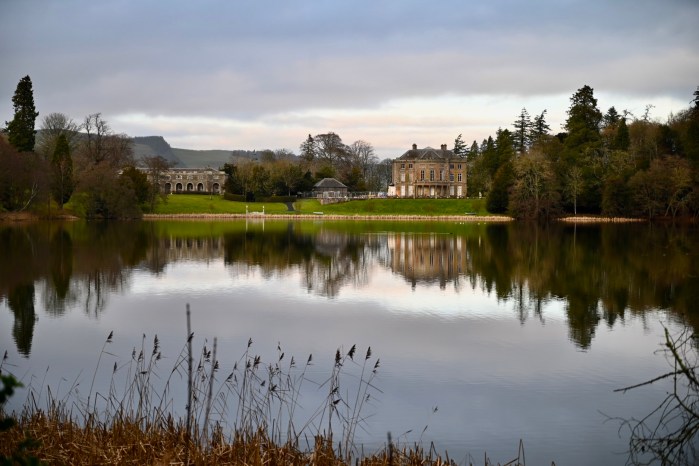
Lunch intervened at this point (can’t remember what or where now) and afterwards we walked up to the Haining Estate with its Palladian mansion house and loch. Originally built in the 1790s for the Pringle family, the last private owner, Andrew Nimmo Smith, bequeathed the house and stables to the people of Selkirkshire in 2009 and they are now managed by a charitable trust. When we were there the house was being refurbished as a centre for exhibitions and events, while some of the outbuildings had already been redeveloped as artists studios and holiday apartments.


Below the house, facing out over the loch, was an attractive row of classical statues and, beneath them, a pair Antonio Canova-inspired busts added in the 1820s to mark extensive additions to the estate.


And we met the Dandie Dinmonts again because this is where the breed originated. “Old Ginger” was born at The Haining on June 4, 1842 and today every Dandie Dinmont Terrier can trace its breeding back to him through its male line. His statue, by Alexander Stoddart, was erected in 2017 in the kennel yard.


Interestingly, we came across more about the history of Dandie Dinmonts on a recent visit to the new Scottish galleries at the National Gallery in Edinburgh. This dog, Callum, is on permanent display for reasons detailed in the information label below. Walter Scott gets everywhere!


One or two more 2022 posts to come, then I make it into 2023! Will I catch up with myself in 2024? Who knows … Linking this one to Jo’s Monday Walk (and yes, I know it’s Friday!)


I never knew there was so much to see in Selkirk! I liked that the library was in an old building with so much character and wonder what it’s like inside.
LikeLike
Nor did I! I’m not sure if the library was open – another time, I would definitely check.
LikeLiked by 1 person
Very interesting post and area. It’s in these wee border towns and villages or over in rural Fife that you sometimes find real oddities, like the metal face harness of the ‘scold’s bridal.’ or the cruel iron spikes of the ‘witches lament.’ Bob. BSS.
LikeLike
I know, those are horrific.
LikeLike
A lot of history there. Very interesting!
LikeLike
Thanks, it was!
LikeLike
We stayed in Selkirk once when the children were very small. I can’t remember seeing most of the places in your post – either not so observant or just getting senile and forgotten them! 😂
LikeLike
That was a while back though. Places just merge in my memory after a few years which is why having the blog is so good. And why I need to get my skates on to catch up!
LikeLiked by 1 person
As the offspring are now in their 30@s it definitely was a long time ago!!
LikeLike
😂
LikeLike
Lots of interesting history here but my favourite bit just has to be the dogs. Back when I was in my early teens a neighbour of ours had a DD who I would take for walks after school. I love the portrait of Callum, he looks cute 🙂
LikeLike
I thought you would like the dogs!
LikeLiked by 1 person
A friend has a bichon dandie dinmont cross rescue so it was interesting to hear about the breed. X
LikeLike
They look rather cute, I think!
LikeLiked by 1 person
I really enjoy reading about the history of all the lovely places you visit, Anabel. I haven’t heard of that type of terrier before but I bet now I’ve learned about it I will see more of them.
LikeLike
I only knew of Dandie Dinmonts because my mum loved dogs and one of her childhood pets was a DD.
LikeLiked by 1 person
Seems like Selkirk has a lot of monuments about war! At least there are the terriers, too.🙂
LikeLike
It certainly does! There were many battles between Scotland and England and the Borders were obviously prime territory for fighting over.
LikeLiked by 1 person
Golly, you really give a place a good going over when you visit it. I have spent most of my time in Selkirk looking for my golf ball.
LikeLike
Ha ha, we certainly do! Like to get as much out of places as possible.
LikeLiked by 1 person
Everyday is a good day for walking and exploring. Selkirk is all new to me. Good to top up my history knowledge, though don’t quiz me on it.
LikeLike
Wouldn’t dream of it, I’d fail a test myself! This is why I like to have a record of our travels and keep struggling on even when I’m a year behind.
LikeLike
A lot of gorgeous buildings 😍 and such an interesting history for that town.
LikeLike
Yes, there is a lot of history in all those Borders towns.
LikeLiked by 1 person
And that answers my unasked question about whether the Dandie Dinmonts were named after the character in Guy Mannering, or vice versa.
I used to stop for a break in Selkirk when I drove from Epping to Edinburgh, the Trossachs or the Highlands (pre guinea pig days!). Should have explored it more.
LikeLike
I was pleased to find that Dandie Dinmont portrait to complete the story!
LikeLike
Another very interesting post and another town I’d like to visit. Thank you.
LikeLike
Thanks for reading, glad you found it interesting,
LikeLiked by 1 person
So it’s not just Glasgow we need to visit … we’re going to have our work cut out …
LikeLike
Indeed – we’ve been up here nearly 40 years and still finding new places!
LikeLiked by 1 person
Hi Anabel – fascinating town, with lots of interesting history … I haven’t even reached into 2024 yet – starting on the 13th! You certainly spotted lots of landmarks … cheers and Happy New Year – Hilary
LikeLike
Thanks Hilary, all these Border towns are packed with history. So interesting!
LikeLiked by 1 person
That looks like an interesting town with lots of history. I love the little statue of the souter (I don’t think I’ve heard that word before) and the Dandie Dinmont statue too 🙂
LikeLike
Souter is Scots – Souter Johnnie appears in one of Burns’ poems. He was a real person and you can visit his cottage in Ayrshire (though I never have that I can remember).
LikeLiked by 1 person
Lovely virtual tour… didn’t realize you were so far behind in your posts. But you keep so active that I am not surprised. Maybe you could simply skip 2023 and jump right into 2024 though I know we would be missing lots of great adventures. (Suzanne)
LikeLike
I could, but I like to have a record for myself! And it would always niggle me that I had missed something. Glad you enjoyed the virtual tour.
LikeLike
I totally understand. The main reason we do the blog is for ourselves so we can keep track of our adventures. That other people find it interesting is a bonus. Good luck with catching-up.
LikeLiked by 2 people
Very interesting that FDR’s maternal ancestors date back to that town.
LikeLike
Yes, that surprised me.
LikeLiked by 1 person
Bless you, hon! Never been to Selkirk so it’s a pleasure. Thanks a lot!
LikeLike
Thanks, Jo, glad you like it.
LikeLike
🤗🩵
LikeLiked by 1 person