
SquaresRenew 27: Bogside murals

As in Belfast, in Derry we took a political walking tour, Bogside History Tours. The Catholic area of Bogside was the site of the infamous Bloody Sunday massacre in 1972 in which British soldiers opened fire on a peaceful protest march killing 13 men and boys outright. It was not until 2010 that the Saville Report exonerated the victims concluding that the killings were “unjustified” and “unjustifiable”. It found that all of those shot were unarmed, that none were posing a serious threat, that no bombs were thrown and that soldiers “knowingly put forward false accounts” to justify their firing.
Our guide, Paul Doherty, lost his father on Bloody Sunday. He showed us part of the route and where the victims fell, as well as taking us to the monuments and murals of the Bogside. I wasn’t sure whether to include these in a series on renewal. Are they just continuing the divide or do they represent remembrance and reflection and thus help the country in its move forward? I’ve come down on the side of the latter and I include three murals that I feel express that best, starting with the Dove of Peace at the top of the post.
Below is a reminder that the Troubles began in the mid-1960s as a peaceful Civil Rights movement aimed at ending discrimination against Catholics. The two placards refer to evidence that Catholics/nationalists were less likely to be given certain jobs, especially government jobs, and that in Northern Ireland, only householders could vote in local elections, whereas in the rest of the United Kingdom all adults could vote.

And finally, a mural showing John Hume, whom I mentioned in my Guildhall post, and fellow Nobel Peace Prize winners Martin Luther King, Mother Theresa, and Nelson Mandela.
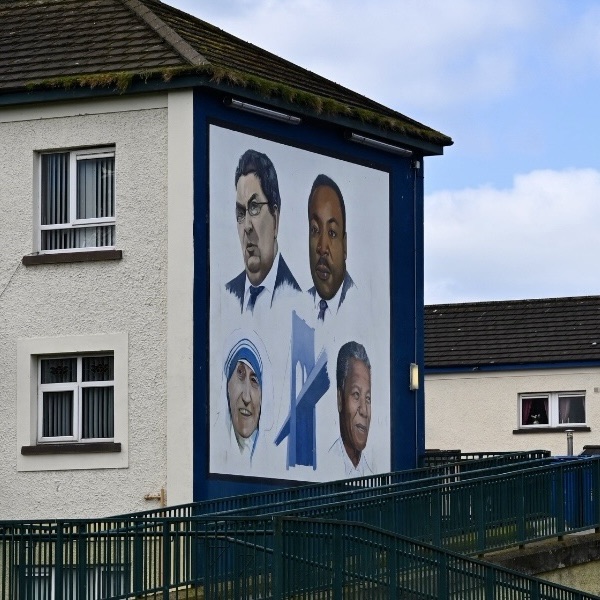
Part of Becky’s SquaresRenew Challenge, using images from our April 2024 trip to Northern Ireland to illustrate one or more of the following:
- Move forward
- Reconstruct
- Renew
- Burgeoning


The Dove of Peace is quite lovely.
LikeLike
And cleverly intertwined with the oak leaf.
LikeLiked by 1 person
We did see most of those murals. One thing that struck me about the housing estates over there was that they were not as bad or as deprived as I expected them to be. Many of the big Glasgow estates in the 1990s were far worse than anywhere we visited in Ireland. Unless the rough estates were knocked down since the troubles era. Also houses in the rural areas looked much better off, more prosperous, than the equivalent Scottish versions. That was a surprise. Bob. BSS.
LikeLike
I don’t know, maybe the UK govt put more money in while the peace process was ongoing? Just a guess, though it would make sense.
LikeLike
Those murals do indeed fit the theme well, and one was enlightening for me at least too, as I never knew that in Northern Ireland, only householders could vote in local elections!
LikeLike
That came as a surprise to me too. And the boundaries were all gerrymandered to prevent too many catholics being elected. Plus the discrimination in housing, jobs etc – shocking.
LikeLiked by 1 person
We were terrifically excited by the civil rights movement when it happened, but we were perhaps a little naive to say the least to imagine that things might change peacefully for the better.
LikeLike
I was too young to understand when it started so I wasn’t so much naive as clueless!
LikeLiked by 1 person
I am still clueless but a bit less naive.
LikeLiked by 1 person
We visited some time ago, the murals seem to have changed. Less aggressive and intimidating in your selection.
LikeLike
No, the boy in the gas mask and Bernadette Devlin are still there, I just chose the most peaceful looking ones for this post.
LikeLiked by 1 person
Most interesting post, Anabel,and it has increased my understanding of events
LikeLike
Thanks, Sue, mine too!
LikeLiked by 2 people
That sounds like an unusually thought-provoking walking tour. Non-Irish UK citizens didn’t have a lot to be proud of in all this, did we? As I’ve only recently begun to find out.
LikeLike
Indeed we didn’t, in fact hard to think of a place in the world where being British might be seen as a matter of pride.
LikeLiked by 1 person
Depressing, isn’t it?
LikeLike
‘Fraid so 🙁.
LikeLiked by 1 person
Nice post & pictures. We went around the Bogside area (on our own) looking at all of the murals. I remember seeing the 3 you are presenting in this post. (Suzanne)
LikeLike
I didn’t realise until the tour and looking into it a bit more for this post how long they had been there, and how unchanging they were. I got the impression the ones in Belfast changed regularly, on the Falls Rd at least where our guide said his brother was one of the mural painters. All were currently pro-Palestinian murals.
LikeLike
I didn’t know either. Also didn’t know that the Belfast ones were ever changing which is probably a good thing. You don’t dwell too much on past events but make a commentary on current ones…
LikeLiked by 1 person
There have been so many conflicts over the millennia. It’s human nature.
LikeLike
Sadly, it seems to be. We progress and then regress.
LikeLiked by 1 person
Lots of squares within your first square. Bloody Sunday was, a disaster, but I remember a young lad who was a soldier serving over there at the time, who had lost several of his unit. He was understandably frightened and dreading having to return after leave.
LikeLike
I never thought of the squares within the squares, but so there are! I think I read that they are symbolic too – equal sides. It would be awful for the ordinary soldiers too, agreed.
LikeLiked by 1 person
Great to see all of this. The Troubles were so much part of the news back in the day.
LikeLike
I know. It seemed incomprehensible at the time (I was very young when it started) but this visit has really increased my understanding.
LikeLike
I am with you, I think seeing it all and acknowledging what happened and recognising its impact is the only way to move forward. It would be even more challenging if things were ignored or deliberately forgotten. And it is such recent history
LikeLike
I think so. I did read up a bit more about it before writing this post and it seems that even the murals which document violence have symbols such as a broken rifle to show it is past.
LikeLiked by 1 person
So many injustices from the past, Anabel. It’s taken a long, long time to put it behind us and move forward, but I’m so glad they have.
LikeLike
I’m hopeful that is the case, but peace is always a fragile thing anywhere in the world.
LikeLike
You’re not kidding! How long have we had the prayer mat out for the Ukraine and Gaza?
LikeLike
And it just gets worse 😢. But NI, apartheid and the Berlin Wall are my talismans. If they could reach some sort of, even imperfect, resolution there is hope for other places.
LikeLiked by 2 people
That looks like a very dense built-up area in your first shot. I really like the third mural, any idea who painted it?
LikeLike
The Bogside is very dense – that was taken looking down from the walls and zooming in, so it is even more dense when you see it all spread out. From Wikipedia:
The Bogside Artists are a trio of mural painters from Derry, Northern Ireland, consisting of brothers Tom and William Kelly, and Kevin Hasson (b. 8 January 1958). Their most famous work, a series of outdoor murals called the People’s Gallery, is located in the Bogside neighbourhood of Derry and depicts the events surrounding sectarian violence and civil rights protests in Northern Ireland during the Troubles.
LikeLiked by 1 person