
A day out in Alloway
Robert Burns (1759-1796) is widely regarded as Scotland’s national poet, or Bard, and is celebrated worldwide – if you know nothing else of his work you will surely have sung Auld Lang Syne at New Year. Many years ago we visited the cottage in Alloway, Ayrshire, where he was born, but to our shame we haven’t returned since it became part of the “new” (2009!) Robert Burns Birthplace Museum run by the National Trust for Scotland. A recent series of posts on Photos by Jez inspired us to put that right last week. Thanks Jez!
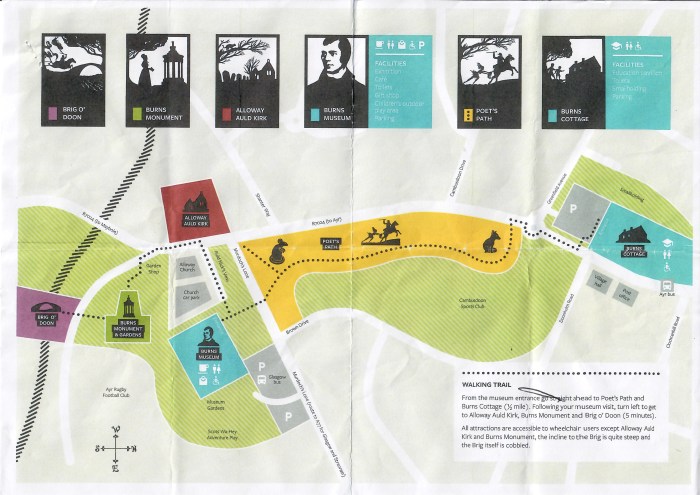
Forgive the rather creased looking plan at the top of the post – it spent a long time in my back pocket! I’ve included a scan because it helps to make sense of the site and I couldn’t find it online. I’ll deal with the sections in the order in which we visited them.
Burns Museum
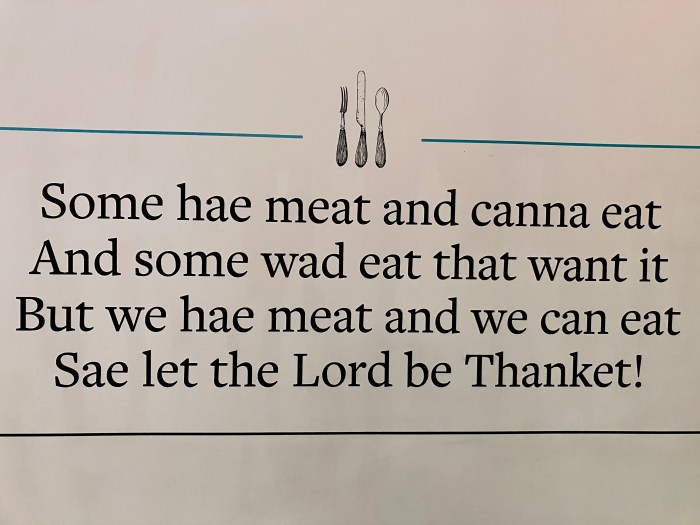
We were impressed with the modern museum building and the exhibits themselves. What really surprised us was how much material has survived, particularly the handwritten manuscripts, many of which have recently been made available online. Burns quotes are painted on the walls – appropriately, the Selkirk Grace appears just outside the café. In case you were wondering, we had both morning coffee and lunch there and can report that it is very good.
Burns Monument and Gardens
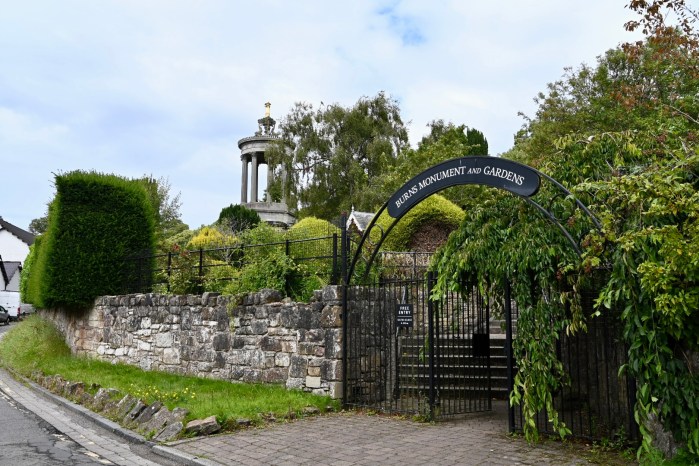
This is where Burns tourism started! A 21m (70ft) high Grecian-style temple, designed by Sir Thomas Hamilton Junior and complete with nine pillars representing muses from Greek mythology, was funded by subscriptions and opened in 1823.


Brig O’ Doon
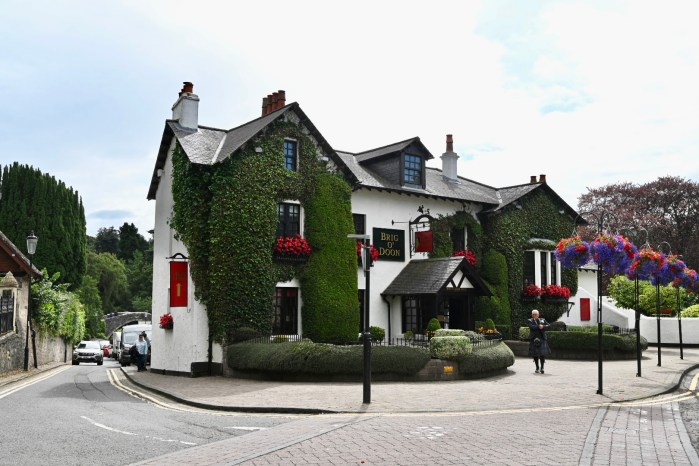
This bridge over the River Doon dates from the 1400s and has twice been saved from demolition because of its connections to Burns who used it in two of his works, The Banks o’ Doon and Tam o’ Shanter. In one of the views taken from its span (and, oh, those cobbles, were hard to walk upon) the monument can be glimpsed top right.


Alloway Auld Kirk

The 16th century Auld Kirk, already a ruin in Burns’ time, also features in Tam o’ Shanter. Burns’ father is buried here: the epitaph on the back of his headstone was composed by the Bard himself.


Many of the other grave stones were intricately carved.


Across from the Auld Kirk is the current church. I was amused by the street sign – Auld Nick’s View!


The church was open so we went in. Even the porch was lovely with a mosaic floor, carved heads above the door and two beautiful little stained glass windows.


The windows inside were even more stunning. At the east and west ends there were traditional 19th century windows.


What really caught our eye were the more modern windows, three of which by Susan Bradbury are shown below. We were so glad we had taken the opportunity to look around.


Poet’s Path

The footpath between the Museum and Burns’ Cottage has ironwork signage by Timorous Beasties, celebrating scenes from Tam o’ Shanter, and a variety of playful sculptures.


Burns’ Cottage

Finally to the four-room cottage where Burns was born and lived until the age of seven, sharing the tiny box bed with three of his siblings. Four nightgowns hang above the bed to represent the children, including an Anabella! The land round about the cottage has been turned into a small-holding – and there’s Tam o’ Shanter again on his horse, Meg, as well as the poet himself.


Time for tea? We visited Poet’s Corner Tearoom across the road from the cottage. No pictures of that, but I loved the Post Office next door which had matched its floral decorations with the pillar box. Beautiful!

Then it was back along the Poet’s Path to the museum car park and the drive back to Glasgow. A grand day out and less than an hour from home – highly recommended.


He’s such a giant of Scottish poetry and I’m not entirely sure why, is it because he wrote in the Scottish vernacular?
LikeLike
I grew up in the English school system so never studied Burns and thus have no ready answers, but I’ll have an uneducated bash! He wrote mostly in Scots as you say, though I don’t think language can be the complete explanation. He was prolific and told entertaining stories (eg Tam o’ Shanter) and had strong views on social conditions (eg A man’s a man for a’ that). Many of his poems are sung which might also add to their popularity. It must have been very clear on his death that his work deserved to be kept for posterity because there are so many handwritten manuscripts extant. That really impressed us.
LikeLike
Interesting thanks
LikeLiked by 1 person
We did a little road trip in Dumfries and Galloway and Ayrshire counties just after Covid. We didn’t visit Alloway as such as we arrived in the evening so only saw the old bridge and went to eat in the pub that served us delicious food.
LikeLike
Something to go back for! Your son might like the sculptures.
LikeLiked by 1 person
What a fabulous day trip! Alloway looks beautiful. My Mum used to recite Burns’s poetry to us when we were kids, so I have a soft spot for his work.
LikeLike
It was a really lovely day out.
LikeLiked by 1 person
Alloway looks a beautiful day out with so much to see and photograph! Looks like a fab place to visit.
LikeLike
It was, we were delighted with it.
LikeLike
It looks like the National Trust of Scotland has done a grand job with the Robert Burns museum and you’ve done a superb job of writing up your visit and showing all your photos. Loved the stained glass windows.
LikeLike
I think they have, especially the way they have drawn everything together and made the whole site so interesting. Glad you liked the post!
LikeLiked by 1 person
What a gorgeous property! Just a visit to the gardens alone would be worth the drive. Loved all the sculptures.
LikeLike
Yes, it was really lovely and the Trust has done an excellent job looking after the whole site.
LikeLiked by 1 person
What a lovely village and so much history! It’s always a good day out when you combine gorgeous scenery, lovely weather, and interesting sights.
LikeLike
You are so right! Very often we only manage two out of three – as you can probably guess it’s the weather which lets us down!
LikeLike
Great set of photos. Not been down that way myself for at least six years. Looking even better now. Bob. BSS.
LikeLike
I imagine it is developing all the time. Very impressed!
LikeLike
Just as well you did go for a second visit after all this time because it looks like a great way to spend a day. I love how there is so much to see and it all really tells his story well.
LikeLike
Yes, they have done a great job linking all the elements together, and the museum itself was well structured too.
LikeLike
Our kind of outing!
LikeLiked by 1 person
Hi, Anabel – I love galivanting with you. I continue to learn so much here. I had thought I knew a fair bit about Robbie Burns. Now I know much more!
LikeLike
There was such a lot about his life and works in the museum that I didn’t know either. Always good to learn!
LikeLiked by 1 person
A grand visit. Lines from his poetry often run uninvited through my mind.
LikeLike
It has that effect!
LikeLiked by 1 person
Fabulous stained glass, Anabel. Definitely an excellent day out.
LikeLike
That was a complete bonus because we didn’t know about the windows until we went in and the two ladies on duty asked if we had come to see them.
LikeLiked by 1 person
Serendipity!
LikeLiked by 1 person
Does look like a great day out!
LikeLike
Yes, one of those where you wonder why you haven’t done it years ago!
LikeLike
The added bonus is the poet’s walk on a lovely day to digest all you have seen. I would love to visit this place.
LikeLike
That was lovely, I didn’t know about the walk and the sculptures till I read Jez’s posts.
LikeLike
Well this looks like a splendid place to visit. I had a wonderful virtual wander with you. Those windows are very beautiful, I do like to find modern stained glass in religious buildings. And the headstones are intriguing. I was very taken by some of the headstones in Scottish churchyards when we were up there.
LikeLike
It was really great, Jude. We had a lovely day. I love old graveyards like this too.
LikeLiked by 1 person
What a lot there is to see there! And everything seems to be so well presented, from museum to cottage and path in between. But my favourites would be the modern stained glass in the church – it looks stunning!
LikeLike
Loads to see! And still things to go back for, It was indeed very well presented.
LikeLiked by 1 person
Hi Anabel – what a fascinating tour you’ve given us … thanks for all the interesting snippets; I’m somewhat baffled at the Grecian temple … being built in 1823 … promoting the nine muses – I don’t know Burns’ work … and I’m sure it’s very pertinent. I’d come across similar when investigating Angelica Kauffman, part of the Blue Stocking 1700s set – albeit she was more recognised as an artist – noted as a muse. It does look a well tended museum and gardens … what a lovely visit – especially with good foodie breaks! Thanks – cheers Hilary
LikeLike
It was a very well tended site, Hilary. There was a competition to design the monument and I don’t know why the Greek Revival style was chosen. Maybe it was just popular at the time?
LikeLiked by 1 person
This looks as if there’s plenty to tempt the traveller to explore and linger.
LikeLike
Yes, there was a lot more to it than we expected. And there are still other Burns sites round about to go (back) to.
LikeLiked by 1 person
Thanks so much for the lovely (as always) photos, Anabel. My dad used to make stained glass figurines (and was a Presbyterian minister whose church had a window very much like first of the contemporary ones in the one in Alloway). So that brought fond memories.
LikeLike
What a lovely talent to have! My father was a Methodist minister.
LikeLike
It’s great that Burns is still revered in Scotland. And thanks for showing and writing about the River Doon. I’d never heard of it before.
LikeLike
Revered all over the world I think – very popular in Russia for some reason!
LikeLiked by 1 person
What a poetic and scenic walk along the poet’s path. So much to see and learn about Robert Burns and his life! I’m so glad they haven’t demolished the Brig o’Doon. It is so scenic and would really be a shame if they did. I’m sure the cobbles were hard to walk on! I walked all the way down a steep hill covered in cobbles on my way into Rome on the Via Francigena and I thought for sure I’d twist my ankle. 🙂
LikeLike
They have certainly done Burns proud. I was VERY careful on the cobbles as my ankle was already dodgy!
LikeLike
Well, you definitely had a Good Day Out, Anabel!
LikeLike
We definitely did!
LikeLiked by 1 person
Looks like a good day out Anabel, and less than an hour from home too. I like the dogs and other creatures on the Poet’s Path and the stained glass windows especially the bottom three, they are stunning😊
LikeLike
The sculptures are fun! We hadn’t planned on visiting the church, but it was open and there were two very welcoming ladies on duty so we were glad we went in.
LikeLike
I visited Burns Cottage in 1973! It was pouring with rain at the time, so we didn’t explore much else. Your pictures stir a desire to venture that way again, should we be fortunate to travel abroad again.
LikeLike
We were so lucky with the weather last week! I think our previous visit to the Cottage was probably 1990s, or even 80s, and we also took in Souter Johnnie’s Cottage and the Tarbolton Bachelors Club, but we’ll have to visit them again separately because there was no time after the main museum.
LikeLiked by 1 person