
London: a women’s history miscellany
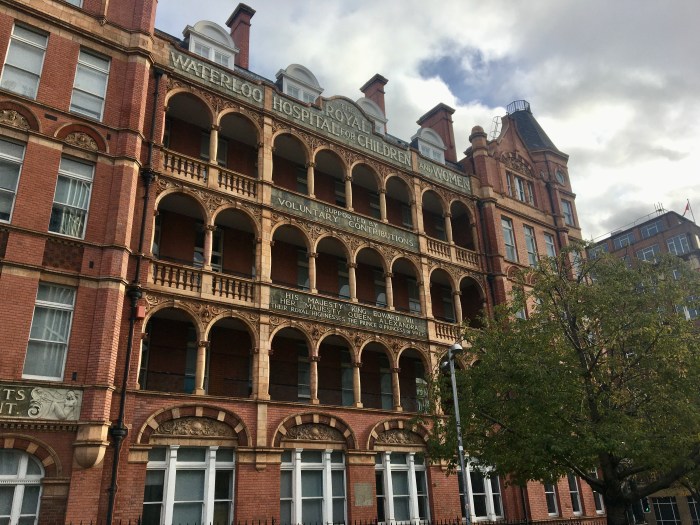
We’ve had three visits to London over the last couple of years. As you know, I always keep my eyes open for evidence of women and their history so I thought I would gather together relevant images from all three trips. A large number have medical connections, starting with the former Royal Waterloo Hospital for Children and Women building (above) which dates from 1903-05 and is now student accommodation.
In a particularly dark episode in the 1960s and 70s its psychiatric ward, run by Dr William Sargant, treated 500 patients, mostly young women, who were subjected to experimental and often dangerous treatments:
They included the ‘Narcosis’ or sleep room where patients suffering depression could be effectively put into a coma for up to 3 months at a time. This was done without the full knowledge and consent of the patients and tragically led to the death of some and life changing mental effects on others.
Sargant retired in 1973 taking all his medical records with him. This is the kind of history which stops me in my tracks – such horrific things were happening here in my lifetime.
Another former hospital is the Elizabeth Garrett Anderson Hospital for Women on Euston Road (shown below). Elizabeth was the first woman to train as a doctor in the UK and founded the New Hospital for Women in 1872. She raised the funds for this building which opened in 1890 and functioned as a hospital into the early 21st century. It now belongs to a Trade Union, UNISON, though it still includes an exhibition gallery about Elizabeth. The opening hours were quite restricted and unfortunately I was never nearby at an appropriate time to visit. Sadly, on checking the website for this post, I see that it is now closed to visitors until further notice – a missed opportunity. Elizabeth’s name lives on in a wing of University College Hospital.


The sculpture below is Unity by Wendy Taylor CBE (2010):
The rings represent a symbol of collective strength and solidarity, which links UNISON with the work of Elizabeth Garrett Anderson and all pioneering women everywhere.


Staying with the medical theme, the first statue below – Florence Nightingale – will need no introduction. She stands on Waterloo Place. The other, in Tavistock Square, is Louisa Brandreth Aldrich-Blake (1865-1925). In the first of many links and overlaps as this post meanders on, she was Surgeon to the Elizabeth Garrett Anderson Hospital (1895-1925). She was also Consulting Surgeon at the Royal Free Hospital (1919-1925) and Dean of the London (Royal Free Hospital) School of Medicine for Women (1914-1925). She died of cancer, aged just 60. I had never heard of Louisa and am pleased to add her to my roll-call of amazing women.


A couple of plaques now, one near Bloomsbury Square which commemorates the foundation of the Association of Women Pharmacists in 1905, and the other on the wall of the Royal Free Hospital School of Medicine commemorating Winifred Cullis (1875 -1956), the first woman to hold a professorial chair at a medical school and only the second woman in the UK to be appointed to a chair at a British university-level institution.


Moving from medicine to the suffrage movement, below are a plaque to the Pankhursts which I spotted on Russell Square, the statue in Parliament Square of Millicent Fawcett, leading suffragist and sister to Elizabeth Garrett Anderson (I told you there were lots of links), and a plaque to Sarah Parker Redmond. The latter could just as easily have been included in the medical section, because as well as an abolitionist and suffragist she was also an obstetrician.


From women struggling to get the vote to women who gained political power by an accident of birth – Queen Victoria on the Strand and Mary Queen of Scots sitting above a branch of Pret on Fleet Street. You can guess which class of women I admire more!


War can be regarded as a failure of politics – below are references to the First and Second World Wars. Again there is overlap with the medical section because the statue is Edith Cavell, a British nurse celebrated for treating wounded soldiers from both sides without discrimination and for helping about 200 Allied soldiers escape from German-occupied Belgium. Cavell was arrested, court-martialled under German military law, and sentenced to death. She was executed at dawn on October 12th, 1915.
The Monument to the Women of World War II was unveiled in Whitehall in 2005 and features 17 different uniforms and helmets sculpted as if hanging on pegs. These represent the hundreds of vital jobs undertaken by over 7 million women during the war, a contribution which is often overlooked.


I passed this church at 17:30 on a November afternoon, so forgive its lack of clarity. St Mary le Strand is the Church of the Women’s Royal Naval Service.


Literature next! Back to Tavistock Square where Virginia Woolf lived from 1924 to 1939 and wrote many of her greatest novels, including To the Lighthouse. Woburn Walk, a Georgian lane much used by film makers, was home to Dorothy Richardson (1873-1957) the author of Pilgrimage, a sequence of 13 novels which emphasised the nature of female experiences. And I can’t resist including the offices of DC Thomson in Fleet Street with the names of its brands emblazoned across it, including The People’s Friend, a women’s magazine beloved by many including my late mother.


Ever since reading about it on A bit about Britain I have wanted to visit Cross Bones on Redcross Way in Southwark. In November 2022 we did so. I’ll briefly describe its origins here, but I commend to you Mike’s article, linked above, for an in depth and thought provoking history.
Cross Bones is thought to have been established in the 17th century as a single women’s cemetery. For single women, read prostitutes, also known as Winchester Geese because they were licensed by the Bishop of Winchester to work within the Liberty of the Clink, an area outside the jurisdiction of the City of London where brothels and other activities not permitted within the city could be found. By 1769, Cross Bones had become a paupers cemetery and remained so until its closure in 1853, by which time as many as 15,000 people are believed to have been buried there. Today it is a memorial garden run by Bankside Open Spaces Trust. As well as honouring the sex workers of the past there are other commemorations, for example a section with Japanese Mizuko jizo statues in honour of babies lost to miscarriage or still birth. I found the whole garden very moving.


And now for something completely different – a wine bar, El Vino on Fleet Street. At one time women could not be served, or even stand, in the main bar but were confined to table service in a back room. After the Sex Discrimination Act of 1975 was passed there were several unsuccessful legal attempts to overturn this policy but it was not until Gill and Coote v El Vino Co Ltd went to the Court of Appeal in 1982 that the ban was overturned. Some of the defence arguments are really quite hilarious in their sexism, such as that it might be be embarrassing for staff to “procure wine from floor level through the legs of a lady who happens to be standing by the wine racks”. Ever heard of “Excuse me”?


I’ll end with some links back to previous posts. The bust in the gallery below is Elizabeth Pepys in St Olave’s Church, wife of diarist Samuel and last written about in October 2023 (In the footsteps of Pepys). I only noticed the small metal objects embedded in the pavement on Marchmont Street in Bloomsbury on our most recent visit in July this year. I had no idea what they were, but Googling the name on one of them, Meriah Duchesne, I discovered that they were linked, indeed led the way, to the Foundling Museum which we had visited in November 2022. Mothers would leave small tokens with their babies as identification should they be in a position to reclaim them from the Foundling Hospital in later years. The artist is John Aldus (2010). So poignant.


Finally, three women already met from the lightbox installation St Marylebone’s Changing Faces which I visited in May 2023. Bringing us almost back full circle, one of them is Elizabeth Garrett Anderson.


I find it really helpful to have a theme in mind on my walks around cities – it makes me much more observant. Some of the sights above were sought out deliberately, but a great deal of serendipity was involved, and many were snapped and forgotten about till I came to write this post. I’ve learned a lot by looking them up. I hope you have too.


How wonderful, touring many familiar places but with such a fresh feminine lens. I feel as if I know nothing at all, oblivious to half or more of London’s citizens, the more vital half.
LikeLike
I keep my eyes open everywhere now for evidence of the women.
LikeLiked by 1 person
Well, now I have always done that in my own masculine fashion. But your exploration goes well beyond the aesthetics!
LikeLike
LOL, I meant, of course, the women’s HISTORY!
LikeLiked by 1 person
Hi Anabel – well you’ve certainly ‘uncovered’ many interesting women for us – some known, some new ones – and the only two I can think of that you’ve not included, I’m sure for lack of time, as opposed to forgetting about … Mary Seacole, outside St Thomas’, and Edith Cavell off Trafalgar Square. Those tokens embedded into the pavement are very poignant … The Foundling Hospital has an essential part of our lives today. Great post – and yes Mike does write some extraordinary articles – cheers Hilary
LikeLiked by 1 person
Well, Edith is definitely in the post! I haven’t yet been to visit Mary Seacole, not been in the right area, but I will someday.
LikeLiked by 1 person
Tells you I didn’t read it all properly – sorry! Happy long night … cheers Hilary
LikeLiked by 1 person
You certainly made some interesting discoveries. The cross bones cemetery and the once very sexist wine bar especially.
LikeLiked by 1 person
Thanks Sharon- I did, didn’t I! I was amazed at some of the stories I found.
LikeLiked by 1 person
Many of the old institutions had pretty grim methods, even in the 1960s and 1970s as I worked in some of them as an apprentice in Glasgow. Like the Redcross Way murals/sculptures. ( been offline last 3 weeks due to fault on outside pole.) Bob. BSS.
LikeLiked by 1 person
Thanks, Bob. I’m glad to see you pop back up! I thought Blogger must have hacked you off again.
LikeLike
Such an interesting post Anabel. I learnt a lot.
LikeLiked by 1 person
Thanks, Mélodie, glad you liked it. I found some of the stories quite eye-opening!
LikeLiked by 1 person
This is such an interesting post (as usual). The wine bar’s outrageously sexist policy, as well as their lame excuses, particularly caught my attention.
LikeLiked by 1 person
Thanks Donna. The wine bar was quite a shocking case!
LikeLiked by 1 person
Lo and behold, One Crossbones Graveyard comes along, and then another one close behind! https://alondonmiscellany.blog/2024/10/23/wordless-wednesday-49/
LikeLiked by 1 person
Amazing!
LikeLike
Hey! Stop scrolling! Get on that train!
LikeLike
Still got over an hour!
LikeLiked by 1 person
Fascinating! As for the psychiatric unit functioning in our lifetimes (I’m about your age, I think), it reminds we why we can’t be satisfied to simply say, “If it’s science, it’s right.” There have always been scientific experiments carried out on humans, often without their permission. Science always has to be tempered with morals and mercy, in my opinion. And as for women, it is encouraging to see how far we’ve come, but we still have a long way to go. Great post!
LikeLiked by 1 person
Thanks Ann. I totally agree. Only last week a member of the uk government suggested experimenting with using weight loss drugs as a means of getting people who were long term sick back to work.
LikeLike
Splendid. I learned so much..
LikeLiked by 1 person
Thanks Geoff, that’s a true compliment coming from a Londoner.
LikeLiked by 1 person
Horrified at Edith Cavell’s ending. Why did I not know that about her? I should pay as much attention as you do, Anabel.
LikeLiked by 1 person
Thanks Jo, it’s only in the last decade or so that I’ve been paying as much attention as I do. Edith’s story combines heroism and horror. Not that we need much reminding about the horrors of war at the moment, humans never seem to learn.
LikeLiked by 1 person
This is a great collection of women and their achievements. I always think of you when I come across a commemoration like these.
LikeLiked by 1 person
Thanks Carol. Always happy to raise awareness of women’s history!
LikeLiked by 1 person
I really appreciate all the women’s history you compile. So much we take for granted today, but as you point out, also many abuses occurring (and still!) in our lifetime. Sigh.
LikeLiked by 1 person
Thanks Eilene. It is increasingly obvious that history cannot be regarded as linear progress.
LikeLiked by 1 person
Terrific photojournalism. These women would have appreciated your efforts and your diligence.
LikeLiked by 1 person
Thanks Neil – I’m sure they would appreciate being remembered. I’m not sure I could ever be as brave as most of them!
LikeLiked by 1 person
I really like the way that you tour with a purpose. It makes for very interesting posts for your readers.
LikeLiked by 1 person
Thanks Tom, it certainly adds interest for me to what could otherwise be aimless wandering.
LikeLiked by 1 person
I feel quite proud to be a woman after reading these astounding stories and yes sadly we are still fighting on various issues. It was a fascinating read, thanks Anabel.
LikeLiked by 1 person
Thanks Suzanne – definitely some true heroines in there. I was glad to find out about them.
LikeLiked by 1 person
Fascinating and totally absorbing to read and see all that you discovered on your visits. I certainly need to be more observant when I visit places! My grandmother gave me The Girls’ Book of Heroines in the 1950’s which still resonates with me and some of your ladies mentioned above feature in the book. I wonder who would feature in a modern book of heroines?! Thank you for such a great post.
LikeLiked by 1 person
Thank you – glad you enjoyed it. We have some modern books of that type in the women’s library – they include young women such as Malala and Greta Thunberg.
LikeLiked by 1 person
Thanks for reminding me about Malala and Greta!
LikeLiked by 1 person
I really enjoyed the theme of this blog post and the idea of engaging in a particular focus of one’s wanderings around a city. It is always interesting to learn from history and I agree it can be a shock to the system to realize that some of these historic failings by society were happening within our lifetimes. It really sharpens the mind on what things are happening right now that we need to shine a light on and get activated about. Women’s rights are, for instance, very much back on the ballot in the imminent US election and I am extremely anxious about the outcome.
LikeLiked by 1 person
Thanks Laura. You are right, there are so many things that seem to be going backwards at the moment, including reproductive rights. It doesn’t just happen in the US, but obviously what happens there has a great effect on the rest of the world. For that reason, I’m also anxious about the result and can’t quite believe how it can be so close. It’s terrifying.
LikeLiked by 1 person
It is ridiculously close and the polling really tells us nothing as I doubt it’s an accurate barometer. Election day falls on my birthday so I am hoping for a gift that allows me to breathe a sigh of relief.
LikeLike
🤞🏻for us all.
LikeLiked by 1 person
I’m in awe of your detailed appreciation of all this women’s history in London. And horrified by your first story. I too need to follow a themed walk or two in my own visits.
LikeLiked by 1 person
Thanks, Margaret. So much of this, including the horrific hospital story, I only discovered when looking for background for the photos I had taken.
LikeLiked by 1 person
What an incredibly informative post Anabel. I had heard of the medical women and knew of that monument to the women of the Second World War but never seen it. But what blew me apart was the fact that women were segregated until 1982 in bars? That blows my mind. They got to vote in 1918 but couldn’t walk into one section of a pub…
LikeLiked by 1 person
Thanks Bernie! El Vino was a notorious and specific case – not all bars were like that, though I know of one in Glasgow which banned women till the early 70s.
LikeLike
It boggles my mind as I grew up in Canada and our female sense of freedom is pretty entrenched.
LikeLiked by 1 person
A thoroughly informative post! Quite a lot I knew, as a Londoner, but you’ve managed to show me several new things despite my decades living here! I’ve never yet managed to get inside Cross Bones (it was locked on both my visits to date) and I didn’t know there were Jizo statues there. They fascinated me when in Japan, especially Nikko, so I must make a point of visiting these. And somehow I’ve never spotted the metal objects on Marchmont Street although I must have walked it much more recently than 2010!
LikeLiked by 1 person
Thanks, Sarah. It’s amazing how much is hidden in plain sight! We didn’t notice the metal objects in the pavement when we were staying in that area and actually visited the Foundling Museum. It was only on a later visit that I happened to look down, spotted one and wondered. Unfortunately we didn’t have time to follow the whole trail to see them all. They are such a lovely idea.
LikeLiked by 1 person
I’ll try to follow it all some time – or we could do it together next time you’re in London!
LikeLike
A good plan!
LikeLiked by 1 person
A fascinating read, much enjoyed. Will be adding Crossbones to the list for my next London trip.
The history of the Waterloo hospital is chilling and the fact that the doctor in question took his notes even more so.
Did you spot any of the history of the maternity hospital around Cathedral quarter when you were here in Belfast? I’ve fallen down the rabbit hole a bit with it all, I have thought of you as I’ve been digging!
LikeLiked by 1 person
Thanks Helen, I did not! Other than the Cathedral itself we didn’t spend much time in that area. More reasons tho go back – and I look forward to reading about what you found in the rabbit hole some day.
LikeLiked by 1 person
I have indeed learned a lot – thank you very much!
LikeLiked by 1 person
Thanks Anne, glad to hear it!
LikeLike
This is a lovely thematic tour. I totally agree with you that having a theme in mind would make more observant. Lots of London details I have never noticed before even though I have been to the city many times…(Suzanne)
LikeLiked by 1 person
Thanks Suzanne. I’ve got to the point where women’s history just seems to jump out at me!
LikeLike
What an incredible post – so many I hadn’t heard of. An excellent post – now wondering what women I can tell you about when you are in BOA! I might have to go and buy a book from one of my neighbours before you get here as they have an amazing tale about one.
LikeLiked by 1 person
Thanks Becky. I shall of course be keeping my eyes open for interesting women 👀! Apart from you and Margaret that is.
LikeLiked by 2 people
Well clearly us two will be stars 🌟 but hopefully I can also impress with the first woman to fly solo around the world!
LikeLike
Clearly! And I am all agog for your revelations.
LikeLiked by 1 person
Some great stories there and pictures.
LikeLiked by 1 person
Thanks, Andrew – I was surprised with how many stories I had collected when I started to sift them out.
LikeLike
As always, a very interesting post. I love the mural with the cats and the section on Cross Bones – what a moving and poignant place. I’ve never heard of it before so I’m off to read Mike’s post about it now 🙂
LikeLiked by 1 person
Thanks Eunice, I didn’t know about Cross Bones either, so that post was very useful. I’m glad to have visited.
LikeLike
Ah my fault I should have mentioned them when you were last in Winchester!
LikeLike
Not your fault! Mike’s original article was 2020 and we visited in 2022 so I’ve been sitting on it a long time.
LikeLiked by 1 person