
Jessie Stephen: Maryhill’s Suffragette

For some time I have been working with Aurora Segnan, Heritage & Operations Coordinator at Maryhill Burgh Halls, to stage an exhibition about Jessie Stephen – Suffragette, Labour and Trades Union activist. I’m delighted to report that it opened on March 11th and will run until 13th June.
Maryhill Burgh Halls: Jessie Stephen
Jessie, who spent her formative years in Maryhill, is one of the few Scottish working class Suffragettes we know much about. Working class women could not afford to be caught and sent to prison because they often had families depending on them, so they tended to remain anonymous. Jessie never married and dedicated her whole life to activism. This public career, her unpublished autobiography, and several interviews she gave in the 1970s mean she has left her mark on history.
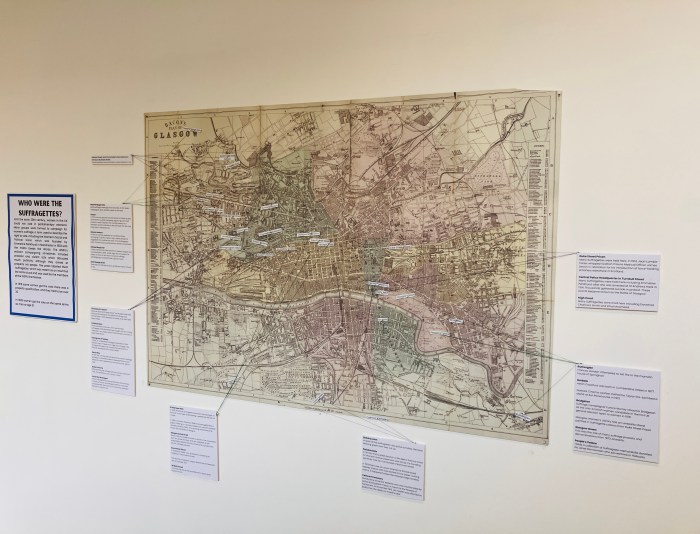
Before going on to tell the story of Jessie’s life the exhibition starts with a brief explanation of who the Suffragettes were and a map of some of the suffrage activities in Glasgow.
Life in Glasgow
Jessie was born in London in 1893 to a Scottish father and an English mother. When she was about two years old the family moved to Edinburgh, then Dunfermline, before finally settling in Glasgow. Their home was in Rolland Street, demolished in the 1970s, but you can still just see a tiny bit of it emerging on to Maryhill Road. A new school has been built on the main site – Jessie would have liked this.


Jessie was the eldest of 11 and worked hard helping her mother with the younger children and taking jobs before and after school, such as delivering laundry. The children all attended Sunday School and Socialist Sunday School. Jessie did well academically and hoped to become a teacher, but in 1908 her father, a tailor, found trade so bad that she left school to help support the family by becoming a domestic servant.

Jessie chose this role because food and lodgings were provided which meant she could send more money home. Her first employer, Mrs Harvey of Burnbank Terrace, was reasonably pleasant to work for but a later employer, Lady Chisholm of Belhaven Terrace, sacked her when she twisted her ankle in the course of her work. Influenced by her father’s socialism, Jessie was already politically active, becoming Vice Chair of Maryhill Independent Labour Party aged only 16, and a strong believer in Trades Unions. Her treatment by the Chisholms prompted her to create the Scottish Domestic Workers’ Federation in 1913. This involved organising not just meetings of servants but addressing their employers too – as a result she got 2 hours off every day for her members and an agreement that all uniform would be paid by employers.


Alongside these activities Jessie joined the Women’s Social and Political Union, or Suffragettes. One of the campaigns she took part in was attacking pillar boxes with paint or acid. Dressed in her maid’s uniform, she looked completely unsuspicious and was never caught. For this she has been commemorated in the Great Tapestry of Scotland Women get the vote panel. The pillar box next to it in the gallery above is Edwardian and right opposite Belhaven Terrace where Jessie worked – could this be one of those she attacked?
Life after Glasgow
During the First World War Jessie was recruited by Sylvia Pankhurst to work for her Workers’ Suffrage Federation in London, and she never lived in Glasgow again. When some women got the vote in 1918, Jessie was not one of them, because she was under 30 and owned no property. Women over 21 did not get the vote until 1928.
Jessie believed this was just the beginning and continued to campaign for equality in all areas of life. She served as a councillor and tried unsuccessfully to become an MP several times between the 1920s and 1960s.

To finance her activism, which included two speaking tours of North America in the 1920s, Jessie worked at a variety of jobs, including in Trades Unions, as a freelance journalist, running a twopenny library, and taking over an ailing typing service which she turned into a thriving secretarial agency and training school. However, one thing she would never do was move to a job for a higher salary if it violated what she stood for. Wherever she worked, she always fought to unionise and to get better conditions for workers, especially equal pay for women.

Jessie finally settled in Bristol in the 1940s where she became the first woman president of the Trades Council. Her work for the Trade Union movement was recognised by a TUC Gold Medal in 1955 and an MBE in 1977. She died in Bristol in 1979.
Remembering Jessie
As well as telling the story of Jessie’s life, the exhibition includes a collection of memorabilia about her, such as:
- A mug produced as part of Journey to Justice Bristol 2017.
- Commemorative material from Glasgow Women’s Library. Jessie features in two of their walks and trails, and in a bookmark made from some of the wood torn from the Suffrage Oak on the Kelvin Way by Storm Ophelia in 2017.
- Educational resources including Jessie from creative project and social enterprise Protests and Suffragettes.
- A portrait by Ann Vance on loan from Govanhill Baths Community Trust.
- The pièce de résistance, a banner made by Sheana Stephen, Jessie’s great-niece, and carried in a procession in Edinburgh in 2018 to celebrate the centenary of the first women getting the vote. I am grateful to Sheana for lending so much to the exhibition.


Conclusion
Jessie could turn her hand to almost anything and was unafraid to stand up to those whose principles did not measure up to her ideals. Some adults found her intimidating, calling her nicknames such as Leather Lungs and Battle Axe, but children were not afraid of her because she always carried a good supply of sweeties in her handbag.
She was an activist almost to her last breath. When she fell ill and was admitted to hospital for the last time, she was due to attend the National Conference of Labour Women. It was reported at her funeral that her last words were: “You’ll have to change my tablets. I’m going to a women’s conference.” What might she have achieved if she had been elected to Parliament? We can only wonder.
Main sources
Corston, J. (2018). Suffragette and activist Jessie Stephen: a life remembered. Retrieved from https://ukvote100.org/2018/03/02/suffragette-and-activist-jessie-stephen-a-life-remembered-by-jean-corston/
Dallas, G. (1975). Jessie. Spare Rib, 32, 10-13. (Available in Glasgow Women’s Library.)
LSE Women’s Library Collection: The Suffrage interviews. Retrieved from https://www.lse.ac.uk/library/collection-highlights/the-suffrage-interviews. (A collection of oral histories conducted by the historian Brian Harrison between 1974 and 1981. Jessie is number 157 on the list.)
Stephen, J. (n.d.). Submission is for slaves. (Unpublished autobiography. Available in Working Class Movement Library, Salford.)


 The Glasgow Gallivanter
Now I’ve just been looking thru my blog comments to find a name – haven’t got that one yet … but came across your comment about Jessie: “My” Suffragette Jessie Stephen once ran a two penny library and a secretarial agency in Lewes! I’ve never been …’ Lewes doesn’t look the image I took when I visited back in March! … but thought I should put that note up here … cheers Hilary
LikeLike
Yes, she used her network to find a job and a friend’s son was setting up the library. She noticed the typing agency across the road wasn’t doing well, took it over and made it a success complete with training school!
LikeLiked by 1 person
Amazing to find out about … thanks for the extra note … cheers H
LikeLiked by 1 person
Well done Anabel – I hope the exhibition gets lots of visitors. It’s great bringing unknown or not well known women to life in our age and remind us of the past. Love the march with your friends all dressed in Suffragette colours … cheers Hilary
LikeLike
Thanks Hilary – I’m happy with how it’s been going so far.
LikeLiked by 1 person
What a fascinating woman! Jessie was so young when she started her activism, I love that she stayed true to her beliefs throughout her life. The exhibition is such a great way to share Jessie’s story, as her achievements deserve to be more widely known. Congratulations!
LikeLike
Thank you! That’s what I like about her too. She never wavered in her beliefs.
LikeLiked by 1 person
Congratulations Anabel in preparing this exhibition. Sounds very interesting.
LikeLike
Thank you Mélodie. I am so pleased with it.
LikeLike
That’s a great exhibition for a truly influential woman! Great job!
LikeLike
Thanks Ann! It’s been a real joy.
LikeLiked by 1 person
Very well done , it looks a great exhibition. Jessie sounds like a real character and I love that she carried sweeties in her handbag. 🙂
It’s amazing that she started her activism at such a young age.
LikeLike
Thanks Sharon, Jessie was one of a kind I think!
LikeLiked by 1 person
What a fascinating and incredible woman, Anabel. I can see why you’ve been so passionate and adamant about sharing her life and story. Congrats on putting the exhibition together. A huge achievement for the greater good!
LikeLike
Thanks Liesbet! I’m proud to have done it.
LikeLiked by 1 person
Congratulations on putting this exhibit together – it looks like you’ve done Jessie proud.
LikeLike
Thanks Carol, I hope so. Her family members are pleased I think.
LikeLike
You’ve just made me wonder about the feasibility of a trip to Glasgow by 13th June. Unlikely, but I might just check the trains…
LikeLike
That would be lovely – but it is quite small! You’ve probably seen most of it now.
LikeLike
Great history and an inspiration. Bob. BSS.
LikeLike
Thanks Bob – head along there if you get the chance!
LikeLike
This is fascinating information, Anabel. Thank you for bringing it alive so vividly for all of us!
LikeLike
Thanks Donna. It has been a joy learning about this amazing woman over the last few years.
LikeLiked by 1 person
You’ve done an amazing job researching Jessie, Anabel, and getting this exhibit organized. I spied you in that last photo, too. Some amazing women dedicated their lives so all women could lead better ones. They deserve our everlasting gratitude.
LikeLike
They do. Somebody wrote a very similar sentiment in the visitors’ book – thank you, Jessie, for fighting so that my life could be easier than yours.
LikeLiked by 1 person
What a very worthwhile life, Anabel. She sounds a right character too. Many hours of work represented in your exhibition xx
LikeLike
Thanks Jo. She would have been an amazing person to meet.
LikeLiked by 1 person
Really interesting. I should try to get my friends in Glasgow to go to the exhibition.
LikeLike
Oh yes, please do!
LikeLike
What a redoubtable woman! I’d – of course – never heard of her, but I have now! The first woman MP I have any memories of was Bessie Braddock. It turns out that Malcolm’s mother knew her well as she, like Bessie was a Labour Councillor in Liverpool. My parents were fiercely Tory and were very underwhelmed when their daughter followed a different political path (‘ You’ll learn, when you’re older’ opined my mother. Well, I didn’t)
LikeLike
I reaise my comment looks as though I thought JS became an MP! No, I realiise that she didn’t. She certainly should have though! Interesting that her work got her an MBE. I can’t help thinking that had she been a member of the Conservative Party and done equivalent tasks for right-leaning causes (whatever they might have been) she’d have had a higher honour.
LikeLike
She should have been. She once had a winnable seat in Bristol in the 1950s but was knocked down on a pedestrian crossing and couldn’t stand (probably in both senses). The seat was taken over by one Tony Benn. The MBE was for services to Trade Unions.
LikeLiked by 1 person
That’s wat I mean. Srrvice to Trade Unions merits an MBE.Services favoured by the Conservatives often merit more.
LikeLiked by 1 person
I hadn’t heard of her either until I started going to the Women’s Library. I’m very happy to bring her to a wider audience. I don’t remember Bessie Braddock, I think Barbara Castle is the first woman MP I have clear memories of. Jessie regarded her as a friend though was quite critical of her. Yes, that thing about moving to the right as you get older doesn’t always work – though I know one or two where it did and it’s scary!
LikeLiked by 1 person
I’d never heard of Jessie Stephen until you started writing about her. Thank you for bringing her to my attention, she sounds like a very interesting and remarkable woman, I would have liked to meet her.
LikeLike
I would LOVE to have met her! She is by far my favourite historic woman.
LikeLike
What a worthwhile project to become involved with! Jessie Stephen is a model for all of us who feel helpless in the face of adversity!
LikeLike
She is! As someone viewing the exhibition said “I’ll never complain about having too much to do again. What a woman!”
LikeLiked by 1 person
Jessie made big, positive differences. And I can only imagine the amount of work you did to help create this exhibit. Great job!
LikeLike
Thank you! It has been quite a lot of work but enjoyable too.
LikeLiked by 1 person
I have to admit to not having heard of Jessie Stephen despite having an interest in the Suffragette movement. She sounds an amazing woman. Congratulations on the exhibition, you’ve clearly done a great job and should be very proud of it! By the way, I had to smile at your comment about the journalist who said the first PM she could remember was David Cameron because Harold Wilson is the first one I remember well. My parents (my mother in particular) were big admirers.
LikeLiked by 1 person
Thank you Sarah! I had never heard of Jessie either till I went to Glasgow Women’s Library 12 years ago and I’m pleased to be bringing her to a wider audience. Harold Wilson is one of the first PMs I remember too, though I also remember Alec Douglas Home who i think was just before him. (The election in the display is 1964 when Wilson won his first term). As you can imagine, I have never felt so ancient as when talking to that young woman!
LikeLiked by 1 person
Congratulations on the exhibition. Well done for highlighting quite a formidable lady!
LikeLike
Thanks! She was quite remarkable.
LikeLiked by 1 person
Very interesting. You do take me into areas I don’t normally read about. Which I guess is the point. 🙂
LikeLike
I guess so! Thanks.
LikeLiked by 1 person
A wonderful and fascinating exhibition. Well done on pulling it all together!
LikeLike
Thanks, Helen. It has been a lot of fun!
LikeLiked by 1 person