
Hebridean Hop 3: Callanish and beyond
Monday 30th July 2018
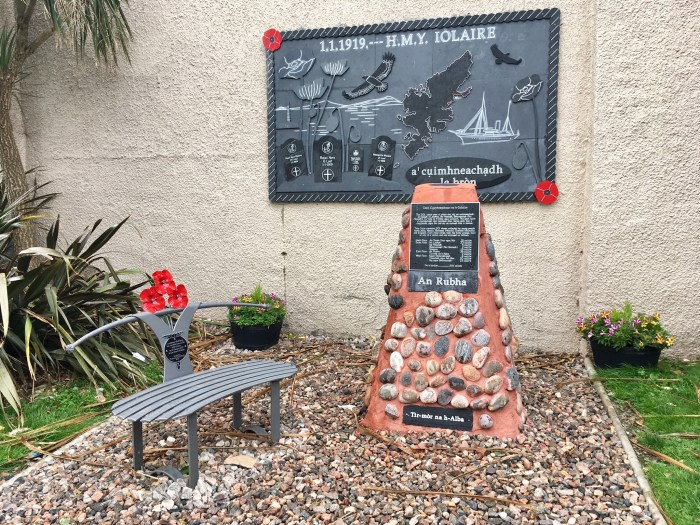
Our day began close to our hotel at a memorial to those who died on HMY Iolaire, a terrible tragedy which hit the island of Lewis just after the close of World War 1. Over 200 returning soldiers drowned on New Year’s Day 1919 when the yacht hit rocks just a mile from Stornoway Harbour. Each stone on the monument signifies a township which lost someone, a very sad representation.
From Stornoway, we made a circular tour taking in some of the main archeological sites of the island. The most famous of all is Callanish (Calanais) where the standing stones are believed to be older than both Stonehenge and the Pyramids of Giza. We last visited as part of an earlier island-hopping holiday in 1989 (then and now pictures below).


What has changed? I don’t remember a Visitor Centre in 1989 – this year, the first thing we did was have coffee in the Visitor Centre Café. Like our visit to Orkney and Shetland a few years ago, in that case after a gap of 20 years, tourist infrastructure has come on in leaps and bounds in the intervening decades.
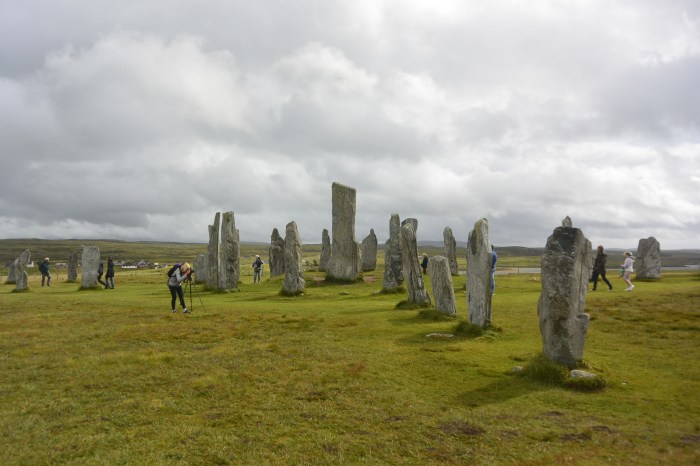 There are far more tourists (though it might not always look it from the photographs) but it’s still possible to see the same people all the time. In Callanish, we recognised several groups who had been on the same ferry. A Swiss couple took the table next to us at coffee. When we had lunch at another site later, they took the table behind us, and when we had dinner at night they were already in the restaurant. This type of thing happened again and again, to the extent that we greeted some people with a cheery hello as if they were long-lost friends!


A short circular walk took us to two lesser stone circles (above), Callanish II and Callanish III, before we headed off to our next stop, Geàrrannan Blackhouse Village. I believe the correct term in estate agent language for the house in the background of Callanish II is “potential”.
Blackhouses were the most common living quarters for islanders right into the 20th century. Made of stone, turf and straw thatch, one end was for people and the other end for cattle. Nine houses have been restored at Geàrrannan, some providing (much modernised) holiday accommodation and the rest the museum and its facilities (where we had our excellent lunch).


The interior above shows how the houses would have looked in the 1950s or 60s – by the 1970s, only a few ageing residents were left and in 1974 they moved to new council houses nearby. As the Trust which took over the deteriorating buildings wasn’t formed until 1989, this was a new museum for us.
After lunch, we backtracked slightly to Dun Carloway, one of the best preserved Iron Age forts in Scotland.


We then stopped at a restored Norse Mill in Dalbeg, before visiting another blackhouse museum at Arnol. This we remembered from 1989, and wondered how its visitor numbers had since been affected by the more extensive Geàrrannan.


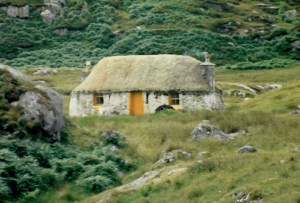 It might seem shocking that people lived in blackhouses until the mid-late 20th century. In 1989, it must have been unusual as we have made a point of snapping this one which is obviously still occupied because it has smoke coming out of the chimney. However things come full circle, and on our travels this year we spotted many which had been restored extensively, like the holiday cottages at Geàrrannan, some of which seemed to be private dwellings. I’d love to see inside – they must be cosy with such thick walls, but I’m not sure I’d like to live in one permanently.
From Arnol, we drove back to our hotel in Stornoway. We had one more day on Lewis to come.


Dear Glasgow Gallivanter, wonder if we can use your image of the Iolaire Memorial in a commemorative booklet we are designing. It has no commercial use and is being produced for school children on Lewis. We will credit, of course. Please let me know if you have any problems with that. Regards,
Andrew Wolffe (andrew@wolffedesign.com)
LikeLike
That sounds a great project! I’ll drop you an email shortly.
LikeLike
Thanks for the fascinating tour. I remember seeing some similar round stone houses in the south and west of Ireland when I visited in 2005, and also some much smaller stone circles.
Jude
LikeLike
Yes, there are great similarities between Scotland and Ireland.
LikeLike
You had such a delightful trip. So many amazing photographs, I so enjoy them.
LikeLike
Thank you, we had a wonderful time and I’m enjoying it all over again with these posts!
LikeLiked by 1 person
Oh, what a terrible tragedy! Those poor returning soldiers and their expectant families waiting in vain for their return. It doesn’t bear thinking about. Those ancient standing stones are amazing. Imagine the times they’ve seen! Thanks for the free tour, Anabel. 🙂
LikeLike
I know, it’s appalling! So close to the shore too.
LikeLiked by 2 people
Interesting, Anabel, how old these standing stones are! I could imagine spending my holidays in such a cottage – with all modern amenities, of course.
LikeLiked by 1 person
Me too! With VERY modern amenities.
LikeLiked by 1 person
Agreed!
LikeLiked by 1 person
Looks so lovely and fascinating. Love the house with “potential.” Actually I would love to see the stone circles and the fort.
LikeLike
“Potential” is a bit of a running joke with us! That one definitely had it.
LikeLiked by 1 person
All places new to me. I’ve been in a few blackhouses over the years. Not that different from some basic bothies I’ve stayed in and fairly cosy once you have a fire going compared to the weather and midges outside. Scottish standing stones are very ‘in’ at the moment worldwide thanks to the power of Outlander.
LikeLike
I did think of you and your bothies! I haven’t seen or read Outlander. But you really can’t escape it.
LikeLike
Thank you for the tour – I’m really enjoying seeing parts of my own homeland through your eyes.
LikeLike
Glad you are enjoying it!
LikeLike
It’s great – touring all over the place from the comfort of my chair. 🙂
LikeLiked by 1 person
I’ve never heard of the Iolaire, but how terribly sad. It is sort of similar to the Sultana disaster, when a steamboat filled with Union soldiers who had just been released from Confederate prison camps after the American Civil War, exploded, killing over a thousand people. How awful to survive a war, and be so close to returning home, only to die in a disaster like that; especially for the loved ones eagerly awaiting their return.
LikeLike
I know – this was so close they could probably see it from the shore. Tragic.
LikeLike
Have you thought of doing some research on the HMY Iolaire tragedy? It sounds as though that would make a great subject if you can get hold of the documents from the Army Museum or Kew (I’m presuming that’s where they are but you may have the Scottish ones in your own country). There can’t be much more of the islands for you to see, but I hope that’s not the case as your reports back are fascinating. Thanks for giving so much pleasure.
LikeLike
I think the Iolaire has been quite well documented already. As for the islands – be careful what you wish for! There’s a LOT more to come. You might be fed up with them by the end 😉
LikeLike
Eunice mentioned Mum being ill, but I didn’t see anything in this post, Anabel? Hope all’s well.
LikeLike
Thanks for your concern, Jo – I think it was a carry over conversation from Eunice’s blog. Mum had a bad fall at the weekend so I’m looking after her at the moment. A night in hospital and now lots of follow up appointments. Nothing too serious, fortunately, it could have been a lot worse.
LikeLike
I’m glad about that, Anabel. Hitting the deck gets more painful as the years go by! 😦
LikeLike
Sure does!
LikeLiked by 1 person
A very interesting and fascinating place, I’d love to see the blackhouses and that derelict cottage looks quite sweet. I’m sorry to hear about your mum, I hope she gets better soon 🙂
LikeLike
Thanks Eunice!
LikeLike
What a fascinating bit of history! I would love to see the inside of those houses, too. You are lucky to live so close to so many great historical sites, and I appreciate you sharing them with us through your blog.
As for getting to know fellow travelers: we’ve had the same experience! By the end of the trip, or even just the day, they feel like old friends. It’s one of the nice benefits of being a tourist, I think.
LikeLike
It is indeed. The islands are so small, some of them, with so few roads that it’s difficult to avoid following the same route.
LikeLike
Way cool post! I had never heard of Callanish Anabel. So neat to know these stones are about as old as it gets compared to similar formations. Love finding gems like this. Fabulous blog 🙂
Ryan
LikeLike
Thank you for the compliment, Ryan, and thanks for visiting!
LikeLike
The cottages I go to on Mull (Haunn – https://tresnish.co.uk/cottages/ ) are blackhouses. I could easily live in the two bedroom one. Not sure about the one bedroom ones as a way of life, but it’s only because I would have to get rid of most of my books.
LikeLike
https://treshnish.co.uk/cottages/ sorry about the typo
LikeLiked by 1 person
Thanks, got the link on the other comment. I’ve saved it in case we go to the Inner Hebrides next year!
LikeLike
A great adventure so far. Callanish looks amazing. Very close to making travel plans reading this!
LikeLike
Oh well, you’ll have your bags packed by the time I finish!
LikeLiked by 2 people
Beautiful and fascinating. I had no idea that ancient stone placements are on Lewis.
LikeLike
They are all over the islands – but Callanish is the best!
LikeLiked by 1 person
Lovely photos and nice tour. I had to smile on the fact that you were meeting the same people throughout the day. We had that same experience in New Zealand where we kept running into the same couple with whom we eventually had a long conversation. I think it is still a sign that there isn’t that many tourists as you can recognize those that are around…
LikeLike
It happened several times! We didn’t see many of the ferry people after the first day as we all dispersed but we made new friends later.
LikeLike
Hi Anabel – how very interesting … I toured around a bit in the late 70s … and definitely travelling now the facilities (visitor centres/small museums) are so much better. Fascinating to see the blackhouses … yet home after the war was relatively primitive … it’s so interesting to think back at how much has changed. I’d love to do this tour … and great you were able to compare – cheers Hilary
LikeLike
It’s true, so much has changed domestically in my life time. Our family home in the 70s would seem very primitive now!
LikeLike
I am so glad you can walk right up to the old stones. I am certain scientists have been exploring the origins of these stones and how and why they were placed there. I wonder if burial mounds are near by. The old homes are fascinating and sufficient enough to live in them until the mid 20th century. I love the old farmhouse with smoke coming from the chimney. I bet it is cosy
LikeLike
We didn’t see any burial mounds, but that’s not to say there weren’t any. The black houses were fascinating. I’d love to have seen inside a currently used one.
LikeLike
Can’t believe that those stones are so old. Really makes you think doesn’t it? I hadn’t heard of Callanish but it looks fascinating and well worth a trip, the houses are so interesting. It’s difficult to take in that they were lived in so recently.
LikeLike
Callanish is amazing. It must have been a very hard life in those black houses.
LikeLiked by 1 person
I can’t imagine just how tough things must have been. Life in those days was so much harder.
LikeLiked by 1 person
Hi, Anabel – I greatly enjoyed this tour. The Blackhouses are fascinating. Too bad no one invited you in for tea. I would have loved to peek inside!
LikeLike
That would have been nice! There was a door open in one and it looked like a modern kitchen so it would have been interesting to see the rest and how it fitted in with the ancient walls.
LikeLike
Those stone circles are certainly impressive! We visited a black House museum on Skye. And the house we stayed in on North Uist was a crofters cottage with amazingly thick walls and a thatched roof. I must crack on with my posts! Lewis definitely is on my must visit list now. 🙂
LikeLike
Good! I’ll be interested to see what you did in North Uist. I cracked on quite well with my posts and I’ve got a few more scheduled, but have now ground to a halt for various reasons. Hopefully I’ll get started again before the scheduled ones run out.
LikeLike
Another great Post. I was reading an article the other day about what the Author considered over rated tourist traps. Interesting one of them was Stonehenge and it was suggested that if you really want to see what standing stones are like – visit Callanish, in Scotland. Interesting…
LikeLike
Yes! As the previous commenter said you can still walk right up to them so it’s a much better experience.
LikeLike
It’s like Stonehenge except you can actually go right up to the stones (and unlike Avebury, it does not have a road though the middle).
LikeLike
Yes, you can, it’s a much better experience!
LikeLike
Everywhere has a visitor centre these days! The blackhouses are amazing.
LikeLike
They seem to, but it was such a contrast to a time when there was very little.
LikeLike
The worst one for me was at the Cliffs of Moher and the Giant’s Causeway in Ireland.
LikeLiked by 1 person
The idea that these stones have been standing for so very long is simply amazing. How exciting to be able to stand right near them. A friend was telling me recently that access to Loch Ness has completely changed since we went with them in 1999. Now there is a big tourist centre you have to go through to get there. We just parked the car and walked in then.
LikeLike
I didn’t know that at all – it’s a long time since we’ve been to Loch Ness too.
LikeLiked by 1 person
We found those blackhouses fascinating and horrifying in equal measure. The way they were furnished though took them back to how.my Gran’s parlour looked in the early 60s
LikeLike
Me too, one of my grannies even had a black range (and a wooden bath which I never saw anywhere else before or since!)
LikeLiked by 1 person