
Artemisia Gentileschi
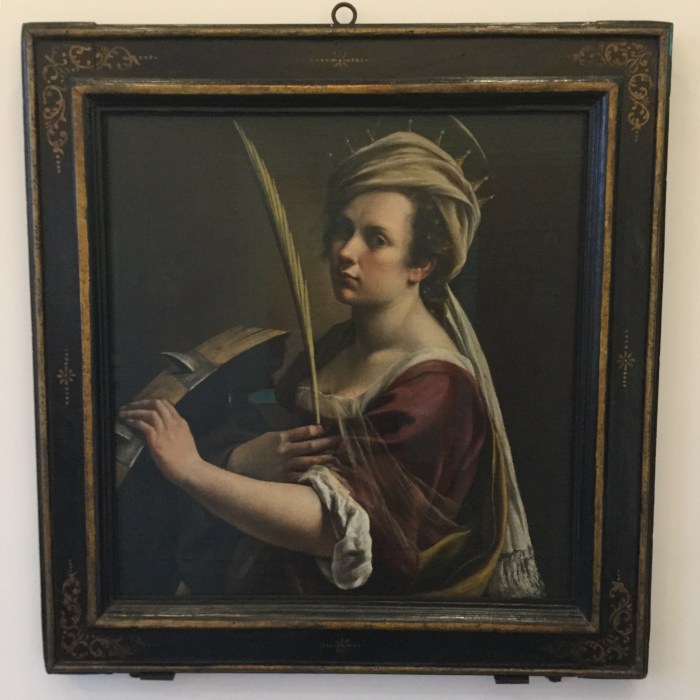
Artemisia Gentileschi, the most celebrated female painter of the 17th century, was born in Rome in 1593. Her date of death is unknown, but it must be after 1654 when she is recorded as living in Naples. Self Portrait as St Catherine of Alexandria (c 1615-17) has recently been acquired by the National Gallery in London, restored, and sent out on tour to unusual and unexpected destinations including a library, a school, and a health centre. The painting’s first stop is Glasgow Women’s Library where it is on display until 19th March, so hurry along if you are in the area.
Who was St Catherine of Alexandria? In the 4th century she was sentenced to death for her Christian beliefs and tied to a wheel studded with iron spikes. Although she was miraculously freed by angels, she could not escape a martyr’s death and was later beheaded. In Artemisia’s portrait she leans on the broken wheel with her left hand while her right hand holds a martyr’s palm. I spent an hour in the same room as Catherine / Artemisia and continually returned to that beautiful, clear gaze.
You can read more on the National Gallery’s site:
I wonder if Artemisia would approve of being added to a blogging challenge? It it gets more people looking at her wonderful painting, maybe she would. I’m linking to Becky’s Spiky Squares.


 The Glasgow Gallivanter
Thank you for writing about this painter. I did not know about her and it was fascinating to read about her story and watch the National Gallery video. She must have been very determined and resilient to have persisted with her art despite the barriers to women, the sexual assault, and having five children!
Jude
LikeLike
I’m glad it prompted you to dig further. She really is quite amazing. I knew little about her too.
LikeLike
The gaze really draws you in – beautiful, poignant, sad, other-worldly. What could she be thinking? Fascinating historical background about both the artist and subject matter she has chosen to portray.
LikeLike
And we have a huge blank wall now that she’s gone! But they wouldn’t let us keep her.
LikeLiked by 1 person
🙁 hope a new painting arrives soon to take her place!
LikeLiked by 1 person
I wish women artists got more love. She is excellent! I love her stare which bores right into your soul
LikeLike
There’s something very special about her, I agree.
LikeLike
Hi Anabel – I had heard of her … but more than that = not much. So you’ve ‘made’ me look her up and take note … and see your note on the frame and its adjustments. It’s great we’re still able to find out so much about early life … she’s a great painter with a wonderful selection shown in Wiki – but this one showing her as the martyred St Catherine is sad … yet evocative. Thanks for showing her to us – cheers Hilary
LikeLike
Thanks Hilary – I’m glad you found the post informative and were prompted to find out more.
LikeLike
What a very dramatic and very sad history this painting his. It is quite beautiful. Thank you for sharing it. I am wondering what she might be holding? any thoughts? I really like the frame as well…
Peta
LikeLike
She’s holding a palm leaf, which is apparently a symbol of martyrdom. The frame is interesting – it is 17C Tuscan but not original to the painting even though it suits it perfectly. It had to be cut down to size and, because of the central motif, that meant altering it in several places. One of the videos on the National Gallery site tells you about it. I looked very, very carefully but couldn’t see any trace of the joins. Very skilful!
LikeLike
I’d not heard of this artist. I think this might win the prize for the most unusual/historical contribution to the challenge!
LikeLike
Thank you!
LikeLiked by 1 person
Not heard of the artist and only know of St Catherine’s story through the firework- always my favourite firework after that as it was appropriately gruesome and made a great display if you nailed them up in a row on a fence.
LikeLike
They did make a great display – I’m not sure if they are still allowed for home use mind you.
LikeLike
It is a beautiful painting, and I can see why it held your attention for so long. Thanks for sharing this…and I also love how often you highlight women and their contributions in your blog…..
LikeLike
I was invigilating for an hour, but it was preview day and not many unexpected visitors so I had plenty of time to commune with Artemisia. I do try to bring women’s history and achievements in as often as I can!
LikeLike
Now that really is a spiky story. Well done you to see the connection. Lovely portrait and lovely to have this female painter brought to people’s attention like this.
LikeLike
I meant to post about Artemisia – it wasn’t till I uploaded the picture I realised it was a perfect match. It was already in square format to match the frame so I didn’t even have to alter it!
LikeLike
Talk about a spiky square – what a fantastic contribution for this challenge, Anabel. I had never heard of Artemisia Gentileschi, and will have a hard time remembering her name.
LikeLike
It trips off my tongue quite easily now!
LikeLiked by 1 person
That is a beautiful portrait. Now I know more about the origin of the term “Catherine Wheel.” How awful for the artist to be tortured after being raped!
LikeLike
I might despair of our current situation, but we have definitely moved on a lot from 17th century methods of “justice”. However, it does seem wrong to name something for entertainment after an instrument of torture!
LikeLiked by 1 person
Agreed!
LikeLiked by 1 person
Beautiful painting! I’m pretty sure Artemisia would approve of being part of the challenge!
LikeLike
I hope so! It just felt slightly odd when I made the link. But I’m sure she’d be quite go-ahead about promoting herself. After all, many of her paintings have her own image, not just this one!
LikeLike
I love the idea of sharing this painting with as many people as possible by taking it on tour. Artemisia looks quite pensive and beautiful as St Catherine. I think she would approve of your way of showing us her work.
LikeLike
It’s a beautiful painting, and a great idea by the National Gallery to tour it out of London. Quite a risk too, I imagine!
LikeLike
I’m hoping to get to see it on Saturday. I’ve seen a lot of positive stuff about the painting being at GWL on social media and it’s a great thing for them and the city.
LikeLike
Oh, I hope you get there! It’s well worth seeing and a real boost for the library (and the city, as you say).
LikeLiked by 1 person
oh this is fabulous . . she has as you say a beautiful gaze. I hope Artemisia didn’t suffer like Catherine?
LikeLike
Well – unfortunately she did, though she wasn’t killed. She was raped as a young woman and tortured with thumb screws to verify her evidence during the trial. Horrific!
LikeLike
omg! no wonder she painted herself as Catherine.
LikeLiked by 1 person
“I wonder if Artemisia would approve of being added to a blogging challenge?” – Now that’s really an intriguing question. 😉
Thanks for the interesting post.
LikeLike
Isn’t it? I think she would. She made it as a female artist in the 17C so I’m sure she’d be strong enough to deal with social media in our times.
LikeLiked by 1 person
🙂
LikeLiked by 1 person
A good painting. Makes you wonder why something like Mona Lisa gets elevated to such adoration status and something like this doesn’t. I like the ‘Girl with a Pearl earring’ but then again I know nothing about art!
LikeLike
Also, you can’t really tell from my picture but St Catherine of Alexandria is much bigger than Mona Lisa. I know bigger isn’t always better, but I certainly find this painting more striking. Her face has the same luminosity as Girl with a Pearl Earring, which I also like.
LikeLiked by 1 person
I remember that I was stunned at how small Mona Lisa was when I saw it in 1989!
LikeLiked by 1 person
How interesting to learn about this painter and about St. Catherine, neither of whom I’ve ever heard of. You’re right. It is a beautiful painting. Thanks for sharing. 🙂
LikeLike
I didn’t know much about her either until this happened. It was an emotional experience to get so close to such a magnificent work of art.
LikeLike
I’m so glad that this beautiful painting is “on tour.” We’re so used to thinking of art from past centuries being a male preserve, and Artemesia’s work proves that women artists’ relative absence from the history of art is not about lack of talent. I’d read about the rape, but not the thumbscrews — what an especially horrific torture for a painter!!
And would she approve of her role in a blogging challenge — absolutely. I’d like to think she would have totally owned social media.
Thank you for sharing this Anabel. I can imagine how moving it must be to see the painting “in the flesh.”
LikeLike
I really admire her for making it as a woman artist at that time, especially under those circumstances. It was more moving than I expected. Although I definitely had something in my eye at the time …
LikeLiked by 1 person
Good art does that 😀
LikeLiked by 1 person
I’m sure it was. I know the feeling just from emotions I felt at places like the Mezquita in Cordoba and other places that inspired awe. 🙂
LikeLiked by 1 person