
Sheffield 4: Kelham Island

Kelham Island Museum opened in 1982, by which time we no longer lived in Sheffield. However, we didn’t move far from the area until 1986 so we visited a few times and were keen to go back. The museum stands on one of the oldest industrial sites in the city, an island which was formed in the 1180s when a mill-race was created to carry water from the River Don to the Town Corn Mill. It now tells Sheffield’s industrial story from light trades and skilled workmanship to mass production, the Industrial Revolution and the growth of “Steel City” through the Victorian Era and two world wars.
Near the entrance I spotted two things which interested me straight away. Scotland is not the only place with unicorns – the one below was made at Kelham in the late 1800s. The other thing was the tribute to Enid Hattersley. When I was studying librarianship, our class was taken to observe a meeting of the council’s Library Committee chaired by Mrs Hattersley who was later instrumental in setting up the museum. My memory is that she was a very formidable woman. Her son Roy (now Lord) Hattersley was a prominent Labour politician from the 1960s to the 1990s. I met him years later at a book signing and he was pleased to hear that I remembered his mother, though I didn’t mention the word formidable! I still have the book – unread, I’m sad to say.


As an aside, in 1980 I wrote my dissertation on library services to the visually handicapped and was granted an interview with the Leader of the Council, one David Blunkett, who had been blind since birth and had useful views on the matter. He also became prominent in a Labour Government, rising as far as Home Secretary (2001-2004), and is also now a Lord. Yup, nothing says socialist like an ermine robe.
The section on steel had some interesting tableaux, and I was pleased to see that women’s role in the industry was represented as well as the actual steelmaking.. The young woman below is a buffer girl, responsible for using polishing machinery to buff cutlery and other metal goods to give them a smooth surface. It was a hot and dirty job that required protective clothing.


The museum’s biggest (and loudest) exhibit is the River Don Engine which is run once or twice a day. Built in 1905, it weighs 400 tons and runs on 12,000 horsepower. It was in use till 1978 and is the biggest, most powerful steam engine in Britain today.


Outside, I liked the Stone Garden, particularly the hanging sheep which was the trademark for Sorby’s sheep shears in the 19th century. The stone carving came from the factory’s gate and could date as far back as 1820.


The Millowners Arms, sadly, was not a real pub but told the story of Ward’s brewery. I enjoyed reading about the 1830 Beerhouse Act which made beer cheaper and more accessible. It was meant to protect people from the perils of drinking gin, but somehow drunkenness still became a problem. Who could have foreseen that?


Fear not, we did manage to visit a real pub. When we lived in Sheffield, a trip to Kelham Island always involved the Fat Cat too. It isn’t the only choice now, as the area roundabout has been considerably gentrified since our day with a selection of smart bars and cafés, but loyalty won out. Fortunately, it was as good as we remembered and we enjoyed a lovely Sunday lunch there.


Some nice street art too, I always like to see that.


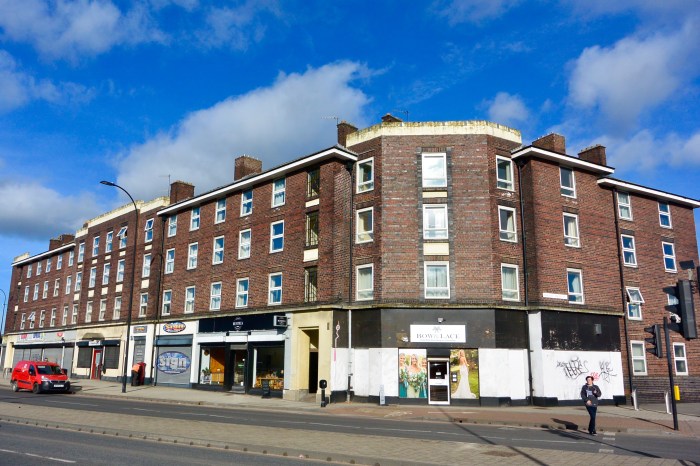
And finally, something that doesn’t look much different: these flats at Moorfields just before you get to Kelham Island. John lived here for a few months after I left Sheffield to work in Nottinghamshire. Soon, he followed me and that was the end of our residence in Sheffield, though we still considered it “our” city.
 It was the end of our trip too – the next day was Monday and we took the train back home to Glasgow. I’m already planning to go back: there are more memories to pursue!


 The Glasgow Gallivanter
what fabulous memories, and so pleased you enjoyed your return
LikeLike
Hello! I have just come in to lots of notifications from you: I see you are back in the world of WordPress. We had a lovely time in Sheffield, thanks.
LikeLiked by 1 person
I am indeed back in the mysterious and lovely WordPress world, and fingers crossed i will be staying here for the next few months 🙂
LikeLike
Good!
LikeLiked by 1 person
The street art and stone gardens are great. And I love those ceramic beer taps.
Jude
LikeLike
It’s a great museum, so much of interest.
LikeLike
Hi Anabel – it does sound nostalgic … and you’ve given us some memories, as well as photos – I enjoyed the tour … Mama Hattersley does sound formidable … but what a great learning curve … and being able to meet David Blunkett – also great knowledge to be learnt. Interesting to know one of your studies was on library studies and the visually handicapped … I’d like to know more. Mama H was very influential in and around Sheffield … doing a great deal for the city and area. Cheers Hilary
LikeLike
She was indeed – but she obviously did not suffer fools gladly and I remember her putting one of the other councillors in his place as if he were a naughty schoolboy! Probably well deserved.
LikeLike
I’ve only ever visited Sheffield on work related trips and never really seen the city. But given my interest in industrial and working class social history I probably should make the effort to visit that museum
LikeLike
I think you would like it.
LikeLiked by 1 person
1180?! Anabel, that is seriously impressive! I love seeing evidence of industrial activity that transcends human life times. It really does provide a reality check on how ephemeral the human life is and how humans manage to build lasting infrastructure and industrial activities that benefit the society for the long run.
Love the stone garden images.
Ben
LikeLike
It’s certainly awe-inspiring to see evidence remaining of how people lived so many centuries ago.
LikeLike
What a striking blue on the pub! Definitely not a colour I’ve seen often on buildings, but very cool (in the social as well as colour-spectrum sense).
LikeLike
It’s very attractive I think. I’m sure it wasn’t that colourful 30 years ago. Black springs to mind.
LikeLiked by 1 person
😕 I do like colourful buildings. My first impression of NZ, travelling from the airport to outperform new home as a 5-year old from Kirkcaldy, was of colour. House after house — all free-standing — painted every colour you could imagine. Turquoise, bright blue and yellow were particularly popular in those days (sometimes together). It was like driving through a kaleidoscope 😀
LikeLike
You do get that sometimes on the west coast here, though more pastels – Tobermory is the obvious one, and we’ve just been to Islay which, although painted houses are mostly white, has some colourful pockets.
LikeLiked by 1 person
I remember a few pretty coloured houses in Portree too.
LikeLike
Yes, seems to be an island thing more than just west coast, maybe.
LikeLiked by 1 person
What an interesting place, we love visiting locations like that with some history. Lovely photos.
LikeLike
Thank you! So do we.
LikeLike
Oooh, lovely tableaux! Why does everything steam related of a certain age seem to have the same colour scheme though? Every Victorian pumping station etc. I’ve seen is green with red accents! I like it, but I have to wonder if they were all originally painted that colour, or just all restored to look the same.
LikeLike
I don’t know! Googling didn’t really help. But as Crown has a shade called Steam Engine Green I guess it was a thing.
LikeLiked by 1 person
“Nothing says socialist like an ermine robe” – hahahaha!!! Anyone can be seduced by power and money, it’s just a question of how much.
Lots to like in here, Anabel, but the Fat Cat gets my nod. LOVE the building with the rounded corner. And the bright blue. And the mural. Oh yes, definitely a favourite. Glad to hear the food was good too 🙂
However I have to give a nod to the dragon beside the machinery. In the thumbprint photo it looked to me like someone had wedged a human sized doll into the machinery. If it wasn’t for the fact it turned out to be a small dragon, I might have been disappointed 😉
LikeLike
There was no explanation whatsoever for the dragon. It was just there!
LikeLiked by 1 person
Socialism and ermine do seem to go well together .. there are other examples with Lord Fitt (Gerry Fitt NI politician) immediately springing to mind. Now, some trivia for you – I was intrigued to read that the hanging sheep was the trademark for Sorby’s sheep sheers. I have seen this used in many instances albeit related to the wool industry. The The Golden Fleece symbol, as it was referred to, was hung outside shops in Saville Road, in the 19th century advertising them as purveyors of fine wool. It also appears on the coat of arms of nearby Leeds.
LikeLike
Ah, you made me go off and do some research! As in Brooks Brothers:
https://magazine.brooksbrothers.com/meet-golden-fleece/
It looks very similar, but I had never come across it before.
LikeLiked by 1 person
That’s great thing about reading blogs, we are always learning. I knew I had come across it before but had to rrsear h too.
LikeLiked by 1 person
Mr ET would like the idea of the Beerhouse Act! I can’t imagine why it didn’t really have the desired effect though. 🙂
LikeLike
There’s really no accounting for it, is there?
LikeLike
Hi, Anabel – I have my share of unread books that I just can’t seem to part with. Because….well…you never know!
Great photos here — especially the street art!
LikeLike
Thanks Donna! You never know indeed. This one is a history book and although it sounds interesting, it always seems a bit heavy – figuratively – to pick up when I’m looking for something to read in the evening.
LikeLike
Never knew the city had an island within it. Still gutted I only viewed the Hyde Park Flats in Sheffield after they were mainly pulled down. Spoiled my bagging list of 1950s, 1960s, 1970s UK council estates which I was once very keen on collecting. One of the largest and most impressive in Europe apparently and I missed it through ignorance. . Wah !!! I take it you remember the 18 floor high deck access spires rising up the central hill in the city? Very impressive in old photos.
LikeLike
Blink and you would miss that it was an island! Yes, those flats were a big part of the landscape when we were there.
LikeLike
Hi Anabel, It is interesting how you keep an unread book. I have a few I have had many years. Not in the mood to read, yet I don’t want to give up on them:) I will have to look up further information on Scotland and unicorns. I didn’t know they were associated. I enjoy reading and seeing the photos of Women’s role in history. An interesting post, and I always enjoy the photos:) Erica
LikeLike
I’m not sure i’ll ever read the book – it’s a history of post-war Britain, so I suppose I might use it for reference some day. The unicorn is Scotland’s national animal. I wrote a post about it a couple of months ago:
https://glasgowgallivanter.com/2019/03/25/unicorns/
LikeLike
Anabel – It’s a great thing to walk your memories. I had to chuckle at the old -and nicely tarnishing – ‘recent works’ photo! Cheers – Susan
LikeLike
That puzzled me until I checked the pictures. It’s Regent Works!
LikeLike
The museum sounds quite interesting. So what is the principle industry or occupation in Sheffield now?
LikeLike
It still has steel, but more specialised and high-tech, not the massive blast furnaces of the past. Probably the two universities are the biggest employers now though.
LikeLiked by 1 person
Interesting that you cover both old and new types of street art/architecture in this interesting post Anabel.
LikeLike
It’s the sort of thing that always catches my eye.
LikeLiked by 1 person
That beer act is quite funny and it makes me think they made this law when they were drunk. I love the Stone works you showcase here…always fun to see this type of history.
LikeLiked by 1 person
They were probably either drunk or daft!
LikeLike
Ermine socialist.
Yep someone has to wear it
Still its a better look than the hobnailed tory
LikeLike
I’m not sure which is worse. A plague on both their houses!
LikeLike