Hill House
In the late 19th and early 20th centuries the upper part of Helensburgh, a small town on the Firth of Clyde, became populated with a series of grand, individually designed villas commissioned by rich businessmen who could afford to move out of Glasgow but still needed to live nearby for work. (Helensburgh Upper Railway Station, opened in 1894, helped to make this possible.)
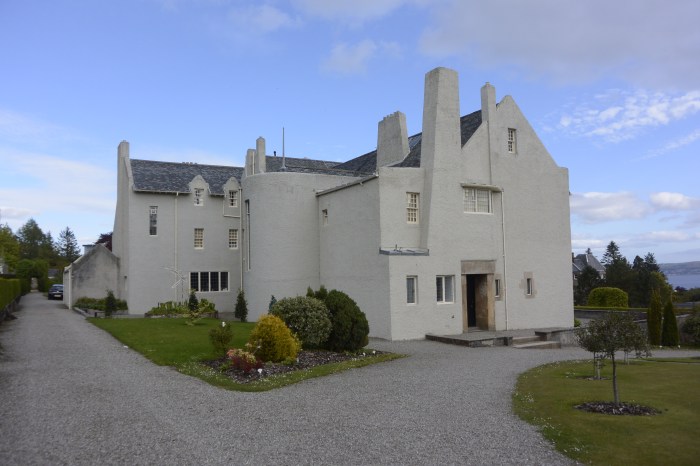
Many of the houses were very traditional in nature, as I’ll show later, but publisher Walter Blackie was more visionary. He appointed Charles Rennie Mackintosh as his architect, resulting in Hill House (designed 1902), as seen in all its glory at the top of this post.
Not only was Mackintosh’s design innovative, he used innovative materials too. Scottish houses are often harled (roughcast) with lime, but Mackintosh chose to use a more modern material: cement. It was easier to work into the curves and crisp angles of his building, but there was a serious flaw – the Scottish weather. Traditional lime harling allows a building to breathe. If cement roughcast cracks, rain soaks in but cannot evaporate back out. This has caused a lifetime of damp and damage to the walls and interiors – according to the National Trust for Scotland which owns the house, it is “dissolving like an aspirin in a glass of water.” NTS has decided to buy time by creating the Hill House Box.

This shelter, designed by architects Carmody Groarke, is made of steel mesh and will protect the house from up to 80% of rainfall. At the same time the wind can pass through, water can evaporate and, as the house dries out, plans can be made for its future conservation, a process which is likely to take up to 15 years.
We’ve made many visits to Hill House over the years. On our first visit to the Box we were impressed, not just with the boldness of the solution, but also with the way that NTS has ensured that the visitor misses nothing. In fact, you see Hill House as never before. Two walkways allow an incredible bird’s-eye view.


Inside is as beautiful as ever – the Blackie family could just have walked out a few minutes ago. Youngest daughter Agnes has left her bicycle, and Walter has obviously been busy in the cosy library, one of the few rooms without the classic Mackintosh touch.


Elsewhere, the interior design of Mackintosh and his wife Margaret Macdonald is much in evidence. The pair worked closely together: Charles said “Margaret has genius, I have only talent”. The drawing room and Anna Blackie’s bedroom are particularly fine. You can also see, at the end of the gallery below, examples of both interior damage and stencilling restoration.


After touring the house we wandered outside for a while waiting for the next part of our visit.


At 1pm, one of the guides, the excellent Taylor, led a group of visitors a couple of blocks downhill to compare and contrast two other houses of similar vintage. These were Red Tower (William Leiper, 1898) and the White House (M. H. Baillie-Scott, 1899). Red Tower is traditionally Scottish Baronial in style. It spent some time as a Drug Rehabilitation Centre earlier this century, but has since been taken back into private hands and restored as a 14-bedroom dwelling-house, which is apparently occupied by only two people. Baillie-Scott’s building has more in common with Hill House – he also designed Blackwell in Cumbria, another house I love to visit which always reminds me of Mackintosh. Both The White House and Blackwell pre-dated Hill House, so who influenced whom?


I know from my heritage volunteering with Maryhill Burgh Halls that their architect also designed a house nearby, so I asked Taylor if she knew which one. She went off to get her plan and identified it for me – it was right next door. Cuilvona (Duncan McNaughtan, 1907) is a mock-Tudor villa which is barely visible from the road. However, part of the Hill House walkway looks right down on it, so after lunch (yes, Hill House has an excellent café in its new visitor centre) we headed back in to look. John took the photograph through the wire mesh which is why it’s less sharp.


I had photographed the plan, so we could also identify some of the other houses. Here are Morar House (at one time known as Drumadoon; Leiper, 1903), Ardluss (Leiper, 1900) and Dhuhill (I think – in which case, James Smith c. 1850). Having been empty for some years, after serving as a nursing home, Morar House ended up on the Buildings at Risk Register, but has recently been converted to flats.


There was still part of the afternoon left, so we looked at the map and plumped for a visit to Glenarn, a 10 acre private garden in the nearby village of Rhu, which is open in the summer months as part of Scotland’s Gardens Scheme.


This was a lovely day out. I wasn’t sure what to expect from the Hill House Box, but I was very impressed with what NTS has done and I fervently hope that it leads them to a permanent solution for conserving Mackintosh’s masterpiece.


 The Glasgow Gallivanter
Dissolving like an aspirin in a glass of water!! What an innovative way to dry the walls out so that it can be restored. As you say, the artistic design of the interior rooms is superlative.
Jude
LikeLike
It’s one of my favourite houses to visit. I really hope they can preserve it.
LikeLike
This is a case of a box containing a big surprise. I love innovative solutions and this is clearly one of the them. At first glance, the box just looks like netted scaffolding, but what a treat inside!! To be able to explore a building from all angles is such a novelty!!
LikeLike
They describe it as chain-mail rather than net, and it is just like that. You could even buy jewellery made from it in the shop (I resisted – I have way too many earrings already and only ever seen to wear the same few pairs!)
LikeLike
I am such a sucker for jewelry. I likely would have bought some! … and yes, I have bazillions of pairs.
LikeLiked by 1 person
Anabel – what an enjoyable walk, and a surprising temporary fix for the aspirin-like condition of all those treasures in your country. Admirable 🙂
LikeLike
It certainly is – thanks, Susan!
LikeLiked by 1 person
I hadn’t yet read your text when I looked at the pictures and recognized immediately the style of Mackintosh. Such lovely house. Great photos. (Suzanne)
LikeLike
It’s unmistakable – I love it.
LikeLike
I love it too. I have found memory of visiting his house or museum when we visited Glasgow years ago… (Suzanne)
LikeLike
Could have been either The Mackintosh House at Glasgow University or House for an Art Lover in Bellahouston Park. Both lovely!
LikeLike
what a glorious and fascinating post . . . . .
LikeLike
Thank you!
LikeLiked by 1 person
I love all of the places that you visit and how you bring them alive for each of us.
“My spouse has genius, I only have talent.” No lack of ego there! 🙂
LikeLike
Thanks Donna. I repeat that Mackintosh sentence at every opportunity as Margaret Macdonald is less celebrated than her husband and so much of the art was hers. Even our First Minister, who is a genuinely cultured person, confessed a couple of years ago at an exhibition of Scottish women artists that she didn’t know Mackintosh’s wife was an artist in her own right.
LikeLike
I have to say that I generally prefer the traditional style of architecture to Hill House (except for the turret. Love a turret), but the box is very cool! Makes it seem almost like a dollhouse all encapsulated inside, albeit on a massive scale!
LikeLiked by 1 person
I love turrets too, my ambition is to live in one. It is a bit like a dollshouse, it’s really weird looking down at the roof.
LikeLiked by 1 person
Mine too! Unfortunately, houses with turrets go for at least 5 million ’round these parts.
LikeLike
Aargh! Maybe not for us then.
LikeLiked by 1 person
Fascinating ! Especially the method of preservation and the creativity in which it has been done while the building “heals” or “dries”. And what a gorgeous garden! Love the combination of interesting architecture and natural beauty. Lovely!
Peta
LikeLike
They have done really well with this. Glad you found it interesting.
LikeLike
What a creative way of preserving the Hill House. I love Mackintosh design. It always reminds me of Scotland when I see his pieces.
LikeLike
Yes, they are so distinctive.
LikeLike
We should obviously make a point of diverting into Helensburgh instead of bombing past. I think there was a similar problem of damp – and a similar ingenious solution – at Rosslyn Chapel which, happily, seems to have done the trick.
LikeLiked by 1 person
Yes, that’s right. Although I think this chain mail solution is a bit more sophisticated – technology has moved on, as it always does! Definitely worth a detour.
LikeLike
Hill House has been on my list for a long time – it’s one of the few RM buildings I haven’t visited. I was thinking the box might ruin the visit but your comments reassure , although I’m sure it prevents taking in the view of the building as a whole. But they need to repair it to preserve it.
I too love Blackwell and as for who influenced who, Baillie-Scott was the winner of the House for an Art Lover competition when RM’s design was commended but didn’t win as he didn’t completely stick to the rules (although I bet you already knew that!)
LikeLike
Yes, you will not get the sort of view in my 2015 picture for a very long time, if ever. I was worried about the box too, but the walkways really add something which goes a long way to making up for the loss of the overall picture. I did know that about House for an Art Lover. I think Mackintosh was late submitting or something. He was never noted for following rules!
LikeLiked by 1 person
I’m a tiny bit envious, Anabel. I love the Rennie MackIntosh style, and that box solution is ingenious. Oh, to be more than a mere mortal! 🙂 🙂
LikeLike
It’s very clever, isn’t it, and a great way to see more of the house.
LikeLiked by 1 person
What an interesting way to preserve the historic house! I wonder what they will do when they finally remove the mesh box? And I love the way they kept it open for visitors too!
LikeLike
I hope they can work something out, maybe replace the cement, I don’t know. I would hate it to be in the box forever!
LikeLike
That cage sure is a bold (temporary) solution to the weather issue facing the Hill House. But, I agree with you, so incredibly well done! Especially since visitors are still allowed inside and manage to have a different view and angle from the walkways. I hope they manage to restore it carefully and perfectly somehow! You had a busy and interesting day! I like all the architecture and the comparisons between different dwellings of the same era.
LikeLike
It is bold, I wasn’t sure that I wanted to go when I read about it at first but my worries that the house would be spoiled were – well – rubbish!
LikeLiked by 1 person
Hi Anabel, Very interesting information and fascinating to see how people live. Cement and the Scottish weather? I did not know the negatives about cement. The Hill House box seems like a very practical ongoing solution. A great idea for photographing the plan. I can see through your story and photos why people love to visit Scotland:)
LikeLike
Nor did I, and I didn’t even know it was cement until the house had to close. I’m always happy to convince people of the beauties of Scotland!
LikeLiked by 1 person
Wow, that is such an innovative way to protect an important historical building. Your picture of the damaged wall really illustrates why it was necessary.
LikeLiked by 1 person
It is, and I’m so glad they are doing it.
LikeLike
What a clever way to protect the house but still allow visitors to come. It must be very costly to repair and maintain these buildings but I’m glad they are saved for everyone to see and learn about.
LikeLike
Yes, NTS is doing great work here.
LikeLiked by 1 person
Looks like a grand day out Anabel.
I am sad about Hill House; I really hope The Box allows enough of a respite for a permanent solution. I do love Macintosh’s work, but (perhaps to my 21sr century aesthetic), the domestic interiors look hard to live with. Too much of a good thing for me.
LikeLike
I agree. That couch is beautiful but I can’t imagine curling up on it. And all that white! But I suppose there would be an army of cleaners. I think I read somewhere that the children complained it was always cold (and knowing what we know now, it was probably damp).
LikeLiked by 1 person
Poor kids. The furniture never looks that comfortable, and it’s miserable feeling cold all the time.
LikeLiked by 1 person
“Dissolving like an aspirin in a glass of water” —
It’s a big problem. Hopefully the current and future actions will succeed.
LikeLiked by 2 people
I hope so. It would be awful if it crumbled.
LikeLiked by 3 people
Your pictures of the interior make me want to visit Hill House.
LikeLike
It’s the most wonderful place.
LikeLike
What a wonderful day out – right up my street (sorry for the pun!) with CRM and Margaret Macdonald things to look at, other lovely houses AND a cafe! The box is a really interesting solution to the problem, and it’s such a great idea that they put in a walkway allowing you to see things from all angles.
I’ve never been to Hill House – it was one of those places that I kept meaning to go to, but never did. Maybe on my next trip back I will.
LikeLike
Oh dear, I have just fished you out of spam! How bizarre. Yes, Hill House was a lovely visit and I would definitely recommend it.
LikeLike
It’s great they’ve found a way to preserve the house while still allowing people to walk through and see it inside and out. It’s too bad they made the decision in the beginning to use the concrete instead of local building materials, which I’m sure would have withstood Scotland’s weather best. The gardens look really lovely too. 🙂
LikeLiked by 1 person
I suppose it seemed like a good idea at the time, using concrete, and to be fair it has lasted over a century. I wonder if he was anticipating that? Maybe not!
LikeLiked by 1 person
Well, if it lasted over a century, I guess it wasn’t the worse material then. 🙂
LikeLiked by 1 person
I am glad they are finding a way to save this home. As soon as I read “cement” i though..”Oh, Oh”. I love the one home where only 2 people live in…Lucky buggers. The gardens look so luch and so beautiful..love to visit
LikeLike
I’ve always fancied a house with a turret – but I think 14 bedrooms might be a bit much to manage!
LikeLike
Smashing post. The torrential downpour today will give the box a test. Nice to see Red Tower and Morar House saved as both were derelict and empty last time I visited. Two of my favourite buildings and my favourite architect working in that area. Leiper that is, getting more recognition at last..
LikeLike
Yes, I wonder if it will keep 80% of that out! Morar House looks amazing – a passer-by told me the flats were beautiful inside, as I’m sure they are. Imagine living in Red Tower with just one other person though – you would never have to see each other. Leiper does seem to play not even second fiddle, but third fiddle to Mackintosh and Thomson.
LikeLike
Hi Anabel – we’re learning so much about ‘new’ materials e.g. cement … and iron. Canterbury Cathedral urgently needed some tender loving care as chunks of masonry were falling off – it was found the iron bars used in the 1800s to repair the stone work made new repairs necessary in the 21st century. We are becoming much more aware of how capable earlier generations were with their building materials.
Fascinating about the box – having not seen something like this before, or read about it … it’s brilliant – and I’ll be interested to see future developments in its preservation. Beautiful house … what fun …
Love the other buildings too … while that part looks delightful … and endorse what Jemima mentions – a visit sometime.
Great write up for us … with photos – cheers Hilary
LikeLike
Thanks Hilary. It’s amazing how many centuries the great cathedrals have lasted. They certainly knew how to build in those days, and without all our modern machinery. Amazing!
LikeLike
Interesting, Anabel, the differnece between traditional and modern building. Confirms my view that in many ways the old ways are best. Those people learned from ages of experience.
LikeLike
I think so! I read somewhere about the huge environmental damage concrete production does too.
LikeLiked by 1 person
Sounds somehow familiar. I must have read about it somewhere.
LikeLiked by 1 person
Wonderful place, dear Anabel! I will also keep it in mind! 🙂
LikeLike
Good! It’s certainly a wonderful place to visit.
LikeLiked by 1 person
For sure, dear Anabel! So much history! So much spirit!
LikeLiked by 1 person
Yes it is very impressive but is this not somewhat similar to what was done some years ago to protect Rosslyn Chapel from the weather and allow the stonework to dry out? The garden walk was very interesting.
LikeLike
Yes, Rosslyn Chapel had a shelter at one time but I think this is more advanced with its “chain mail” structure. As it would be, many years having passed!
LikeLike
The box is brilliant. Its quite a while since we saw Hill House. Methinks we need to build in time when next in Glasgow
.. thanks for the tour, Anabel
LikeLike
Highly recommended, Geoff! I didn’t know about the walkways till after it reopened. They add a huge positive to what could otherwise have been seen as a completely negative event.
LikeLiked by 1 person
Nice post. The whole restoration is been done very imaginatively. Will have to go over there soon. The walk up from the station isn’t great because of the steep incline and lack of pavements but it’s usually worth it when you get there.
LikeLike
Yes, it’s well worth a visit. It’s amazing what they are doing.
LikeLiked by 1 person
Oh gosh – I MUST visit this. Fantastic report, thank you. Inspirational!
LikeLike
It is very impressive – I was dubious when I first read the proposal about the box, and obviously from outside it doesn’t look as good as it used to, but preservation is crucial – and the walkways really add to the experience.
LikeLike