Dear green place
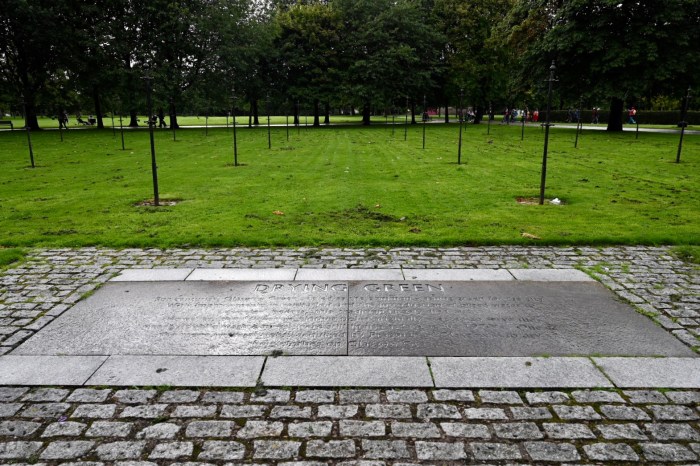
Jude at Travel Words is running a Life in Colour Photo Challenge this year, with the colour changing every month. For March it is green, and as Jude says “it’s easy to find shades of green in nature, but what else can you discover?” I’ll answer that question in a later post, but living in a city sometimes known as the dear green place with its own Glasgow Green I can’t avoid starting with that. And, as always, I can’t avoid including a history lesson along with the pictures!
Green is built into the name Glasgow, which is thought to derive from the Brythonic words glas meaning green and cau meaning hollow. Our oldest public park is Glasgow Green, where local citizens went to wash and dry their clothes from the time the land was gifted to the people in 1450 until the 20th century.
At first, women tramped their washing in large tubs, hitching up their skirts and petticoats, in what was known as Scotch Washing. This became an early tourist attraction, and English travellers in the 18th and 19th centuries commented on the brazen women of Glasgow Green. Later, wash-houses, or “steamies”, were built on the Green, the first opening in 1732 and the last closing in 1960, but the popularity of the common drying green continued up to the 1970s. The city’s bylaws still allow Glasgow residents the right to dry their laundry on the green, where a set of Victorian drying poles is maintained, though they’re seldom put to use these days.
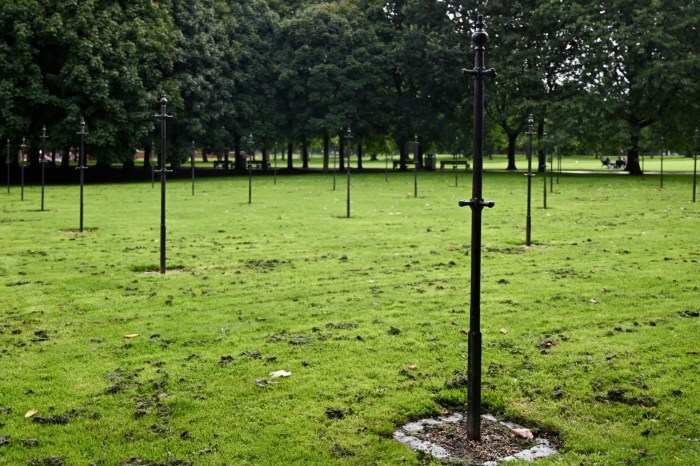 I could almost get away with adding this to Andrew’s Monday Washing Lines challenge at Have Bag, Will Travel. However, there are no lines and no washing on the poles! To get over that, here’s a flashback shot from our October break in Cellardyke. The matching pegs and the carefully separated white washing should please him.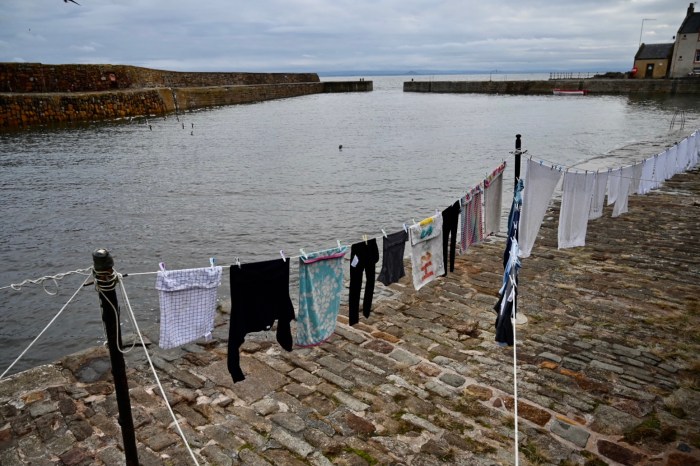


 The Glasgow Gallivanter
How wonderful to live in a city called the dear green place. Do you think it makes residents more appreciative of parks and public spaces in the city? It makes sense that before the advent of washing machines, or running water, women would congregate in a public place to do the washing, and of course laundry needed to be hung to dry.
Jude
LikeLike
I certainly appreciate the green character of the city! I think the wash houses and drying greens were a source of great camaraderie in very hard times.
LikeLike
That green grass is looking amazing!
LikeLike
Yes, I think so! Thanks for commenting.
LikeLike
Very interesting! I love that that little bit of history has been kept rather than being built over 🙂
LikeLike
Yes, it’s a lovely nod to tradition.
LikeLike
Hi Anabel, This is the first time I have heard about “Glasgow Green.” I appreciate the history lessons (only from you, Anabel, since you make them interesting)🙂 Intriguing about the common drying green. The flashback photo is picturesque and shares a snippet of actual life. Interesting post!
LikeLiked by 1 person
Thanks Erica – I’m glad you found it interesting.
LikeLiked by 1 person
I walked (or marched) to Glasgow Green during my first ever visit to Glasgow. It was the end point of a demonstration during the black days of the woman with the handbag 👜. I remember it being a cold, grey Winter’s day. I’ve been back there since, a couple of times. On nicer days when it was certainly much greener.
LikeLike
Maybe we were even on the same demo! Depending which end of her reign of terror it was (we arrived here in 86).
LikeLiked by 1 person
It was a few years before that. I was an early adopter!
LikeLiked by 1 person
Hi Anabel – love the washing lines … though probably wise they’re no longer in use – life has changed. Interesting history about Glasgow’s naming . St Patrick’s Day too for a Green Day … we are greening up down here … slow but sure – til the trees burst into green.
As Jude says – the Cornish ‘glas’ … one I hadn’t come across – so thanks for that – Hilary
LikeLiked by 1 person
Life has certainly moved on, thank goodness! And yes, Spring is definitely springing now.
LikeLike
Hi, Anabel – Once again, I’ve learned so much from your post. I love the history lessons that you throw in for us. I’d love to see photos of the wash done with hiked-up petticoats. So interesting!
LikeLike
Here’s an illustration from the National Gallery:
https://www.nationalgalleries.org/art-and-artists/90185/scotch-washing
LikeLike
This is an interesting story, Anabel. I’m intrigued by the washing poles. Did they once have lines attached to them?
LikeLike
They did! See https://www.theglasgowstory.com/image/?inum=TGSE00651
I think you would have to take your own now.
LikeLiked by 1 person
That’s a great photo. Thanks for sharing it with me.
LikeLiked by 1 person
Anabel, I think you did get away with it 😉 I do enjoy learning more your history of Glasgow. You’re right thank goodness for modern technology!
LikeLike
I just about got away with it, didn’t I? Andrew seemed to approve.
LikeLiked by 1 person
I’d never heard about Scottish women washing their clothes that way. Your posts are always so interesting!
LikeLike
Thanks Ann! It’s not a fashion I intend to revive.
LikeLike
Those Victorian poles would look great with lines of modern washing strung between them 🙂 When I was a child, and right up to 1979 when I moved here and had my own garden, it was common for people living in terraced houses to hang washing on lines strung across the back streets, in fact at one time most back yard outer walls had washing line pegs knocked into them. It was a great way to dry large things like blankets and sheets but you had to remember not to put anything out when it was bin day 🙂 🙂
LikeLike
They would. I’m not sure if there are still communal washing lines here in the back courts of tenements but there certainly used to be when I used to visit my grannies.
LikeLike
Fascinating history, and wouldn’t it be marvellous if every now and then washing did appear
LikeLike
It would, though as I’ve said to others, it won’t be mine!
LikeLiked by 1 person
That’s really interesting. I didn’t know any of that. I’m sure the poles could be used to hang art, pop up outdoor art gallery springs to mind. X
LikeLike
I think they have occasionally had art hung from them but I’ve never seen it. I half remember reading about embroidered sheets. We had a Women’s Library event there once and I’m afraid I was required to dance round one, a never to be repeated experience! (Nothing resembling pole dancing I hasten to add!)
LikeLiked by 2 people
Haha that’s one way of using them 🤭
LikeLiked by 1 person
I learn so many new things from you, Anabel. Don’t know if I recall hearing about any such large public laundry goings on.
LikeLike
I think it was quite common here, and when the steamies took over they created a fabulous female culture. There’s a wonderful play about it called, unsurprisingly, The Steamie.
LikeLiked by 1 person
I can imagine if it was a windy day in Fife half that washing might end up in the harbour as they are usually exposed areas. Had a day there years ago during the Sea Queen gala and even the bunting was taking off into the air in places.
LikeLike
I think you’re right! We were told which line we were entitled to use, but didn’t avail ourselves of the opportunity.
LikeLike
Such a fabulous history lesson, I love all your posts! And I love that drying green, such a shame there is no washing hanging up there. And I was chuffed with the use of the word glas – which in Cornwall is used to describe the colour of the sea – blue/green/grey. A great word. And it never occurred to me that it was the colour associated with Glasgow.
LikeLiked by 1 person
Thanks Jude! I’m glad you approve of my green effort. Another one next week I hope. It’s also interesting to hear about the similarities in different Celtic languages.
LikeLike
That’s a very sustainable (green) way to dry your laundry. Dryers are convenient but line-dried laundry smells so good. Interesting history!
LikeLike
Washing certainly gets a very good blow here! The challenge can sometimes be keeping it on the line.
LikeLike
Yes, like Sue I appreciated the information, Anabel. Amazing the things one doesn’t know! Washing would look great on that green. I’m surprised someone hasn’t organised it 🙂 🙂
LikeLike
Thanks Jo. A couple of people have suggested I should take my washing down there, but I’m politely declining!
LikeLiked by 1 person
That was a great post and line, thank you!
LikeLike
Thanks Jemima! Glad you enjoyed it.
LikeLike
The Washing Line challenge. That sounds like fun. I recently took a photo of doing our laundry at a campground in Mexico. The color green is a pleasing one, Anabel. I had no idea Glasgow was derived from it. Even in the desert, the prickly bushes are turning a bit more vibrant, some starting to appear … green! 🙂
LikeLike
It is fun. Most of the washing pictures in the challenge come from Mediterranean, or at least a warmer climate, so mine are a little different! It’s certainly good to see the green shoots of spring appearing.
LikeLiked by 1 person
What a great story and what an unusual fit for the ‘green’ challenge. I’m so glad the washing poles are preserved in Glasgow even if only to be used as content for a blog!
LikeLike
Thanks Mari! I’ve fixed your comment so it only appears once. We used the poles for a Women’s Library event once (I’m afraid I actually danced round one, not a pretty sight) and I think they have been used for other artistic endeavours, but I’m not sure they are ever used for their original purpose.
LikeLike
You should dry some laundry on the green!
LikeLike
I prefer to keep my undergarments a little more private!
LikeLiked by 1 person
Great post, never knew the Glasgow Green stories. Those maintained washing posts are fabulous, someone should definitely make a point of using them still.
LikeLiked by 1 person
It won’t be me! But I’d be there with my camera.
LikeLiked by 1 person
I love drying my clothes on a line but my hubby hates it. I like those Victorian poles and the shot you took it quite neat. How very interesting to learn some history here…those brazen women!
LikeLike
Showing their legs – shocking!
LikeLike
Peg discipline at its finest!
LikeLike
I hoped you’d approve!
LikeLiked by 1 person
How interesting, that the name “Glasgow” derives from “green”. Thanks for the info. As to “drying green”: from my childhood I still remember an enclosed courtyard just around the corner from our house, where washing was just spread on the grass to dry. And I also remember – that from France – women doing their washing at the side of a river, by scrubbing the washing on the paved stones at the bank and beaating te washing on the stones.
LikeLike
Thanks goodness for modern technology so that we don’t have to do that!
LikeLike
Well, I’ve had a rare old history lesson here! Never knew Glasgow was ‘the dear green place’, love the story of the women doing the washing on the green, and those cheeky 18th century English bods seeing it as a tourist attraction! And then the Steamies came along Thanks fo th info!
LikeLiked by 2 people
Thanks Sue, glad you enjoyed the history!
LikeLiked by 1 person
I did!
LikeLike
👍🏻
LikeLiked by 1 person