
Manchester: the libraries

Our visit to Manchester in November 2024 had four library visits in it! And we still missed one that I really wanted to see. (All headings below are linked to the relevant library website should you wish to know more).
Manchester Central Library
We visited the main public library in Manchester with Eunice, of Life in the Mouse House, on the day she came over to meet us. It’s a magnificent building. Entrance is via the Shakespeare Hall, called after the huge stained glass window above the front door. The window was designed by the Arts & Crafts artist, Robert Anning Bell RA (1863-1933) and includes a portrait of William Shakespeare and scenes from many of his plays. The ceiling is covered in heraldic decorations by George Kruger Gray (1880-1943).


On the ground floor we met one of several bee sculptures we came across over the week. They were part of the Bee in the City Trail in 2018, the worker bee being a symbol of Manchester. On the stairs was a beautiful sculpture of a girl reading by Giovanni Ciniselli (1832-1883).


Our first sight of the Reading Room took our breath away. What a beautiful space to work in!

We walked round the circular shelves very silently admiring the exhibition of Hoyles Collection of Printed Cottons 1884, and the little bird with the message Reading sets me free. Wonderful!


While with Eunice we also tried to visit the John Rylands Library and the Portico Library, but both were closed that day. The Portico remains on our to-do list, but we managed to visit John Rylands a few days later.
John Rylands Research Institute and Library
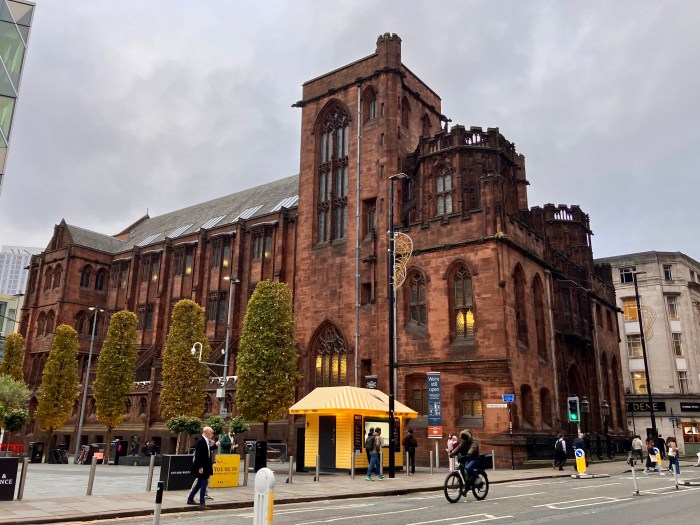
Now part of the University of Manchester, the John Rylands Library was founded by Enriqueta Rylands in memory of her husband, entrepreneur and philanthropist John Rylands, who died in 1888. Eunice has written a comprehensive post about the library so I will restrict myself mainly to pictures here, especially as I still have two libraries to go! The building is one of the finest examples of neo-Gothic architecture in Europe.


In the historic entrance hall two old printing presses were on display. The Columbian Press, also known as the Eagle Press, was invented by American engineer George Clymer in 1813 and, despite being over two hundred years old, is still used for demonstrations. The Albion Printing Press dates from the 1860s.


The main reading room, with statues of Enriqueta and John Rylands at opposite ends, stunned us even more than the one at the Central Library.


As you might expect, I just loved wandering round looking at the books and the old card catalogues. What librarian of a certain age has not dropped one of those drawers without its securing pin and had to refile all the cards? (Hint: I have definitely done this).


I also loved the doors and the glimpse of the Librarian’s Office with its green lampshade. I could certainly see myself working in there!


Chetham’s Library
Chetham’s Library, which was founded in 1653, is the oldest surviving public library in Britain. It was established under the will of Humphrey Chetham (1580-1653), a prosperous Manchester textile merchant, banker and landowner. The building is even older, dating from 1421 when it was built to accommodate the priests of Manchester’s Collegiate Church. It is now part of Chetham’s School of Music so, because the site is populated with children and young people, visits are by pre-booked guided tour only and for safeguarding reasons photographs of the library exterior are not allowed – however, the interior was more than interesting enough. As usual I have far too many pictures of book shelves – I just can’t help it! A few are shown below.


Other than the magnificent decoration, this reading room held two particularly interesting items: a chained library and the table where Marx and Engels studied for six weeks in the summer of 1845. The books they read are still held by the library – those on the table are facsimiles.


The chained library was one of five for which Chetham left £200 in his will. They were to contain “Godly books … chained upon desks or to be fixed to the pillars … in the Parish Churches of Manchester and Bolton-in-the-Moors, and in the Chapels of Turton, Walmesley and Gorton”. Two survive – this one is Gorton’s.


Working Class Movement Library
My final library, although historic, is quite different from the others – and I am actually a member! I first heard of the Working Class Movement Library some years ago when a Tory MP objected to it receiving any public funds. (It’s a charity, but I suspect he thought it was part of the public library system. I don’t expect Tory MPs to be clued up.) This kind of complaint is often counter-productive and, like many others, I was inspired to send a donation. I’ve renewed my “Radical Readership” every year since, but this was my first opportunity to visit.
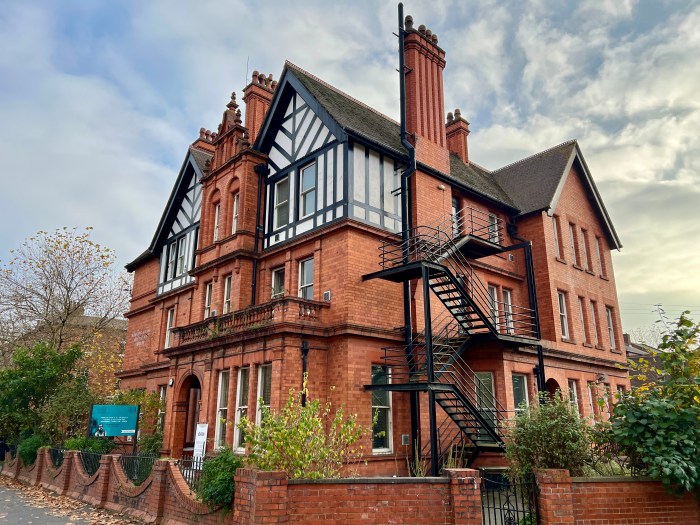
The Library is across the river from Manchester in the neighbouring city of Salford. Jubilee House originally opened in 1899 as a home for district nurses, then in 1957 became a local authority home for adults with learning disabilities. In 1987 Edmund and Ruth Frow moved in with their Working Class Movement Library, which they had been amassing since the 1950s, and lived there until shortly before Eddie’s death in 1997.
Opening hours are fairly limited, and if you want to see beyond the exhibition space on the ground floor you’ll need to book a Friday afternoon tour. We did exactly that. I don’t have photos of rows of books this time as they are all crammed into what are essentially bedrooms and not very picturesque. The view below looking up from one of the landings gives a general idea of the layout. The NALGO Room housed an exhibition of posters – I liked the name because many, many years ago I was a NALGO Shop Steward (National and Local Government Officers’ Association).


Some exhibits remain very pertinent today.


Some reminded us of home.


We met the Suffragettes again (of course).


And finally, a few other items which caught my eye.


It’s a good job John is happy to visit both women’s history sites and libraries! We didn’t neglect his primary interests though. My next Manchester post will concentrate on science and industry.


 The Glasgow Gallivanter
These libraries are beautiful and interesting. My favourite is the John Rylands Library reading room.
LikeLike
They are palaces to books!
LikeLike
I didn’t know the last one but absolutely loved the first three that I visited several times when living in Manchester. I actually have a similar post in my blog.
Looking forward to read your science post 😁.
LikeLike
The last one is definitely worth visiting too if you are ever back that way.
LikeLiked by 1 person
Hi Anabel – what a fascinating post – wonderful to see here … I really need to inwardly digest and re-read … but I’d love to visit – perhaps one day. Absolutely entrancing … so pleased you and John were able to visit – cheers Hilary
LikeLike
‘M sure you would love it there. So much interesting history.
LikeLiked by 1 person
As you know, Chetham’s is one of my favourite places to visit! I visited John Ryland’s library a couple of years ago… I nearly visited last weekend too, but the exhibition areas are closed due to work and there happened to be a queue to get in.
I do have a blog post about The Portico Library coming up.
LikeLike
The exhibition areas at John Rylands were closed when we went too, but there was no queue – we went about 4pm so it was quieter. I’ll look forward to your post about the Portico.
LikeLike
There is so much history that has been retained there and lucky we are today to have that! It is always so interesting to learn about Scotland.
LikeLike
We are very lucky to have so much history preserved.
LikeLiked by 1 person
So which was your favourite?
I have been in the John Ryland Library, though as part of a Toilets of Manchester Tour. There are some original Thomas Crappers there. 😁
LikeLike
That’s a very difficult question. I loved something about them all. Maybe John Rylands for beauty and the Working Class Movement Library for contents. That’s interesting about the toilets – we certainly didn’t see those.
LikeLiked by 1 person
wow, what a marvellous few days you had and what fabulous libraries. I am worry in chained libraries though that the books might be chained because they are magical!!
LikeLike
Ha ha! Magical or just too expensive to let the plebs get their sticky hands on.
LikeLiked by 1 person
I love average libraries, but the ones you feature here are anything but! How lucky to get to visit those in person!
LikeLike
They were all quite splendid!
LikeLiked by 1 person
We really enjoyed our visit to the John Rylands Library a few years ago. The others look great too. You must have been completely in your element.
LikeLike
I absolutely was!
LikeLiked by 1 person
Hi, Anabel – I absolutely love libraries and try to sneak in a visit to new ones when I am out of town. I’ve been to the University of Manchester Library and absolutely loved it! ❤
LikeLike
It’s amazing, isn’t it? So glad I have so many library-loving readers who don’t think I’m peculiar.
LikeLike
The Rylands looks like a cathedral! And I’ve never heard of a prohibition on photographing the exterior of a building (though it seems you snuck in the historic plaque—wasn’t it on the outside?)
LikeLike
It is very church-like! The Victorians did like their Gothic. The photography prohibition is for safeguarding reasons because the library is in the middle of a school campus, it’s not to do with the actual building. I’ve updated the post to make that clear, because someone else also thought it was odd. The plaque was on a high wall surrounding the site before you went through the gates, so even if they wanted to they couldn’t stop passers-by photographing that bit!
LikeLiked by 1 person
I’d love to read a book in any of those libraries. I love the stained glass and know each pane means something. Love that 2nd library because I love Gothic. I could go to that library every day.
LikeLike
Yes, I think if I lived in Manchester I would spend a lot of time in those libraries.
LikeLike
What a lovely collection of libraries! As beautiful as the grander ones are, my favorite is the Working Class Movement Library. I love the history and that you’ve been a Radical Readership member for so many years!
LikeLike
That one was really interesting. I would love to go back with more time as a proper “reader” to dive into some of their files. I think when I first joined it was just a Friends Scheme. I love the rebrand to Radical Reader!
LikeLike
Goodness such a great deal of interesting info and photos to read. I’ll have to print it all off and take time to read and enjoy. Thank you.
LikeLike
Thank you! Glad you think so.
LikeLiked by 1 person
You didn’t waste any time on frivolities then.
LikeLike
Frivolities? Us? Unheard of!
LikeLiked by 1 person
Ah, memories memories! I used to enjoy Manchester Central LIbrary almost as much as John Rylands. But I never saw Chetham’s Library, unsurprisingly, nor the Working Class Movement Library, which I never even knew existed until this minute. Thanks for a lovely nostalgic moment ior two.
LikeLiked by 1 person
Glad to oblige!
LikeLiked by 1 person
Visited the Rylands museum on a one day visit to Manchester and was absolutely blown away by the collections on display. Manchester certainly has done a wonderful job ensuring the libraries are thriving.
LikeLike
Yes, it has – thanks for commenting! I found your Manchester post and diverted to PEI which we visited many years ago because I was so keen to go to Green Gables.
LikeLiked by 1 person
Just a quick hop across the pond haha. Green Gables was a childhood dream of mine. Thanks for checking out my post!
LikeLiked by 1 person
Wonderful to see libraries alive and thriving in such stunning buildings, Anabel. I was gobsmacked!
LikeLike
So were we!
LikeLiked by 1 person
Very impressive buildings and a more interesting city than I thought from just seeing it on TV news reports over the years. Mind you, could say that of any city or town before you explore them properly. Bob. BSS.
LikeLike
We found it a great city to wander round – I was really glad we went.
LikeLike
The buildings are fascinating. We take so much for granted at times
LikeLike
We certainly do. These libraries were all wonderful.
LikeLiked by 1 person
The Working Class library is a unique one. Of the ones you write about, it’s the one I would most want to see.
LikeLike
WCML was so interesting – next time I shall book a spot in the reading room and do some research! They have a file about “my” suffragette.
LikeLiked by 1 person
Wonderful and beautiful libraries. I often visit libraries when we travel as I find it gives insight into a country and they are often beautiful buildings…(Suzanne)
LikeLike
All very true – though i just love nosing round other people’s libraries too!
LikeLike
I must admit that I do that too. It is always interesting to see what other people are reading.
LikeLiked by 1 person
I love this post for many reasons – thanks for the mention and the link by the way 😊 I’m so glad you managed to visit John Rylands and you got to see the reading room, it’s stunning isn’t it? You were lucky to get that outside shot with no traffic and few people too as it’s always very busy round there.
Chetham’s Library is one which, so far, I’ve had no desire to visit, plus it seems strange that you can take photos inside but not outside – it’s usually the other way round with old buildings like that. In Turton Tower, not far from me, is the Priest’s Room with a display of several of Humphrey Chetham’s chained books.
I’d never heard of the Working Class Movement Library so that’s gone on my list for another time. The Portico? such a shame it was closed when we went, that just means you’ll have to get back down here before too long!😀
LikeLike
It was quite late in the afternoon before we got to John Rylands (just before 4) so maybe we just avoided lunch time at one end and rush hour at the other. The reason you can’t take photos outside Chetham’s is because of safeguarding – it’s part of the music school campus and they don’t want any of the pupils to get in the picture. WCML is well worth a visit if you book the Friday pm tour. And yes, we’ll definitely have to come back to see the Portico!
LikeLike
These are such incredible places, Anabel. I’m sure you were in book heaven! 🙂 These libraries remind me more of museums than working libraries. Very special places!
LikeLike
I certainly was in book heaven! They are all working libraries, though i agree they were museums too – especially Chethams.
LikeLiked by 1 person
What a great set of interesting buildings!
LikeLike
They are – and fabulous contents too!
LikeLiked by 1 person
Sure!
LikeLike
Sue, when I’ve commented on your blog lately it has just disappeared (usually I can see the comment with a note that it’s awaiting moderation). Do you think WP has taken against me and is sending me to spam?
LikeLiked by 1 person
come to think about it, I haven’t seen any comments from you lately. Must check spam and see if you’re there.
LikeLike
I don’t always comment, but when I do you always reply and I don’t remember many replies recently either. Have you put any new filters in? Jude once blocked the word Van and it blocked GalliVANter!
LikeLiked by 1 person
I’ve never put in filters!
LikeLike
Oh well, WordPress just hates me then!
LikeLiked by 1 person
Well, I have just found loads of your posts in spam, so having rescued yo from there, WP should now know not to put you there any more – we shall see
LikeLike
👍🏻
LikeLiked by 1 person