
A Manchester miscellany
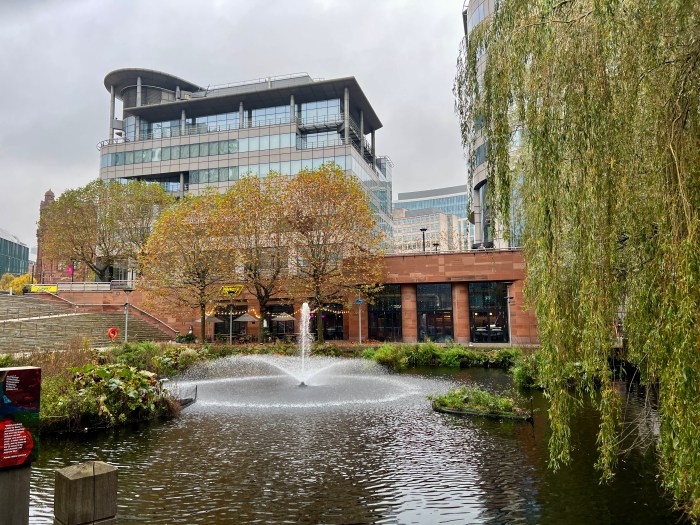
After seven Manchester posts, I’m itching to get on with something else, so I’m finishing with a sort of best of the rest summary. The header image was taken next to the Bridgewater Hall, opened in 1996 as the main venue for classical music concerts in Manchester. Outside stands a bronze bust of Sir John Barbirolli (1899-1970), renowned conductor of the city’s Hallé Orchestra.


Sticking with cultural venues, we visited the Royal Exchange Theatre, but only to look round the exterior and use the café. The theatre sits like a space module inside the old Exchange building – it opened in 1976 and I remember attending some early performances there in my student days. Above our heads we could see the board preserving the trading position on the last day that the building housed the Stock Exchange, 31st December 1968.


We passed the Whitworth Art Gallery on our way to the Pankhurst Museum and meant to go back to visit but ran out of time. We stopped long enough to admire the reflections of Anya Gallaccio’s stainless steel tree in the café windows.


We did visit Manchester Art Gallery where we discovered half a day was not enough. I honed in on my usual themes. Decolonialism is represented here by two Empire Marketing Board posters from the 1930s and reflections on their meaning today. To represent women’s history I’ve chosen two plaster casts for bronze reliefs on the Pankhurst Museum in London. The streetscape is included because it depicts Oxford Road in 1910. The large building being constructed back left is the Refuge Assurance Group HQ, now the Clocktower Hotel where we stayed.


We strolled through the University grounds and found several plaques to interesting people, some of which have already appeared in my science and industry post. Here are Labour politician Ellen Wilkinson and writer Anthony Burgess.


Manchester has a strong radical history. In August 1819 a peaceful protest of around 60,000 people took place at St. Peter’s Field. The crowd, demonstrating in favour of voting rights and political reform, was brutally dispersed by the authorities resulting in hundreds of injuries and several deaths, and becoming known as the Peterloo Massacre. A red plaque on the site, later occupied by the Free Trade Hall which is now a hotel, commemorates this. In 2019, on the 200th anniversary of the massacre, Manchester City Council inaugurated a new Peterloo Memorial by the artist Jeremy Deller, featuring eleven concentric circles of local stone engraved with the names of the dead and the places from which the victims came.


The statues below are Abraham Lincoln and social reformer Robert Owen. There is a long explanation on the Lincoln plaque about the Lancashire Cotton Famine of 1861-1865. By supporting the Union under Lincoln, when there was an economic blockade of the Southern states, the Lancashire cotton workers were denied access to raw cotton causing unemployment throughout the industry. The statue was presented to the city by Mr and Mrs Phelps Taft of Cincinnati, Ohio, to commemorate the support that the working people of Manchester gave to their fight for the abolition of slavery.


On a less serious note, pubs! Manchester has some very interesting pub buildings. I could have written a whole post about their history, but I will confine myself to saying that two of them are not all they seem. The Old Wellington and Sinclair’s Oyster Bar have been relocated brick by brick – Eunice can tell you all about that. I’ll also point out that the Britons Protection has another commemoration of Peterloo.


To end on a really colourful note, here’s China Town at night. And for Manchester, that’s a wrap!


 The Glasgow Gallivanter
Great shots. I’m yet to make it to Manchester but I’d like to. Something intriguing about the board with the last days trading captured on it. A moment, frozen in time.
LikeLike
Thanks – it’s definitely worth a visit! Yes, I liked the trading board being preserved too.
LikeLike
ah the fabulous challenge of an amazing city break – too much to share! Great way to end
LikeLike
Thanks Becky! Hope the house is looking good.
LikeLiked by 1 person
Very happy with first phase, now trying to decide on wall colours ready for when they return for phase two 🙂
LikeLike
Good luck with that! I can never decide.
LikeLiked by 1 person
I am going to make my builders make final decision!!
LikeLike
I hope they have good taste!
LikeLiked by 1 person
yeah, they’ve been excellent so far so trust them to make the final decision. I will have it down to two for each room by then
LikeLike
👍🏻
LikeLiked by 1 person
Great photos Anabel. I remember visiting most of the places you took in photos.
LikeLike
Thanks Mélodie!
LikeLiked by 1 person
Wow, I think you saw everything! I love those old pubs at the end. Have been in them all. 🙂
LikeLike
Oh well done! we just looked from the outside. And, yes, we saw loads – but not quite everything. Still things to go back for!
LikeLiked by 1 person
Even though the working life of canals only lasted a short period, overtaken by railways, every city, village, and town has benefited from them immensely, as they would never have been constructed purely for leisure, or boat living, the main purpose now. They could easily have been filled in and lost forever during previous dormant decades. Instead they are one of the delightful aspects of the UK for tourists and locals that few would think of removing now, replaced by house building or car parks, as your first photo highlights. A real asset to any district lucky enough to have one. Bob. BSS.
LikeLike
That’s very true. I love ours, and some of the Manchester ones had been very well done up.
LikeLike
Glad you wrapped it up with the pubs—I was feeling a thirst coming on!
LikeLike
Ha ha! Believe it or not we didn’t go into any of these pubs, though we had good food and drink elsewhere every evening.
LikeLiked by 1 person
I understand your wanting to move on, but I really have been enjoying the Manchester posts!
LikeLike
Thanks, Ann, glad you enjoyed your virtual visit.
LikeLiked by 1 person
All so familiar, Anabel. It’s been interesting to read your take on it all
My first taste of Manchester was when I was a 6th former and used to go in for concerts – the first one was at the Free Trade Hall and I saw so many there. It was a sad day when they demolished it (except the facade) and turned it into a hotel.
(One of your photos isn’t so far from my office – not that I go in there very often!)
LikeLike
I didn’t realise it was just a facade, though I should have guessed. Well, at least it still looks good on the outside!
LikeLike
Hi Anabel – a place I should obviously spend more time in … but there’s so much to explore now-a-days … you’ve given us lots to think about … thank you – and a great range of 7 blogposts – cheers Hilary
LikeLike
Thank you Hilary. I could have kept going but decided enough was enough!
LikeLiked by 1 person
I’ve loved your posts from Manchester, Anabel! Thank you for taking me back there.
LikeLike
Thanks Donna! Glad you enjoyed the memories.
LikeLiked by 1 person
Love the variety of pubs you have photographed. We only had a day in Manchester when our flight was cancelled but it turned out to be one of the best days on our latest trip to England. Really enjoyed visiting some of the main touristy sites.
LikeLike
Thanks, it’s a splendid city!
LikeLiked by 1 person
You are indefatigable explorers.
LikeLike
We do like to see as much as possible!
LikeLiked by 1 person
A great collection of finds from Manchester! I particularly the pubs, they have so much character.
LikeLike
Thank you, they were an interesting collection! We never actually tried any of them inside.
LikeLiked by 1 person
A mint mooch around Manchester! Amazing what you’ve seen and recorded -all very interesting. Thank you.
LikeLike
Thank you! There was so much to find.
LikeLiked by 1 person
Thanks for the virtual tours!
LikeLike
And thanks for your interest and promotion of them!
LikeLike
Shifting a building brick by brick what an achievement and hard work. Yes, like Jude mentioned my eyes have been opened regarding Manchester. We have extended family friends shift there in recent years and they love it.
LikeLike
I’m not surprised, if I had to move from Glasgow (not gonna happen) it’s certainly a place I would enjoy living.
LikeLiked by 1 person
You have opened my eyes to this city which I have only ever associated with cotton and rain!
LikeLike
We had a dry week – I think if it had rained every day I might have been less positive!
LikeLiked by 1 person
The Whitworth especially, but also Manchester City Art Gallery were basically my second homes there. If Chinatown existed then, we didn’t know about it. And as to pubs, the only one I remember is The Grapes on Deansgate, which did a bowl of chilli con carne for 2/6, and was a great place to go after a morning slaving away at the John Rylands Library.
LikeLike
We were very impressed with the city art gallery and were sorry to miss the Whitworth. Chinatown is next to the Gay Village which I suspect also did not exist in your day! 2/6, I doubt you’d get a single sweetie for 12.5p now!
LikeLiked by 1 person
Quite so. I used to get out £2.10s for weekly housekeeping for our flat in Withington. Including bus fares: it was quite enough. And no – no Gay Village or Chinatown then. The very idea!
LikeLike
In my day, £10 a week was required. (Cue Monty Pythonesque competition!)
LikeLiked by 1 person
🤣 You young thing you!
LikeLike
A mere stripling!
LikeLiked by 1 person
A very good idea to do this wrap-up post, covering things that might otherwise not have had an airing 🙂 Most of these are new to me although I have been to Chinatown (and eaten in an excellent restaurant there). You’ve shown through all these posts quite how much Manchester has to offer for a city break!
LikeLiked by 1 person
It’s a great place for a city break, though I have definitely exhausted it now in terms of blogging! We also had an excellent meal in Chinatown.
LikeLiked by 1 person
Philadelphia’s Chinatown has a huge arch that looks a lot like the one in Manchester. I’m automatically a fan of any city that has a Chinatown.
LikeLiked by 1 person
Yes, me too. We had one great meal in China Town but there were so many other cuisines to choose from we had something different every night.
LikeLiked by 1 person
Yes, because every country is a eccentric mix of so many cultures. New York comes to mind.
LikeLiked by 1 person
It’s what makes life enjoyable, though unfortunately not everyone sees it that way.
LikeLiked by 1 person
Well done you for covering so much ground!
LikeLike
It was quite a tiring week but very enjoyable!
LikeLiked by 1 person
Somehow I don’t think a week in Manchester is long enough Anabel 😉😀 I like the stainless steel tree and the Pankhurst plaster casts, and that’s a lovely colourful shot of Chinatown at night.
I was back at the Central Library on Saturday – I’m just now writing about it – and I thought about you. In the Reading Room there’s a display on the history of womens’ cycling with a quotation from an American Womens’ Rights activist.
Thanks for the link by the way, I did finally manage to go into Sinclairs for lunch one day last March, it has lots of very small rooms and poky corners, also a policy of no mobiles, tablets or laptops 🙂
LikeLike
It definitely isn’t long enough! I’ll look forward to your post about the Central Library. We didn’t actually go into any of these pubs but they all looked interesting from the outside!
LikeLike
You covered a lot of territory and saw so much. We really enjoyed our time in Manchester too. It’s a great city.
LikeLike
Yes, we were on our feet most of the time! It is definitely a great city.
LikeLiked by 1 person