
A tale of three counties (2023)
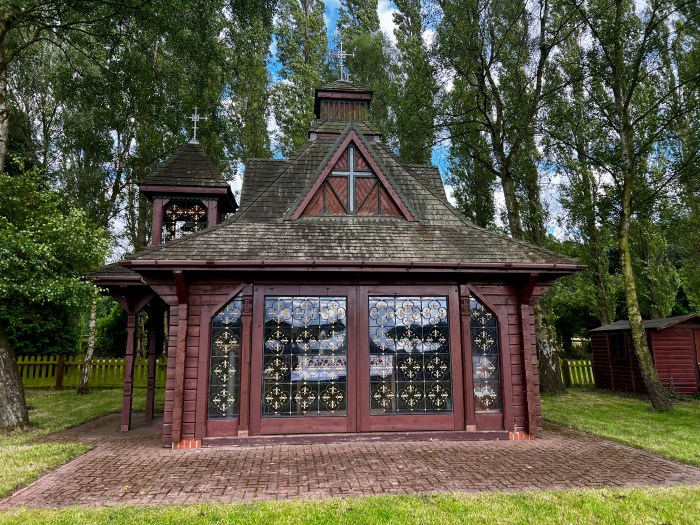
After our stop in Mansfield we carried on to Derby to stay with our friend Janet for three nights. I admit I saw little of Derby or Derbyshire other than Janet’s house while we were there, because the excursions we made were in other counties, but John had his bike and explored a bit more locally. He found, for example, the beautiful little Ukrainian Chapel (above) near Weston On Trent and the milestones below, included because a certain Mr Tootlepedal tells me he is partial to milestones.


The National Memorial Arboretum (Staffordshire)
I had never heard of the National Memorial Arboretum at Alrewas, but it’s a fascinating place. In 150 acres of woodland and gardens there are over 400 memorials to both military and civilian organisations as well as trees dedicated to individuals, such as Janet’s father. To start us off, here is his plaque and a bench for Jude, found in the Visitor Centre, which remembers young people’s experience of lockdown.


I’m not sure that we photographed all 400 memorials, but we spent all day there and must have seen most of them. These are the two which made the biggest impression: I found them both harrowing.
The Shot at Dawn Memorial commemorates 309 British and Commonwealth soldiers who were shot for desertion, cowardice, striking a senior officer, disobeying a lawful order, casting away arms, mutiny and sleeping at post during the First World War. Most of them were sentenced after a short trial with no real opportunity for defence, despite some of the “offences” being minimal. From Private Abraham Bevistein’s last letter home before his execution:
We were in the trenches, and I was ill, so I went out and they took me to prison, and I am in a bit of trouble now. I will have to go in front of a court. I will try my best to get out of it, don’t worry.
Many others would have been suffering from Post Traumatic Stress Disorder (PTSD), which was not recognised as a medical condition until 1980. In 2006 all were officially pardoned by the British Government. Not before time.
The figure in the memorial, which is by Andy deComyn, represents Private Herbert Burden who is surrounded by stakes representing the other soldiers. I read on the Arboretum news page that these were all replaced last year thanks to hundreds of donors.


The other memorial which made a huge impression was the Armed Forces Memorial to those killed since the Second World War. It is enormous and already holds about 16,000 names with, chillingly, space for another 15,000. We never learn.


The Workhouse and Infirmary, Southwell (Nottinghamshire)
When we lived in Nottinghamshire we visited Southwell from time to time – it has an interesting Minster. I did not know that it also had the most complete workhouse still in existence, now run by the National Trust. The Workhouse was built in 1824 to provide a last resort for around 160 of the local area’s destitute and desperate. Over the years thousands of inmates and patients passed through its strictly segregated layout, influenced by the design of prisons. After the Workhouse some of the buildings became homeless accommodation and a home for the elderly, not finally falling out of use until the 1980s. I can’t possibly do it justice in a short post – if interested there is a comprehensive history on the NT site as well as some case studies on Find My Past.


I liked the way they got the history across, even though they didn’t have many actual artefacts, using information on walls, fabrics, and even the café plates. The sad page from the punishment book and the mean recipe for gruel have a connection. Both Ann Smith and Eliza Alney had their porridge stopped, one for using indelicate language and the other for neglecting to attend prayers. The recipe suggests they weren’t missing much – when I make porridge I use 100g oatmeal, rather than 20g as here, for a similar amount of liquid. Unfortunately, some current politicians adhere to the opinion that you can make a nutritious meal for 30p. They’d have loved the Workhouse.


While the conditions in the Workhouse were shocking I did already know what they were like. More surprising was the room illustrating homeless accommodation in the 1970s. Six rooms were adapted for families, not including male partners who could visit but had to live elsewhere. The one recreated was grim – but then we still don’t get this right with homeless families stuck in bedsits and run down hotel rooms, so maybe I shouldn’t have been so surprised.


Hardwick Hall (Derbyshire)
After leaving Janet, we finally visited a Derbyshire destination – Hardwick Hall, a place we often took visitors when we lived in the area but which we hadn’t been to in decades. It could not have been a bigger contrast to the Workhouse.
Elizabeth Hardwick (1521-1608) was born of a good family but not an especially wealthy one. Surviving four husbands, she increased her fortune each time she was widowed and ended up as the Countess of Shrewsbury. This was not just luck: Bess of Hardwick, as she became known, was clearly fiercely ambitious and reportedly a shrewd businesswoman.
Barely a month after her fourth husband, the Earl of Shrewsbury, died in 1590 the foundations were being dug for Hardwick New Hall. (The ruins of the Old Hall are also on site.) Robert Smythson, known as the first English architect, created plans using new ideas on symmetry and a daring quantity of glass, giving rise to a local saying Hardwick Hall, more glass than wall. The turrets at the top are emblazoned with the initials ES (for Elizabeth Shrewsbury) and a coronet, leaving no doubt of Bess’s pride in her achievements.


The interiors are equally splendid.


As are the grounds and gardens.


From Hardwick we continued to the final destination of our four-stop English road trip: Aysgarth in the Yorkshire Dales.


 The Glasgow Gallivanter
Three very interesting visits Anabel. The air memorial is magnificent. I always find it so sad when I visit these kind of working places and to see how they were treated. Not that it is better nowadays as this still happens in some parts of the world but still sad.
The last manor is gorgeous 😍.
LikeLike
The first two visited were very sad, but we found them very interesting. Bess’s house is magnificent but life was probably hard there too for anyone but her and her family.
LikeLiked by 1 person
My family history research has revealed that several relatives were in workhouses – some spending their final days there. Not surprising for a working class family. But what awful places they were.
LikeLike
They were, and seemingly devoid of all human feeling for the inmates.Some of the stories were horrifying.
LikeLike
I worked for the Royal British Legion many years ago and was familiar with the National Arboretum, but have never visited. The Shot at Dawn memorial looks incredibly poignant. As you say, we never learn… I had no idea the National Trust looked after a workhouse, it looks a fascinating place. I’ve only ever read about the workhouses in books by the likes of Dickens, so it’s interesting to get a glimpse of what they may have been like. Hardwick Hall looks glorious!
LikeLike
All three of these places are well worth visiting. I was surprised to find out about the workhouse too – it did give an idea of what it could have been like to live there, but I’m sure it didn’t express the full horror of the squalid conditions.
LikeLiked by 1 person
Hardwick House looks very fine and Bess was right to be proud of it. 😊
LikeLike
Bess was some woman!
LikeLiked by 1 person
You couldn’t get more of a contrast with these three places – all very interesting and moving.
LikeLike
I know – I had been to Hardwick in the past, it was the sort of place where we took visitors, but I hadn’t heard of the other two which weren’t open when we lived there.
LikeLiked by 1 person
There could hardly be a greater contrast between Hardwick Hall and that workhouse, could there? A perfect illustration of the saying, ‘How the other half live’. And the National Memorial Arboretum looks even more moving than the workhouse, especially the memorial to those shot for desertion.
LikeLike
Exactly, Sarah. I learned so much from these two sites (the workhouse and arboretum).
LikeLiked by 1 person
What a moving journey through history! The National Memorial Arboretum’s memorials are powerful reminders, and the contrast between the Workhouse and Hardwick Hall really highlights England’s past. Thanks for sharing these thoughtful reflections and beautiful photos!
LikeLike
Thank you. I was very struck by the contrasts.
LikeLiked by 1 person
The chapel and milestones are very cool. I guess I didn’t get what was so harrowing about the two memorials you shared.
Wars and workhouses are such reminders of how inhumane humans can really be. Ugh.
Well, the Countess did quite well now, didn’t she?!
LikeLike
And the inhumanity continues, sadly. Bess did ok for herself, but I bet her peasants didn’t.
LikeLiked by 1 person
Thanks to you I now know that some milestones are physical objects. I thought they were only memorable moments.
LikeLike
There are still quite a lot of old ones around. These seemed especially picturesque, I liked the cylindrical shape.
LikeLiked by 1 person
You certainly get around. I’m glad I live in current times. Even in the 1960s- 1980s period, in many institutions, it was tough and primitive and frequently open to abuse due to a lack of accountability. Bob. BSS.
LikeLike
Yes, and the abuse still continues in many cases. No institution seems to be exempt.
LikeLike
Fascinating post. I haven’t been to any of these places though I have a feeling Hardwick Hall might have featured on the NT programme? What a contrast with the Workhouse. And The Shot at Dawn Memorial is so harrowing. I mean what those poor men went through, no-one deserved to be shot. And we still haven’t learned to live in peace.
Thank you for the very interesting bench. Covid heh! Doesn’t seem like 5 years ago already.
LikeLike
Thanks Jude. Very interesting contrasts in those three places, and the workhouse and memorials were sobering. Yes, peace is still elusive and Covid doesn’t seem five years ago in some ways, but in others feels like another world.
LikeLiked by 1 person
I would’ve enjoyed a wander around the National Memorial Arboretum at Alrewas. Especially poignant for your friend Janet.
LikeLike
Yes, having given up her car she hadn’t been able to visit for some time.
LikeLiked by 1 person
I do like milestones and these were very good. Thank you and John. I will have to ask my Derby based brother if he has ever noticed them.
LikeLike
I’m glad you find them pleasing.
LikeLiked by 1 person
I forgot to mention how much I like the milestones and the chapel.
LikeLiked by 1 person
A post full of contrasts …just like life now. I lived in Nottinghamshire for 35 years so visited Hardwick many times with parties of school children in tow! They loved seeing the contrasts in their 1990 lives to those of Bess! We only talked about workhouses in class and didn’t visit any…maybe we should have opened their eyes more. The Memorial Arboretum opened in 2001 so no visit there but I do hope that school children are taken there now.
LikeLike
It’s hard to imagine three more different visits – and something to be learned from them all.
LikeLiked by 1 person
Hardwick Hall is a must in that area of course, but you’ve unearthed some treasures here. Tends to develop your political bent, these kind of contrasts, non?
LikeLike
It’s enough to turn you into a leftie. Oh hang on …
LikeLiked by 3 people
🤣😉
LikeLiked by 1 person
Thanks for taking us on these tours. I would love to visit Hardwick Hall – my mum and I watched a TV series when I was a young teenager about Elizabeth Hardwick which we both just loved and I have wanted to go since.
LikeLike
She was a remarkable woman!
LikeLike
Plenty of arresting, poignant history here, the type of experiences we ought to be learning from but sadly do not appear to be heeding.
LikeLike
I agree, also sadly. I had been to Hardwick Hall before but the other two places were a complete revelation. I had never visited anywhere quite like them.
LikeLiked by 1 person
An interesting day of contrasts. Shot at Dawn was truly awful… a different era, and a poignant memorial
LikeLike
I suppose we have now learned about PTSD, but there are still too many (mainly) young men dying in wars. ‘Never again’ didn’t seem to work.
LikeLiked by 1 person
Precisely… humankind will never learn or has no desire to act on what it has learnt
LikeLike
I know 😢.
LikeLiked by 1 person
I think the officers should have been shot instead!
Great interesting post Anabel, enjoyed reading about The Workhouse and also Bess of Hardwick. I’m sure I’ve heard of her before, sounds like a formidable woman
LikeLike
Exactly – lions led by donkeys.
LikeLiked by 1 person
The Shot at Dawn Memorial reminds me of this:
As you say, traumatised soldiers were often regarded as being cowardly or mutinous rather than being ill and consequently many were shot as either cowards or deserters. S.J. Robinson described the fate of a young soldier accused of being a shirker:
They said he had fallen, fallen from grace:
Deserted the line, without a trace
They said he was a Coward, deserving to die
We know he was ill, so you tell us why
He’d fought at Wipers, Mons and The Somme:
Won medals for bravery, slogged on and on:
Lost friends, lost a brother, but not once at all
Shirked from his duty, let courage stall
Then last night in a barrage, the Germans advanced
HE blocked their way, gave comrades a chance,
Ran back to the lines to call for some aid
So more senseless slaughter could be allayed
But he couldn’t run, couldn’t move, couldn’t speak
When he saw his mate, blown to bits in a breach.
Should have been used to it? Been Prepared?
He was only nineteen-no wonder he’s scared
They say he ran, deserted his station
A total disgrace to battalion and nation
No trial was given, ‘Shellshock’ dismissed
Though they’d never even tried to enlist
They’ll shoot him at dawn, it’ll say on his grave
Not mention the number of lives that he saved
But could they later, go to that place
And swear that he’d fallen, fallen from grace?
LikeLiked by 2 people
So apposite. Between 2014 and 2018 National Theatre of Scotland had a wonderful trilogy of plays about the men shot for ‘desertion’ and the effects on their families at home. We saw them all – harrowing but beautifully done.
LikeLiked by 1 person
Fascinating contrasts between all of the places you visited. Interesting quite like the memorial and the story of the workhouse. (Suzanne)
LikeLike
There was a real contrast between the opulence that Bess lived in and the abject poverty of the workhouse. It was interesting to see them both so close together.
LikeLike
Those memorials in the arboretum are certainly very poignant. Such a vast contrast between the workhouse and Hardwick Hall too, the Hall looks very grand and opulent. I have to wonder about Bess though, surviving four husbands and becoming better off each time – maybe she was secretly bumping them off 😀😀
Incidentally, I went to Elizabeth Gaskell’s house the other day – a very interesting place but the young man serving in the tea room gave me the creeps.
LikeLike
Maybe she was! Glad you enjoyed the Gaskell House. I do remember a young man whom I thought was probably neurodivergent in some way but he was helpful.
LikeLiked by 1 person
You certainly fit a lot in. Life was so tough back then, we really haven’t much to complain about these days
LikeLike
In comparison, no – and it was just a few generations back.
LikeLiked by 1 person