
Edinburgh: a Canongate walk
After our recent visit to the Scottish Parliament, we walked slowly up Canongate exploring the closes, or courtyards, to either side. Canongate itself is over 800 years old and was a separate burgh from Edinburgh until 1856. Its name comes from the Augustinian Canons of Holyrood Abbey who, in the 12th century, were given permission by the king to build on either side of the path, or “gait”, between the Abbey and the Old Town of Edinburgh.
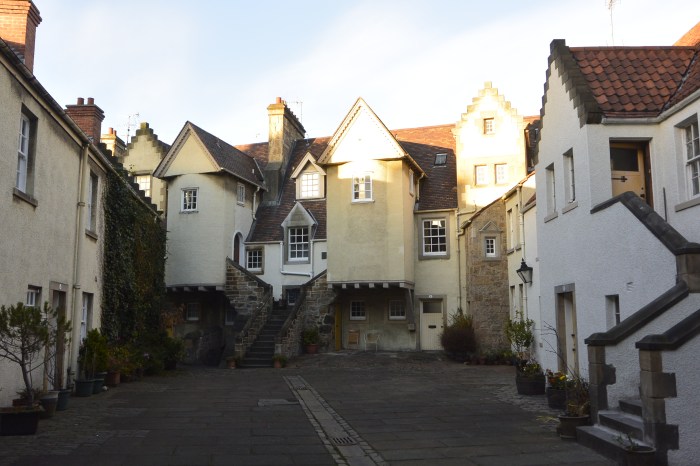
Immediately opposite the parliament is White Horse Close (above) which takes its name from an inn which once stood there. The buildings have been restored, but still give a good impression of how the courtyard must have looked hundreds of years ago. Zoom in on the window above the stairs and you will see that it is dated 1623.
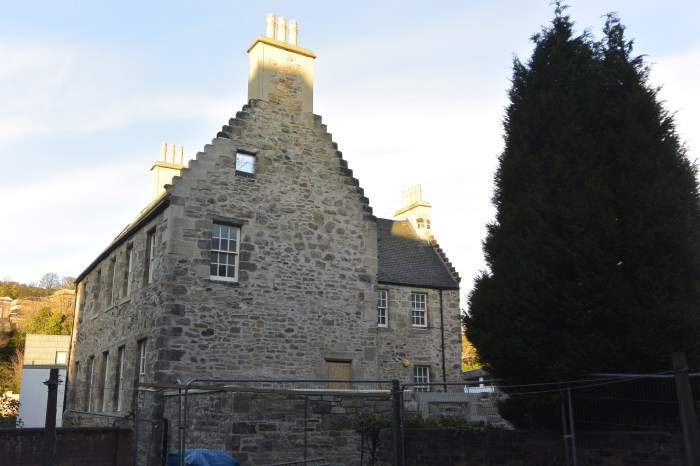
Further up Canongate is 17th century Panmure House, once home to the economist and philosopher Adam Smith. It’s currently undergoing renovation, so it was hard to get a photograph to do it justice.
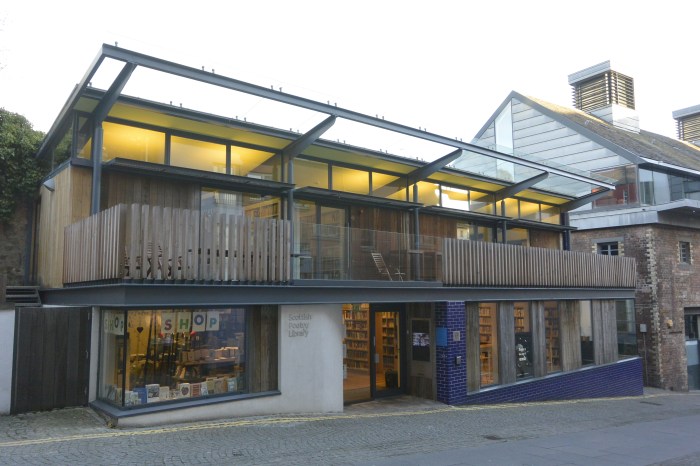
Not all the closes hide old buildings – tucked away in Crichton Close is the Scottish Poetry Library (1999).
Next, we explored Canongate Kirkyard – like all these places, apart from the Poetry Library, somewhere I’ve walked past many times without investigating. I was surprised how extensive the Kirkyard is.


The next close was my absolute favourite – Bakehouse Close is home to Acheson House, built in 1633 for Sir Archibald Acheson and now the home of Edinburgh World Heritage. The Acheson family crest, a cock and trumpet, is above the door.


Why do I love it so much? The information panels on the wall about Rangers Impartial List, a 1775 guide to 66 of Edinburgh’s prostitutes. Many of the closes in the Old Town housed brothels, and Acheson House was one of them, then known as the Cock and Trumpet after the crest. The list pulls no punches in assessing the women’s appearance and skills – I hope you can enlarge the panels sufficiently to read some of it. I particularly like Mrs Agnew, a “drunken bundle of iniquity” who would think nothing of a company of Grenadiers at one time. At 50!


A couple of shots as we made our way to our next stop – the Tolbooth Tavern on Canongate peeking through an archway, and a further example of modern buildings behind old ones. These are student flats, with a lovely view of Salisbury Crags.


Another 17th century mansion is Moray House, now owned by the University of Edinburgh. The buildings round about comprise the University’s School of Education.


Next up is Chessel’s Court with this traditional 18th century Edinburgh ‘mansion style’ tenement, originally built to provide better accommodation for relatively wealthy residents of the Old Town. Back on Canongate, we were observed by a strange statue which is said to represent the Emperor of Morocco.


Finally, we turned the corner into St Mary’s Street, the site of Boyd’s Inn where Dr Johnson stayed in 1773 on his way to meet James Boswell for the start of their journey to the Hebrides. I liked the shop opposite with its rather cross looking bull!


From here, we headed across to the New Town and our visit to the ice sculptures which I’ve written about previously. I was soon to find out that it was possible to shiver even more on this bitterly cold December day!
I hope you’ve enjoyed your tour through part of old Edinburgh. I’m linking to Jo’s Monday walks – the blue skies of Portugal should warm you up after this chilly post!


 The Glasgow Gallivanter
A lovely tour through old Edinburgh. After reading your descriptions and viewing the photos, I almost feel as if I’ve been there.
Jude
LikeLike
Thank you, glad you enjoyed it. I’s a fascinating area with so much history.
LikeLike
Lovely visit. (Suzanne)
LikeLike
Thank you – and lovely to hear from you. I hope all is well with you both.
LikeLike
Hi Anabel. Yes, we are both doing well and we have great travel plans for 2018. Hopefully, they will all be realized. We have a posts coming up on our last trip to Mexico City and we will probably make sporadic appearances on our blog when we want to document our trips…
LikeLike
Oh, I will look out for that! I hope your plans all come off.
LikeLike
oh this is wonderful, really must return to Edinburgh – ooh there’s another thought for our reunion. Be warmer in the Spring too!
LikeLike
Well, that would certainly be easy for me – though maybe not so fair on you!
LikeLiked by 1 person
Can fly from So’ton – so once we know dates I would just need to check out prices.
LikeLiked by 1 person
I’m late but I am here! I would love to live in that old part of town because it looks so medieval. I laughed at the prostitutes’ descriptions especially the one you mentioned and the other about her teeth being tolerable
LikeLike
They were certainly very frank in their descriptions!
LikeLike
So many goodies here! I wish I’d known you when I visited Scotland, Guess I will just have to come back.
That cock and trumpet family crest has now got me thinking about what I want my family crest to be (Perhaps a unicorn and rainbow 🦄🌈😁)
LikeLike
That sounds good! Of course, the unicorn is Scotland’s national animal and appears on our coat of arms so you’d be in good company.
LikeLiked by 1 person
I love Scotland now more than ever!
LikeLiked by 1 person
A fascinating walk through your part of the world Anabel
LikeLike
Thank you, the history is fascinating.
LikeLiked by 1 person
Lots of interesting sites on this walk! Love the cock and trumpet crest, but I’m most intrigued by Rangers Impartial List, which sounds very much like Harris’s List of Covent Garden Ladies…which was published by an H. Ranger, so now I’m rather curious if this is somehow an offshoot of the London version. I’ve always wondered how they were compiled – did Tytler (who has a rather apt name for the job, if it’s pronounced the way I think it is!) actually visit all the ladies in question himself, or did he have correspondents? From what I know of Boswell, I wouldn’t be surprised if he was a correspondent!
LikeLike
Interesting! Ranger’s maybe published a whole series in different cities. I read elsewhere that Tytler (I’d pronounce it that way too) found the research for the Edinburgh guide so exhausting he didn’t do one for Glasgow. Make of that what you will…
LikeLiked by 1 person
I enjoyed strolling through history with you, Anabel. What a picturesque place this is and with so much to take in. 🙂
LikeLike
Thanks – we were surprised too at how much we had been missing.
LikeLiked by 1 person
Hi Anabel – what an enlightening part of the world … fascinating to see so many gems – thanks for giving us an insight … when I visit Edinburgh – an area to add in to the list … lovely post – cheers Hilary
LikeLike
Thanks Hilary! Glad you enjoyed it, it is indeed a fascinating area.
LikeLike
No one can deny that the ladies of Acheson House had stamina: a company of Grenadiers indeed. Reminds me of the line in the lovely Victoria Wood song about Brenda “… could handle half the tenors in a male voice choir”.
I really feel I know your Glasgow now after all your Posts.
LikeLike
Ooh, yes, I remember Brenda! Victoria Wood sadly missed.
LikeLike
What a lovely tour, Anabel! I have not been to Scotland, but would love to see these sights in person some day. My favorite was the cross looking bull. LOL!
LikeLike
Thanks, glad you enjoyed it! The bull certainly was cross.
LikeLiked by 1 person
I do like Edinburgh. Last time I was there (2015) I went to the castle to see Ewart’s Eagle but it wasn’t there – it had been loaned out. I need to go back!
LikeLike
I haven’t been to Edinburgh Castle for years! We always seem to be going for something else and, we’ll, it’s always going to be there when I’m ready for it again.
LikeLiked by 1 person
Didn’t know much about Edinburgh – other that the usual tourist things built around the castle and a few other places, so canongate was all new. I enjoyed the experience.
LikeLike
Thank you – a lot was new to me too. The walk came about by chance when I picked up a leaflet on our way out of the Parliament.
LikeLike
Really enjoyed that tour. I use that graveyard and that first close as a scenic short cut fairly often walking between CH and AS but the other items were new to me. Must have been slightly confusing using f for S when they also had the normal f at that time. It’s a fascinating district.
LikeLike
I suppose if you just learn to read it that way, it’s fine – it’s certainly confusing for us. Most of this was new to me too, it definitely pays to get off the main drag from time to time.
LikeLike
Beautiful photos as usual! I love that there is a whole library dedicated to poetry.
LikeLike
And not only that – Scottish Poetry!
LikeLiked by 1 person
I love that part of Edinburgh, though my explorations haven’t been nearly as thorough, and always ended in a pub. So nice to see a photo of the Scottish Poetry Library; I only know it in its virtual incarnation. 🙂
LikeLike
Pubs often figure in our visits to Edinburgh too! Not this time, though we did have a good, warming curry before we got the train back to Glasgow.
LikeLiked by 1 person
Now I am jealous. NZ doesn’t do Indian restaurants like the UK. I miss that!
LikeLike
It’s something we seek out everywhere we go – with variable results!
LikeLiked by 1 person
🙂
LikeLiked by 1 person
I wonder who wrote that list and if they had any first hand experience. Go Mrs Agnew! She sounds like a party girl!
LikeLiked by 1 person
A bit more here:
https://www.scotsman.com/news/the-secret-guide-to-18th-century-edinburgh-s-working-girls-1-4359510
He was a preacher’s son! And apparently found the research for the Edinburgh guide so exhausting he didn’t do one for Glasgow. Make of that what you will…
LikeLiked by 1 person
Hilarious 😃
LikeLiked by 1 person
I’ve never been around that part of Edinburgh – too much time working and not enough visiting! I agree – great architecture is wasted on students!!
LikeLike
It’s such a city of contrasts, Edinburgh, with the Old and New Towns. The Old Town is definitely worth visiting – I find the New Town, though beautiful, anodyne in comparison.
LikeLiked by 2 people
I know Canongate well, having lived in Edinburgh for a few years, including undertaking my PGCE at Moray House. You have taught me something new, however, in that I did not know that that building had been a brothel.
LikeLike
I think there were quite a few of them round there! Moray House was a “rival” – I worked at Jordanhill.
LikeLiked by 1 person
I have heard only good things about Jordanhill. I went to Moray House for largely pragmatic reasons – I was already living in Edinburgh at the time.
LikeLiked by 1 person
Chilly it is in Northern Spain, though with sunshine and lots of snow. We did not venture to that part of Edinburgh so it was grand to learn about it. Thanks, Anabel.
LikeLike
Brrr! We don’t have snow but sub-zero C and thick frost. Wrapping up well!
LikeLike
What a wonderful walk – I would love to read more on Rangers Impartial List.
I do love how well the old and new blends here – and it’s not even new meant to look old, just a seamless blend.
LikeLike
There’s a little more about it here:
https://www.scotsman.com/news/the-secret-guide-to-18th-century-edinburgh-s-working-girls-1-4359510
I particularly like that “It is said James Tytler planned a follow-up list dealing with the ladies of Glasgow, but decided to scrap the idea after an ‘exhausting’ effort compiling the Edinburgh version.”
Exhausting? I’ll bet!
LikeLiked by 1 person
I’ve opened it up for some reading this evening – and that comment on the follow up list is classic. Love it!
LikeLiked by 1 person
I am glad you explained what a “close” was. I can’t wait to visit. I agree I like the bull head and it is rather large over that doorway. I guess it is nice to make way for modern buildings, but to me, they would be better someplace else. The ambiance through your photos is what I like. Thank you!
LikeLike
Yes, I prefer the old buildings too. Just to confuse you, as well as a courtyard a close can also be the shared entrance to a tenement building!
LikeLiked by 1 person
Me thinks students are spoiled these days. A very interesting tour Anabel of a part of Edinburgh I didn’t see.
LikeLike
I know, when I think of some of the hovels I lived in! There’s even a place in Glasgow with a big slide in it for the big kids.
LikeLike
I love the Mrs. Agnew description 🙂 Thanks for the tour. It’s fun to poke around the closes virtually with you.
LikeLike
Sometimes it can be eye-opening!
LikeLike
Hi, Anabel – I thoroughly enjoy taking these virtual walks with you. They are fascinating – and I always learn a great deal. I followed your suggestion to enlarge ‘Rangers Impartial List’ (screen shot and then drag to increase size). What irony that the author of the list was thought to be a Preacher and son of a Minister!
LikeLike
I know, I could hardly believe that! As a daughter of the Manse myself I can say that times have changed 😉
LikeLike
I enjoyed that, thank you. The Canongate is one of my favourite bits of Edinburgh. Have you been to Dunbar’s Close? It’s just off the Canongate, near the Christmas shop across from Starbucks. It’s a nice garden, one of the quieter and more pleasant places in the Old Town.
LikeLike
Thank’s Kev. Dunbar Close was padlocked the day we were there – don’t know why. I can see why you might like the name !
LikeLiked by 1 person
How interesting – the gentlemen’s reviews of the 66 prostitutes! Crazy. I love that photo of the student flats with the Salisbury Crags glowing in the distance. The closes must have been fun to explore. Thanks for sharing this bit of Edinburgh, Anabel. 🙂
LikeLike
I had never heard of these reviews before – so interesting. And the author was thought to be a preacher too!
LikeLike
It’s an amazing mish mash of old and even older, isn’t it? When I was there with Jude last year I did a bit of snooping around some of those properties. 🙂 🙂 Many thanks for the link, Anabel!
LikeLike
Snooping around is always good – so many things hidden in nooks and crannies!
LikeLiked by 1 person
Thanks for the tour, Anabel. And especially for explaining the name “Canongate”!
Have a great week,
Pit
LikeLike
Thanks, Pit, you too!
LikeLiked by 1 person
Nice story, I have been here, but I didn’t notice till I saw the picture, that Panmure House, looks a lot like our historic Officers Square in down town Fredericton. ( Museum of New Brunswick.) I can definitely see the English architecture influence of the time period. ThanlKs
LikeLike
Thanks Kelly, glad you found it interesting.
LikeLike