
Sheffield 2: more student memories – and a murder enquiry

In my last post about our recent visit to Sheffield I confined myself to the university campus and the memories it invoked. This time I’ll be looking at the places I lived: stop reading now if you’re not prepared for a bit of a rant!
In my first year as an undergraduate (1975-6) I lodged in an area called Woodseats, sharing a room with another History student, Hazel. Our landlady was Mrs Fisher and we were her last “girls”. I don’t think we were so bad that we finished her off, but she must have been in her 70s by then and probably finding lodgers too much to deal with. Although I liked both Hazel and Mrs F, this arrangement was quite isolating: I had applied to a Hall of Residence nearer campus but didn’t get a place. Woodseats was two bus-rides from the university which made going out at night tricky: I used the late night buses and occasionally walked home which, in the light of what I am going to write about later in this post, is quite hair-raising to look back on.
Woodseats was too far out to visit, but I did go to see the house I shared with two other students, Janice and Hilary, in my second and third years. 43 Bates Street, a typical two-up two-down terrace seen at the top of the post, was much nearer campus. It was also absolutely freezing with one gas-fire in the living room being the only heating. Upstairs was particularly cold because our rooms extended over the entrance to the back yard and thus had no downstairs to insulate them. After we moved out the owners decided not to rent to students any more and sold the house – hang on, is there a pattern here?
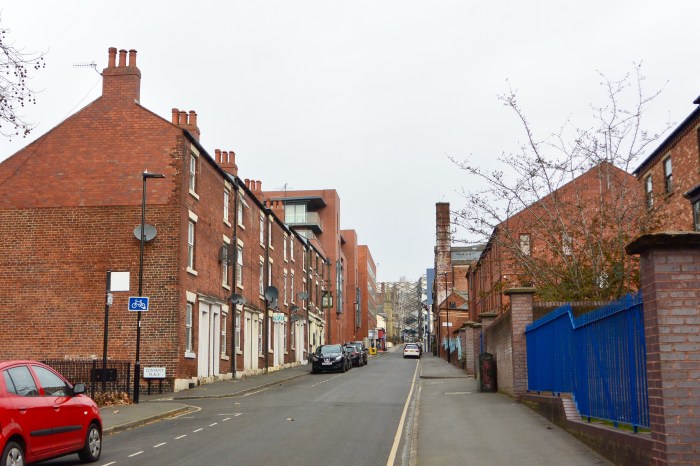
After graduating in 1978, I left Sheffield for a year to work for Hampshire Libraries (subject of last year’s nostalgic visits: Winchester and me and Southampton and me). When I returned in 1979 I moved into a university flat in Victoria House. I shared with Janet (who featured in March’s Gallivanting post) and four other young women, and John lived in the flat above us (How we met). That block has been demolished (see – it’s a pattern!) and replaced by the modern building just beyond the terrace of houses, pictured above, which terminates in the Bath Hotel.
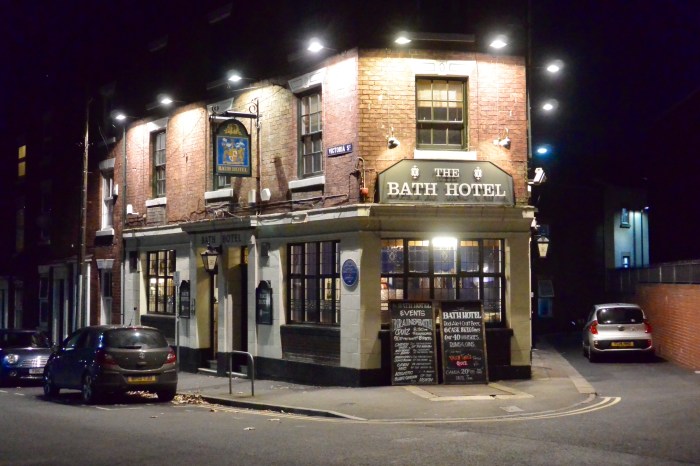
Both terrace and pub look far more salubrious than they did in our day when they were at the edge of the red-light district. At the time, that impacted on John more than on me, but later it made my blood run cold. John recalls being asked if he was “doing business” by women standing at their front doors and, because he sometimes parked a hired mini-bus in the area (he went caving with the university’s Speleological Society), he was interviewed by police in connection with the Yorkshire Ripper enquiry. I have a lot to get off my chest about this, so here comes the rant.
UK readers will no doubt be familiar with the case of Peter Sutcliffe who killed 13 women between 1975 and 1980 (neatly spanning my time in Sheffield) and who became known as the Yorkshire Ripper. I’ve always known the enquiry into the murders was badly botched (Sutcliffe was interviewed 9 times and dismissed before he was finally charged) but a recent documentary showed it was even worse than I had thought. I can forgive an inability to cross-reference thousands of pieces of paper in a pre-computer age. I can’t forgive antediluvian views on women, but can see they were part of the times: the police formed a theory that the killer was “just” targeting prostitutes and women of “loose morals”. You know, the kind who went out to pubs and enjoyed themselves. (Utterly, utterly unforgivable was the retired detective who had learned nothing in 40 years and still appeared to hold similar views.) At the beginning of the killing spree “ordinary” women victims were regarded as mistakes and the evidence of women who had been attacked by what appeared to be the same man, because of his methods, was discounted if they were not prostitutes. Some of these women gave remarkably accurate descriptions of Peter Sutcliffe.
The police were later taken in by a hoax tape and letters from a man calling himself Jack the Ripper. One retired detective said in the documentary that there was nothing in these which had not been in the press, so there was no proof that they came from the killer – when he pointed this out he, as a junior officer, was over-ruled. “Jack” had a Sunderland accent, and the letters were postmarked from there, so anyone interviewed from then on was judged by those criteria. (John was asked when he last visited Sunderland. He didn’t even know where it was.) Many lives could have been saved if the evidence of women survivors who said their attacker had a local accent had been taken seriously, but as it wasn’t the enquiry failed completely. The conscientious policeman who finally caught Sutcliffe in January 1981 was not part of it, yet afterwards the enquiry’s leaders were filmed smiling and congratulating themselves at a press conference. They should have been ashamed to show their faces.
I expect many people who lived in Yorkshire at the time have their stories about how the Ripper touched their lives. As I have said, John was interviewed. A friend of a friend was in the same Bradford pub as student Barbara Leach the night she died in September 1979. Even closer, the final victim, Jacqueline Hill, was an English Literature student at Leeds in the same year-group as my sister. However, Sutcliffe had never killed in Sheffield, which was maybe why I wasn’t worried about going home alone to my lodgings at night. But where was he caught? Here:
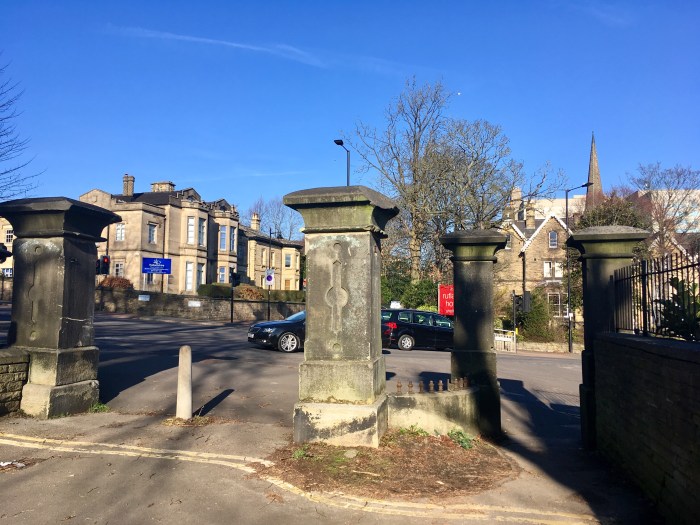
In my postgraduate year, I volunteered as a tutor to a woman from the Bangladeshi community who had little English. To train for this, I attended a few evening classes in a Teachers’ Centre on Melbourne Avenue which starts right where I was standing to take the photograph above. I had no idea it was a place prostitutes took their clients, but this is where Sutcliffe was caught with a young woman who had a very lucky escape. No wonder my blood ran cold when I heard about it. It makes me shiver even now.
When I planned this post, I meant to write about my student homes and then look at the wider city, but anger ran away with me. Normal service will resume next time. For now, I want to end by remembering the following women whose lives were cut short in the most brutal fashion:
Wilma McCann, Emily Jackson, Irene Richardson, Patricia Atkinson, Jayne MacDonald, Jean Jordan, Yvonne Pearson, Helen Rytka, Vera Millward, Josephine Whitaker, Barbara Leach, Marguerite Walls, Jacqueline Hill.


 The Glasgow Gallivanter
It’s awful what happened, your writing style is amazing I must add..
I agree with the comments you made throughout
But yes victims do become the ones on trial ..
LikeLike
Thank you for reading. Your observation about victims is very accurate.
LikeLiked by 1 person
Thank you for remembering their names . . . . we seem to live in a world where we remember the attackers more than the victims, it should be the other way round.
LikeLike
It certainly should. That’s why I thought the documentary was good: it treated the victims with respect.
LikeLiked by 1 person
I was living in the Vancouver area, Canada, at the time the notorious BC serial killer Robert Picton was taking women to his pig farm and killing them. At the time of the trial, it came out that sex workers in Vancouver’s downtown east side had suspected that a serial killer was on the loose, but that police were slow to listen to them because they weren’t “credible.”
I also lived in northern BC at the time that women started disappearing along Highway 16, the main highway that connects many small isolated communities. For decades, police did not look for a serial killer but investigated the disappearances as isolated occurrences. Many suspect the lack of effort was because most of the victims were young indigenous women who were hitch-hiking on the highway. It wasn’t until a white female hitch-hiker disappeared that more resources were finally put on the case. There are between 18 and 40 possible victims. That killer has not yet been found. Highway 16 has been dubbed “The Highway of Tears” and public outcry has finally led to a national inquiry into the deaths of Missing and Murdered Indigenous Women.
https://en.m.wikipedia.org/wiki/Highway_of_Tears
Jude
LikeLike
Horrifying! I had a look at the article too – some case are quite recent. Same old misogyny, racism and prejudices still alive and well unfortunately.
LikeLike
I had no idea! And I’m so angered that the police don’t make progress in so many ways. Thinking about the grooming of hundreds of young white women in Birmingham area. Because we are women, we are still worth less???
Enough rant.
I’m in the States; I have had ankle surgery; I’ll be back early June. Let’s catch up.
M x
LikeLike
It’s shocking, isn’t it? I’m around most of June so let me know when you’re back.
LikeLike
Anabel – I am so glad you are here to have your little rant. Amazing the things we live through without even knowing it at the time! – Susan
LikeLike
So am I! Amazing how blasé we are when young.
LikeLiked by 1 person
Hello! I missed a few but now back on board. This is scary as i remember this well since it was in all the news. How infuriating with the police and their judgemental way of thinking. I wish i could say it is better and maybe it is…somewhat but I doubt it. It is scary when you realize you were so close to the scene. It reminds me of the time I was coming home from volunteering and this van was following me all the way to my home (apartments). It stopped and then sped away only to come back a minute later waiting for me to get out of my car. I had a feeling not to get out and was ready to honk my horn(the entrance was blocked by the van) when my ex came down to see why I didn`t come up (it was 3am). This was the summer when the serial killer Paul Bernaderdo and his wife took at least 2 girls (plus his wife`s sister at her urging)and killed them and he was known as the Scarborough rapist. They did have a van….my heart sank!
LikeLike
That sounds terrifying! I have never felt unsafe like that myself, but looking back I did put myself in potentially unsafe situations, but then i’d never have gone anywhere otherwise. As for the police, totally agree.
LikeLike
I didn’t realise you lived in Yorkshire at the same time the Yorkshire Ripper was active. It must have been a frightening time, though I know sometimes when we’re young, we can be quite blase about these things.I was still living in Cleveland at the time of the Ariel Castro kidnappings, and was roughly the same age as Amanda Berry, yet I don’t remember hearing anything about her or the other missing women in the news at the time, even though my mother says it was everywhere, and she was worried about my safety. And I agree that the handling of the Yorkshire Ripper case was completely botched, and certainly don’t blame you for being angry. It is infuriating.
LikeLike
I was definitely blasé about it. It was only when the girl in my sister’s year was killed that I felt a bit worried – then when I found out I had been walking up and down the lane where he was caught I was horrified!
LikeLiked by 1 person
That is scary!
LikeLike
Hi Anabel – sadly, it was the way of the world … and still is in some countries. We need to get people to think … and evaluate … I’m glad you’re safe – but feel for those young women, as too their families. A chilling thought provoking post for us all to read. A rant is fine and I’m glad you’ve written it … Hilary
LikeLike
Thanks Hilary. I wish I could be 100% sure that these attitudes had been completely eradicated in this country too 😟.
LikeLike
This post definitely made me shiver. It is a well-deserved, and very important, rant!
LikeLike
Visiting Sheffield again combined with the documentary brought it all back to the surface.
LikeLike
You’re entitled to rant! It is horrible that the police didn’t take this more seriously because they thought the victims were “just” prostitutes. Especially since earlier action could have saved lives. I can’t imagine how much more personal it feels since you were actually living in the area at the time! So sad, but also infuriating…
LikeLike
It was appalling. I hadn’t thought about it for a long time till the recent documentary: it was very good in that it concentrated on the victims and their families rather than on Sutcliffe which some others have done.
LikeLike
Hi. What happened to Sutcliffe? Life in prison? Executed?
LikeLike
We don’t have the death penalty here, not since the 1960s, so he’s in prison and will never get out. I think he has also spent time in Broadmoor (secure psychiatric hospital).
LikeLiked by 1 person
I’ve heard of this case of course, but I didn’t know the story behind it all. Talk about a botched job. Hopefully they learned something from it. Scary to think how close it all was.
LikeLike
You have to hope something was learned but sometimes I have my doubts how much! It was scarily close, but, as someone commented earlier – when you are young you think you are invincible. I don’t remember being too worried at the time, we just got on with life.
LikeLiked by 1 person
I suppose people think these ghastly things will never happened to them too. How awful.
LikeLike
Exactly. And, of course, the police line of enquiry fostered that sense of safety in what they called”ordinary” women.
LikeLike
Interesting stuff. I’ve not got an in depth knowledge of individual cases but just looking at the news over the last 40 years Yorkshire pops up frequently for sex crimes, murders, etc , often with criticism over police mishandling or somehow turning a blind eye. Been quite a few documentary/tv series about several investigations in the past that happened in Yorkshire, re-examining the evidence.
LikeLike
To be fair, there are several Yorkshire forces (though I’m not sure if that makes it better or worse!) This would be West Yorkshire. I can think of Hillsborough and the Rotherham grooming cases which would be South Yorkshire.
LikeLike
Excellent post and I didn’t mind the rant at all.
LikeLike
Glad to hear it! It was a shocking situation.
LikeLiked by 1 person
Excellent post, Anabel. Rant well deserved. Not only do people in law enforcement still have these attitudes about women, they seem to fall into many incorrect generalizations. As in mass murderers are always loners and loners are all sickos.
Like you, I did move around a lot, but quite settled since I landed in Durango. What’s amazing is all the names and details you can pull out from those years! How do you do it? And what was it about you and your roomies that made people want to get out of the landlord business, eh?
LikeLike
I suppose we all have our biases but I think the police should have better training in seeing through theirs and being more objective. You’re right, it still happens. I suppose even though I haven’t been back for a long time, because we were both in Sheffield for some of my student days we still talk about it and that maybe keeps the details fresh in my mind. As for the landlords – I’m sure we were model tenants, how could we have been at fault? All coincidence I’m sure!
LikeLiked by 1 person
I can’t imagine – you’re quite prim and proper.
LikeLike
Of course!
LikeLiked by 1 person
Not one to ‘like’ much, Anabel. You needed that smile 🙂
LikeLike
I did, thanks!
LikeLiked by 1 person
Rant well deserved! I’m sure that wasn’t (and isn’t) an isolated case of botched police work based on clear prejudice against the “class” of the victims. Poor John to be caught up in it.
LikeLike
It’s probably the worst case in modern times, but I know there are others. They just didn’t seem to see beyond the end of their noses. How they fell for that tape I don’t know – but we all believed in it because the police were so sure. I wouldn’t be so trusting now.
LikeLiked by 1 person
You were at University around the same time as me but I was over in Liverpool. A rare working class student! As I live close to Liverpool we often go over there and sometimes see the places where I hung out. “Colin’s magic mystery tour” last year brought back memories when we visited penny Lane which is round the corner from the halls I lived in during my first year.
Your comments about the Ripper are very appropriate. Well said👏. Fortunately police methods have improved but there are still bad attitudes amongst some officers against women and minority groups. So improvements still needed.
LikeLiked by 1 person
John worked in Sheffield till 1986 when we moved to Glasgow so we still regarded it as our city then, even when living in Nottinghamshire, and continued to visit regularly. No doubt we’d have gone on doing so if we weren’t so far away. Of all the places i’ve lived it’s my second favourite after Glasgow. Sometimes I feel encouraged that we’ve made progress, other times I despair!
LikeLiked by 2 people
You’ve moved around quite a lot. I’ve only ever lived in 2 towns and one city, all in South Lancashire. But I do try to see other places and taste other cultures when I get the chance.
As for Sheffield, amazingly, I’ve only ever been there about 3 times, and always for meetings to do with work. So I’ve never really seen the city properly.
LikeLike
Well, I moved around until we came to Glasgow! Well settled now.
LikeLiked by 1 person
Fabulous post, Anabel! Good on you for calling out the prejudices and biases that tainted the investigation. I especially like how you name the victims at the end so that they are remembered and not forgotten.
LikeLiked by 1 person
Thanks Ellen. I had forgotten how bad it all was until I saw the programme.
LikeLike
What’s very sad about this story is that there is still some of this bias going on today. It makes me angry too. I can see why it would make your blood run cold.
LikeLiked by 1 person
That’s very true, and more than a bit I think.
LikeLiked by 1 person
I was living out of the country when this all took place, but it still had an impact on me as I used to walk home to a bedsit in Bradford, alone in 1972. Somehow when you are young you think you are invincible. Truth is, this can happen to anyone.
LikeLike
You do think you are invincible. I don’t remember worrying much until near the end when the girl my sister knew (slightly) was killed. It could have been any of us.
LikeLiked by 1 person
Beautifully written, Anabel – and I completely agree with your comments on the police investigation into the Yorkshire Ripper. The “But they’re only prostitutes / women with loose morals” attitude displayed by the police (and wider society) makes my blood boil and is a view that I fear is still held on to by some. You only need to look at the media treatment of Claudia Lawrence after she went missing to see how women are still judged for their “behaviour”.
LikeLiked by 1 person
Thanks Liz! I hope that view is less widespread but agree it still lingers. Rape trials are another horrifying example of women’s lives being torn apart in search of any hint of “dubious moral standards” (another phrase from the Ripper documentary).
LikeLiked by 2 people
I completely agree – more often than not, it’s as though the victim is on trial, not the accused.
LikeLike
Exactly 😟
LikeLiked by 1 person
How typical of the police to run investigations based on prejudices and woolly thinking. We have had several cases in the last few years where Courts of Appeal have overturned convictions of innocent people who’ve been wrongly jailed based on bad police investigations. And in most of these, the guilty person is still at large, leaving grieving families without any chance of closure and the rest of us wondering it there is a killer amongst us.
LikeLike
Yes, I can think of some of those as well in this country. The famous one is Jill Dando, the journalist, who was murdered 20 years ago thus there were anniversary appeals for information recently. The man originally jailed was released after some years. He didn’t do it so who did?
LikeLike
Gawd I remember that bit of history like it was just last week. So unusual a case and since we rarely had any murder cases in the news it was a hot topic at 6pm on TV1. Must admit not a story for bedtime reading!
LikeLike
No, it was quite horrific. Unbearable to think what these women suffered – and that some of them could have been saved if only the police had listened to women.
LikeLiked by 1 person
Hopefully one day the police will be made accountable?
LikeLike
Most of the police on this case are now dead so are beyond accountability. To his credit one was instrumental in catching and convicting the hoaxer years later. I don’t know if it happened here, but in some other cases they have retired early on the grounds of ill-health before they can be disciplined which I don’t think should be allowed.
LikeLike
I agree and as Su mentioned there have been a few cases here where the police have less morals than the criminals. Though some feel there us a fune line between both. Here’s to less prejudice and accountability in our police forces!!!
LikeLiked by 1 person
It’s awful, what happened and how those attitudes are still there. Nice to see Sheffield again. Having done my masters there I need to go back soon
LikeLike
It’s shocking. I think Sheffield is well worth revisiting. I didn’t know, or had forgotten, that you had studied there, presumably in the Law School? That had moved since my day. My undergraduate boyfriend was a lawyer so I used to study in the Law Library with him sometimes. I found that building on Conduit Rd but it’s now the Business School. Law is in the old St George’s Hospital opposite the back of the Arts Tower.
LikeLiked by 1 person
Creative writing in the (say it quietly) Hallam branch. A poly back in the day I expect!
LikeLike
Ah, something completely different! Yes, Sheffield Poly in my day.
LikeLiked by 1 person
Splendid strong post, dear Anabel! True! Silence kills the truth…the truth of history. Never let it be. Have a nice exploring week!
LikeLike
Thank you! It’s important to remember these things and, hopefully, learn from them.
LikeLiked by 1 person
I share fully your opinion. In fact, more truth will be spoken out in historical metters, better our future will be! 🙂
LikeLiked by 1 person