Australia 2004, part 4: Cooktown
Cooktown marks the point where Captain Cook beached his ship, the Endeavour, in June 1770, thus becoming Australia’s first non-indigenous, though temporary, settlement. The town itself was founded in 1873 as a supply port for the goldfields along the Palmer River, and at its peak it had a population of over 30,000. The guidebook we used in 2004 gave the population as 1410: interestingly, according to Wikipedia, the 2016 census puts it at 2631. It’s not very big anyway!
After our drive along the Bloomfield Track, we arrived in Cooktown for a three night stay in Milkwood Lodge Cabins. This was one of the places John had phoned in advance to check accessibility for a person in plaster to the knee, and the owners had kindly moved our booking to a cabin with no steps to the entrance. They couldn’t have been more helpful, and I see they are still in business getting good reviews on Trip Advisor, so I feel confident recommending them. The only downside is that a bushturkey seemed to think he had visiting rights, and when not pushing his way inside could be heard scrabbling about on the roof! But we were quite fond of him.


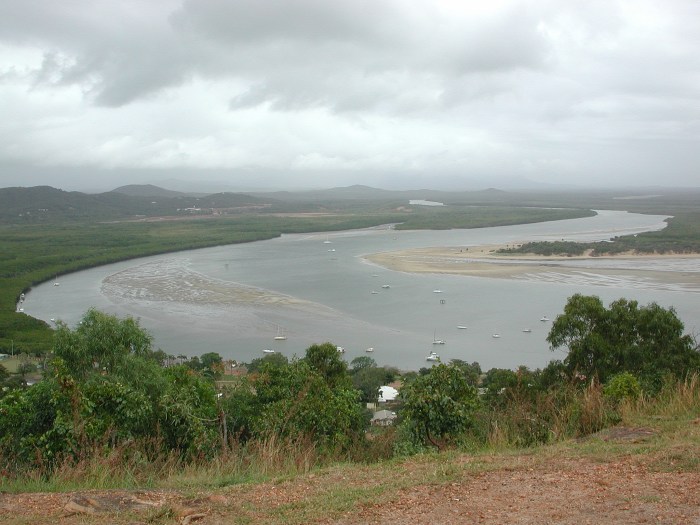
On our first day we explored the town, first of all driving to the lookout on Grassy Hill, with its 19th century iron lighthouse, from where we got a good overview.


Cooktown’s main street is Charlotte Street which has many historic buildings along it. We drove up and down so that I could look at it, then John returned on foot to take photographs while I sat on this bench resting my leg. I look quite happy, but I do remember shedding a small tear at this point because wandering round historic buildings is what I love doing.


There is, of course, a statue to the eponymous Captain Cook, and a graveyard where the most interesting memorial was to Mrs Watson “heroine of Lizard Island tragedy of 1881” and her infant son, Ferrier.


.jpg)
Mrs Watson also has a memorial in town, on which she is given a name – Mary. For some reason, we don’t have a photograph of it, so above is the Wikimedia image (clicking on the image takes you to the attribution page). We do have a picture of one of the plaques, which you can see below – “last entry” refers to a journal she kept of her ordeal.

It’s a tragic story: the monument was erected in 1886 to honour this young woman, who died, along with her infant son and her Chinese employee Ah Sam, from thirst and exposure after a conflict with a group of indigenous people in October 1881. I can’t do the story justice in this short post: it’s well worth reading the Wikipedia entry if you are interested. Important points I took away from the article are that this is the only known public monument to an individual woman (other than a head of state) in Queensland; and the way it illustrates the injustices which accompanied early European settlement, and the lack of communication and understanding between indigenous and non-indigenous peoples. That the memorial does not mention Ah Sam is another illustration of the racist attitudes of the time.
On our second day we explored the area around the town, visiting Isabella Falls, Endeavour River Falls, Barretts Lagoon, and Archer Point.


I wasn’t able to do very much at any of these places except look, but at least we weren’t inhibited from enjoying nice cafes during our stay – often with a view and a good beer.


It was now a week since my accident and I hadn’t yet told anyone at home, so on our last night in Cooktown I made the dreaded phone calls to my parents and my closest colleague. All were sympathetic, of course, so having got that out of the way, we packed up to head back to Cairns and (hopefully) to enjoy the last few days of our Australian adventure.


 The Glasgow Gallivanter
Poor Mrs Watson. History is full of stories, too many of which aren’t told…especially when they involve women and children! Looks like you made the best of things despite the injury.
LikeLike
It’s a very sad story, I agree. I’m glad she got her memorial, but with the Chinese servant had got one too.
LikeLike
What a fascinating place, and so frustrating for you that you couldn’t properly explore yourself. Glad you got to see what you did though
LikeLike
Frustrating is the word!
LikeLiked by 1 person
A bush turkey looks less scary than a regular turkey (which scare the crap out of me), but I still wouldn’t particularly want one in my room! I think all those old mining towns in Australia are just adorable, and I wish we’d had time to explore some. It sounds as though it has quite a depressing history though!
LikeLike
The turkey was friendly, too friendly! I suspect previous residents had fed it. Never a good idea.
LikeLiked by 2 people
Hi Anabel – it sounds so interesting … and I know you, like me, appreciate the lack of thought about the indigenous populations … I learnt so much when I was in Canada – picked up on my own account – but read up and understand more. I’m older now and definitely should have understood more when I was in South Africa. Thanks for letting us know about Cookstown – pity you couldn’t do as much exploring as you’d have like.
Love the turkey – rather have him … than the wretched seagulls! take care – Hilary
LikeLike
I know, the older we get, the wiser we become – hopefully! I agree on the gulls, viscous creatures. Our turkey was friendly.
LikeLike
I’m catching up after being away for a week without reception so I’m wondering what happened to you. I’ll need to go back a couple of posts. We are yet to visit as far north as Cooktown but it’s on our list. I’m not sure that the monument to Mary is the only one to a woman in Queensland. I can think of a couple nearby to us.
LikeLike
Oh right, I got my info from that count of all knowledge Wikipedia! It does specify “individual” women, so maybe it has a very narrow definition. We are very careful on our guided walks when we say we have 4 statues of “named” women because there are lots of generic female figures. Or maybe Wiki is just wrong …
LikeLiked by 2 people
Who knows what criteria they’ve used. One here that comes immediately to mind is for Sister Elizabeth Kenny. She was a nurse who, in the early 1900s, developed a new method for treating polio. Her methods became the foundations of what we know now as Physiotherapy. Anyway, as long as the remarkable women of our past are recognised, it doesn’t really matter how.
LikeLike
She sounds an excellent woman. So wiki is just wrong then!
LikeLiked by 1 person
Well worth amending the Wiki entries – I went on a course a year ago on how to do it, being run by an organisation working hard to ensure that women and persons of colour are more accurately represented on Wiki. Amending and adding entries much easier than I thought
LikeLike
Yes, I’ve been to a couple of workshops to add entries about women, so I’ve written a grand total of two articles and have never done any more! It’s a nice idea in theory but not something I’ve made time for since. I’ve done a few small updates but I don’t think I know enough about this topic to tackle it. One thing the workshops did give me was a respect for Wikipedia which is often dismissed as unreliable, but is actually much more rigorously controlled than I had thought. It’s a great starting point for anything, as long as you don’t use it as the only source.
LikeLiked by 1 person
Likewise, I was more impressed too after the training but also like you just haven’t been able to commit the time to it. Maybe however next year I will . . . . . .
LikeLiked by 1 person
Looks lovely…even though you couldn’t truly enjoy it as you would have wished. (Suzanne)
LikeLike
I still got a lot out of it, though it obviously wasn’t what it could have been.
LikeLike
I’ve not long come back from my first trip up to far north Queensland (I’m on the Sunshine Coast so can travel within the state but not outside it) and your posts over the past few weeks have brought back memories. We didn’t get up to Cooktown or over the mountain, but are planning a road trip to do exactly that. Interestingly, I just finished reading a novel set in Cooktown and googled the Lizard Island tragedy…different times, hey…
LikeLike
I hope you enjoy driving up to Cooktown. We loved our time in Queensland, despite my obvious difficulty. Definitely different times, but nothing like perfect now. We’ve just had a young asylum seeker starve to death, with her malnourished baby beside her, because she wasn’t allowed to work and had no many for food. Thanks for commenting!
LikeLiked by 1 person
Oh my goodness, I hadn’t read that story about the asylum seeker and it makes my heart hurt that anyone can starve to death in a developed country.
LikeLike
I know. It’s maybe more complex than I thought when I wrote about it last night, but it’s still a shocking situation. She had obviously fallen through the cracks in the system.
LikeLiked by 1 person
Fascinating post and some amazing photos. It’s a completely different world down there isn’t it? Everything seems new and so different. Cooktown looks interesting as it has a lot more history than most Aussie towns.
LikeLike
It is! Cooktown definitely has a bit of a frontier town feel to it.
LikeLiked by 1 person
Hi, Anabel – What a timely post. Since a chunk of time has been taken out of everyone’s travels plans, Richard and I have just been updating our travel bucket list. Australia was definitely on our list but your post helped push it higher and to flesh out more details for us.
Thanks for the vicarious tour!
LikeLike
I hope you make it there some day! And I hope I make it back.
LikeLike
A lovely part of the country but it’s so long since I was last there… before you! Thanks for bringing it back to me Anabel.
LikeLike
Glad to do so!
LikeLiked by 1 person
This looks like such a great trip and I love the photos especially that Turkey. I am glad that the place accommodated you. The waterfall looks like it was right in the middle of the road. It is just lush and green
LikeLike
The turkey was fun! I think he’d been visiting for a while, as we found a few hidden – ahem – deposits.
LikeLike
That looks a really nice area and town. Very lush and green. I loved the city parks over there as practically every day you saw spectacular birds, insects, reptiles, and furry creatures you’d never seen before. It was amazing. I’ve been watching Aussie Gold Hunters on TV here last few months
if you want go back to the bush vicariously. One of the few countries where riches still lie on the surface of the earth, waiting to be picked up.
LikeLike
Surprisingly green! A bit of a Wild West feel to the buildings. I’d love to have been able to explore the surrounding area more.
LikeLike
And by the way, how come you guys never change?
LikeLike
Well, we both went grey early and people started offering us senior discounts very young! So I guess now that we actually qualify we don’t look much different.
LikeLike
So good to read this post. My nephew and his family are up there at the moment on a three-year teaching stint and, not having been there myself, it gives me an idea of what the place is like.
LikeLike
Glad to be useful!
LikeLike
Late to the party, Anabel, I don’t know how you injured your leg but I can imagine how aggrieved you must have felt. Going back… one day? 😦
LikeLike
Tripped and broke two metatarsals a couple of episodes before this one. Would like to think I could go back, but the world isn’t cooperating. Very inconsiderate!
LikeLike
Ouch! 😦 And ouch again!
LikeLike
Exactly!
LikeLiked by 1 person
I like the Pickled Gecko sign. I hope the gecko was pickled in a pleasant stupor, not to be eaten.
Mary’s tale is quite sad, and also the Chinese gentlemen. So much unpleasantness arises from cultural clashes.
LikeLike
As a veggie, i had no designs on the gecko and so didn’t find out 😉! The story of Mary Watson is tragic for all three of them. Ah Sam should have been acknowledged.
LikeLiked by 1 person
Greetings. Jackey Jackey is a catchy name. Did you eat there?
LikeLike
No, we didn’t. We were probably amused by the name though, because in Glasgow a jakey is a down-at-heel drunk!
LikeLiked by 1 person
Yes, I can see the strain in your face in some of those photos.
I have a feeling that when the Coast programme decided to do Australia, they included a visit to Cookstown, as the story of that lady was vaguely familiar. Coast Australia was one of their best series. Wonder if it’s hiding in the BBC iPlayer somewhere?
LikeLike
Everything just became such an effort, so I probably do look strained. I haven’t seen Coast Australia – there would be a lot of it to choose from!
LikeLike
Well, at you we’re able to see a certain amount, Anabel. And as Mari says, tales about people make a place come to life
LikeLike
I saw just enough to appreciate the place while desperately wishing for more!
LikeLiked by 1 person
Yep, I know that feeling, now that may health has limited may ability to get about
LikeLike
😟
LikeLiked by 1 person
Life
LikeLiked by 1 person
I was with you in spirit as I read this as we made a brief visit to Cooktown on our big trip to Oz in 2003 (I think). Our bookings were all made in advance by the parents of an Australian ex-pat and they were all pretty good, except the one in Cairns which was a bit of a disaster as they only had self-service food which left a lot to be desired. I love tales about people, they make a place come to life and your story of Mary Watson is a perfect example. I can forget about the area, the photos and the terrain and just think of that poor woman dying of thirst. Maybe it’s my nationality – the Irish love a good death!!
LikeLike
Just the year before us then! We almost met 😉. I’ve learned through my tour-guiding that telling stories about specific people is always more popular than generic facts.
LikeLike
The inscription on Mary Watson’s memorial brought a lump to my throat before I read the Wikipedia entry. Such a sad story but a beautiful monument to remember Mary and her baby 😦 The ford at Isabelle Falls looks interesting and I like the Ferrari estates building and the Grassy Hill lighthouse. You look much happier in the bottom shot than you do in the one on the bench 🙂
LikeLike
It was a very sad story. I had forgotten all about it till I looked at the pictures for the first time in years to write this post.
LikeLike