
Graveyards of Glasgow: Western Necropolis and St Kentigern’s
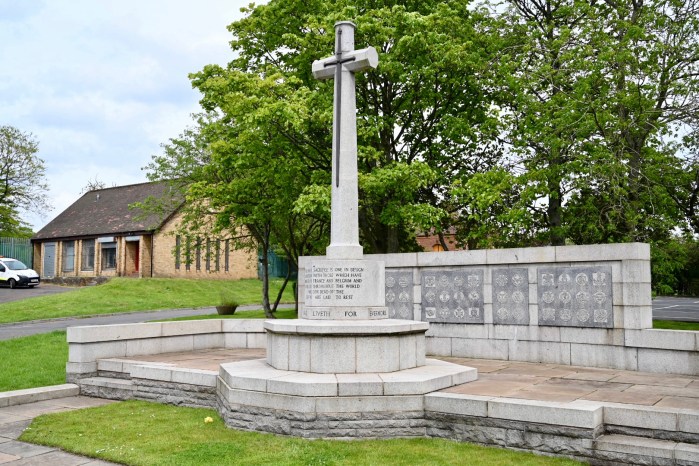
Glasgow’s main Necropolis, which I wrote about last time, is not the only one in the city which also boasts Southern, Eastern and Western Necropoli. I’ve yet to visit the Eastern one, the Southern has appeared in a long ago post on the Gorbals, and the Western first appeared (along with its neighbour, Lambhill Cemetery) in May’s Gallivanting post, a visit which inspired us to go back to explore further.
Western Necropolis


Established in 1882, the Western Necropolis was one of several non-denominational cemeteries established to cope with the huge demand for burial space created by the rapid expansion of Victorian Glasgow. Garden cemeteries were designed to be recreational spaces where contemplation of death was made less painful by careful layout and design. The Western was the last of the four Necropoli to be created, and the only one to have a crematorium on the grounds: built in 1895 it was the first crematorium in Scotland and only the third in Great Britain. Opposite the cenotaph and crematorium is the monument shown above, It commemorates the South African War of 1899-1902, the Second Boer War.
Further into the necropolis we found a grave for which we were specifically looking. Sir William Alexander Smith, who founded the Boys’ Brigade in Glasgow in 1883, is buried here with his wife and other family members. His headstone is shown below in a gallery which also includes images of the building in North Woodside Road where the BB began, and of its commemorative plaque.


Other graves to catch my eye included (left to right below) Isobel MacKinnon Gardner who died at the young age of 32 in 1908, an array of Celtic crosses, and the three-part Walker memorial. The last one prompted some further research into “David Walker of Belmont, Kelvinside Gardens, and Principal of Belgravia College, Glasgow” who died in 1906.


I had never heard of Belgravia College, but it turns out to be a school for young ladies situated on Newton Terrace, Sauchiehall Street. To appreciate fully the floridity of its description it’s worth following the link to this 1891 business directory entry, but here’s a flavour:
The College, which was established in the year 1868, has had a career of great usefulness and academical prosperity. Having been instituted for the special purpose of providing young ladies with a very complete course of instruction, in all branches of a liberal English education, upon the most moderate of terms, it has with a remarkable elasticity of constitution adjusted itself to the varying needs of the age, and to-day, by reason of its admirable appointments, excellent management, and efficient teaching staff, occupies a position of scholastic repute of no mean order.
Lucky young ladies!


The Western Necropolis forms part of a larger cemetery network with the adjoining Lambhill Cemetery and St Kentigern’s. Having visited the former last time, this time we crossed into the latter via the poignant Infant Memorial Garden, as shown above.
St Kentigern’s
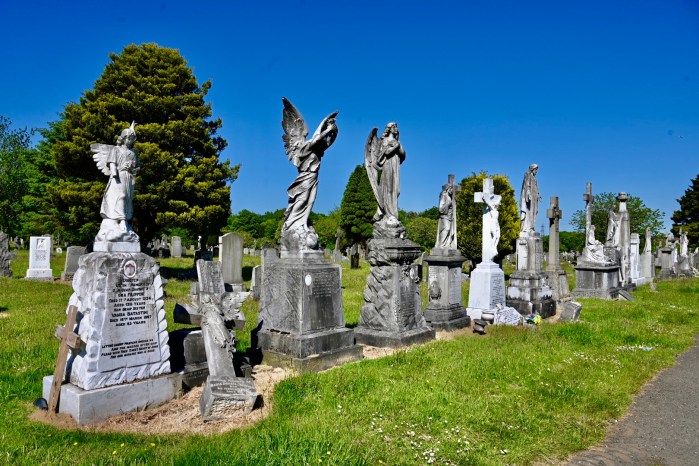
St. Kentigern’s Roman Catholic Cemetery was established, like the Western Necropolis, in 1882 and is named after the founder of Glasgow (also known as St Mungo). Many memorials feature beautiful, if sentimental, sculptures.


Two memorials of note are shown below. The worst pit disaster in the area was at Cadder, in August 1913, when 22 miners were killed. Most lived locally and all of Lambhill turned out for the funeral cortege. This collective memorial for the eleven Catholic miners was erected in St Kentigern’s, while the others had individual stones in Lambhill Cemetery.
Benny Lynch (1913-1976) was the undefeated flyweight champion of the world and the first Scotsman to win a world boxing title. His black marble headstone was erected by fans, features an image of him boxing, and has the inscription “Always a fighter”


Jewish cemetery
Finally, we arrived back at the entrance to the Western Necropolis via the Jewish section which serves Garnethill Synagogue in the city centre (also shown).


Next time: Cathcart Cemetery


Inerested in the reference to Rev David Walker. He was my Great Grandfather.
LikeLike
How fascinating! I was very taken with the monument which caused me to look up the college and then, later, to go to see the building it was in.
LikeLike
Hi Anabel – the first couple of pictures give the concept of a garden crematorium just beautifully … also was pleased to see the Boer War II Memorial … fascinating people you found … your ladies! Incredible sculptures … one can wander round graveyards, crematorium and see so much … thanks for all the info … especially that look back to 1891 and David Walker’s school … take care and stay safe – Hilary
LikeLike
They are very like gardens, and in lock down were much quieter to walk round than parks. There are so many interesting stories to be found if you look carefully enough.
LikeLike
Cemeteries are often fascinating places to explore, Anabel. Wow, the memorials do feature beautiful sculptures. Fascinating history and stories. Reading through the comments, I agree how sad the infant mortality numbers at that time.
LikeLike
I love just wandering to see who I find! Though sometimes I am looking for someone definite which can occasionally be a wild goose chase.
LikeLiked by 1 person
I love that Glasgow has four different Necropoli cemeteries – the plural of necropolis is fun to say! I’ve been to a lot of Catholic cemeteries, since that’s where basically all my deceased relatives are buried, and they’re usually not that exciting, as all the graves seem to have similar motifs (Jesus, Virgin Mary, angels) – you seem to only get the more creative headstones in non-denominational cemeteries, though I’m sure there are exceptions to that rule!
LikeLike
I find the opposite, Certainly in these two cemeteries, the Catholic ones seem to be more elaborate and interesting – with exceptions such as the college principle with his triple angel affair.
LikeLike
Anabel – Am I being insensitive by being glad you posted another tribute to cemeteries? More, please 😉 Cheers – Susan
LikeLike
At least two more to come!
LikeLiked by 1 person
There are so many fascinating stories to be found on gravestones and memorial plaques though the infant mortality back in those times is so terribly sad.
LikeLike
That’s so true. Always makes me sad too.
LikeLiked by 1 person
Cemeteries are fascinating places, I think. There is so much history there. But I always find the grave stones for infants and children beyond depressing.
LikeLike
I know, those are terribly sad.
LikeLike
It’s fascinating to read all of these inscriptions and to look at the different styles of gravestones and markers. Western Necropolis is one I know, and I think it is a beautiful spot with wonderful views over the countryside. It is where both my parents are, though their choice was for cremation. I didn’t know that this was the first crematorium in Scotland.
LikeLike
Nor did I till recently. It is a beautiful spot, near the canal and the Possil Loch nature reserve.
LikeLike
oh my that description. What a school – hope it was as good as its advertising would suggest!
And what a fabulous necropolis. I do so love that word. Don’t tend to see it used much around here, we do have the large cemeteries but maybe we don’t have as many angels and other statues
LikeLike
I expect it turned out charming young ladies! There were certainly plenty of angels here, especially in the Catholic cemetery.
LikeLiked by 1 person
They do like their angels don’t they!
LikeLiked by 1 person
Infant memorials are always the saddest, especially if there’s more than one child on the headstone. It was a sad fact of life in the past.
LikeLike
They are. Often evidence of the high rate of infant mortality on older stones, and most cemeteries we visit have more modern sections for remembering list babies and young children. Very poignant with their teddy bears and other tributes.
LikeLike
Graveyards are always interesting places to wander through and are ideal for nature as well. Hedgehogs, frogs, toads, and foxes have plenty of space to roam across unlike modern gardens, many of which are fenced off into dozens of sealed boxes in every street. A natural quiet Eden in every city and town.
LikeLike
They are, both interesting and good natural spaces. We were drawn to them in lockdown because they were quieter than the parks, though I was surprised how busy the Western Necropolis was, not just with wanderers such as ourselves. Still a lot of well tended graves.
LikeLike
Providing young women “a very complete course of instruction”… “upon the most moderate of terms.” What in the heck does that mean?
Love the angels on the grave markers.
LikeLike
I think they get it cheap – and probably still over priced!
LikeLiked by 1 person
“Elasticity of constitution” … a phrase for our times?
I do love a good wander around a cemetery. Your last post inspired a wee stroll around the local one and now I am engrossed in the land wars of a Scottish migrant family to 19th century Auckland. I love Archives New Zealand and digitised newspapers!!
LikeLike
He sounds like a snake oil salesman to me! Glad to have inspired – maybe the land wars tale will be told on your blog some day.
LikeLike
Absolutely fascinating. We have visited Glasgow Necropolis, but not this one. I’m still trying to figure out my fascination for cemeteries – something to do with mortality, possibly, but also I think a celebration of life and the stories behind each one. Lovely post.
LikeLike
It’s the stories that make it for me. There are so many forgotten lives in there it’s good to find out about a few of them, such as the Principal of Belgravia College. Looking him up gave an interesting insight into the lives of “young ladies”!
LikeLike
Mining was and is such a dangerous occupation. It’s sad to see eleven names on the same memorial.
LikeLike
It is very poignant.
LikeLiked by 1 person
Certainly some very ornate memorials here, I like the Kinney and the Casci and Equi ones, and the infant memorial garden looks very sweet.
LikeLike
Yes, those are my favourites. I love the way the statues drape themselves over the gravestones.
LikeLike
I especially love the description of Belgravia College. Fascinating!
LikeLike
Weren’t they pompous in those days!
LikeLike
Love cemeteries and would go with my dad looking at them. My mom never got the reason why we liked it so much. This is a great cemetery to wander through and I love the sentimental ones especially with the angels.
LikeLike
I didn’t get it at one time, but now I find them fascinating.
LikeLike
There are certainly lots of very ornate statues here. X
LikeLike
Very fancy! Lots of angels.
LikeLike