
Graveyards of Glasgow: Calton Burial Ground
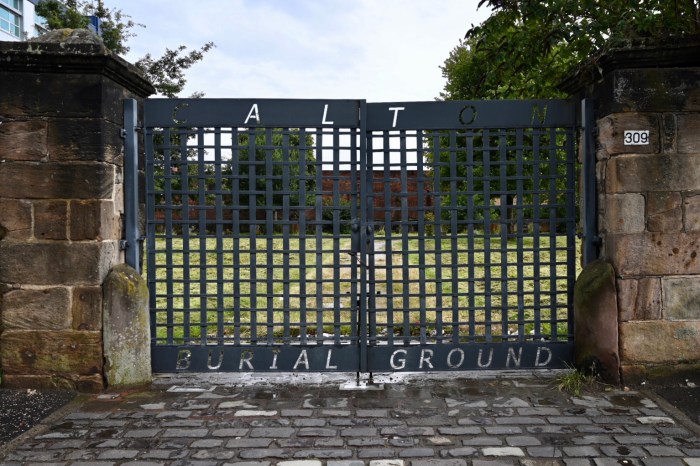
Calton Burial Ground, founded 1787, is situated in Glasgow’s East End on Abercromby Street, which was then known as Witches Loan. How did that name come about? Witches Loan was en route from the Duke Street Cattle Market to the river, and cattle seemed to be spellbound as they passed. Was this witchcraft, or due to the cows being the victims of poor pasture and recovering when they reached lusher ground by the Clyde? You decide!


Calton at the end of the eighteenth century was a handweaving community just outside Glasgow. The decision to build the burial ground was made in December 1786 by the Incorporation of Weavers of Calton and Blackfaulds, and the original land (it was extended to the south in 1822) was purchased in January 1787. Individual plots or lairs were numbered and offered for sale, with the plots beside the walls being more expensive (£2) than the inner plots (£1).


At the peak of Calton’s prosperity, wages had risen to nearly £100 a year, but by 1787 mechanization and growth in the labour force had severely depressed wages. That summer, the Calton weavers marched through Glasgow protesting at a 25 percent wage cut and lockout. During one of these demonstrations, on 3rd September, soldiers opened fire on the protestors: three weavers were killed and three mortally wounded. This was the earliest major industrial dispute in Scottish history and the Calton weavers became Scotland’s first working-class martyrs.
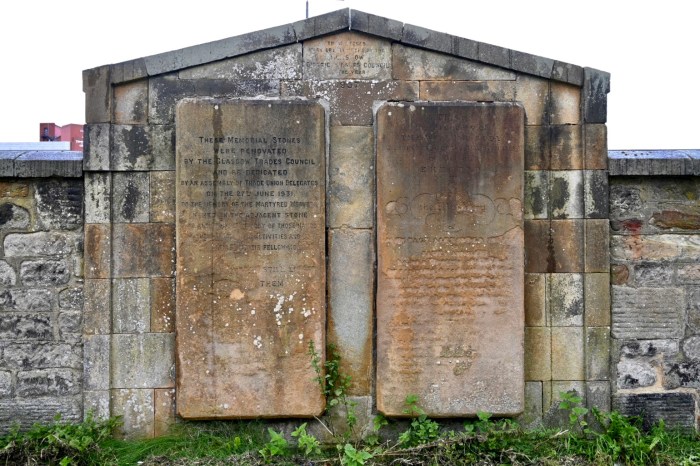
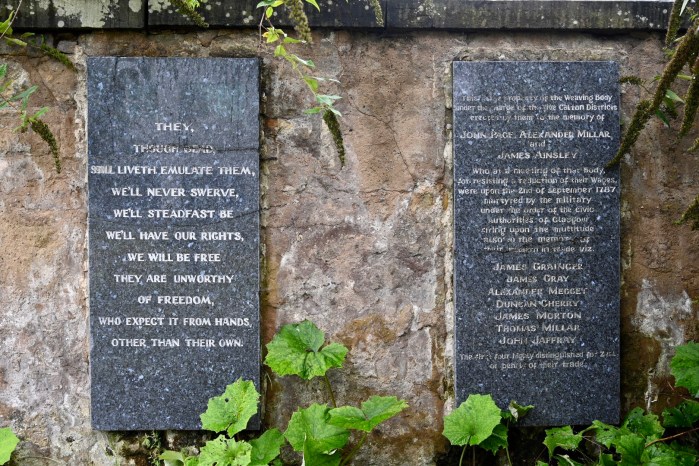
On 5th September, three of the dead weavers were interred in Lair 83 which lay unclaimed until 1825 when a memorial slab was laid over the plot. In 1957 the memorial was rededicated. The two original stones were moved to the southern gate (above) and replaced with two granite slabs (below) at Lair 83.
The other significant stone we found was that of Rev James Smith, a Glasgow Presbyterian minister who moved to the US and was at one time pastor to Abraham Lincoln. He ended his days as US Consul to Dundee.


I usually find some women to write about in these graveyard posts, but not this one. I’ll make up for it next time when we visit Maryhill Old Parish Burial Ground.


 The Glasgow Gallivanter
Interesting history about the hand weavers.
Jude
LikeLike
Glasgow has more than its share of interesting history!
LikeLike
Anabel, You remind me how there is a vast amount of information gleaned from graveyards. Spellbound cattle? Like you say, many significant stones and stories.
LikeLike
Always! I’ve never yet found a boring graveyard.
LikeLiked by 1 person
My dad, whose grandfather was a coachman and who had learned to ride as part of his national service etc always said that horses knew when they walked past a graveyard and you could see them respond …
LikeLiked by 1 person
Interesting! So there might be something in the spellbound cattle idea? Maybe … Thanks for visiting and commenting.
LikeLike
The innate wisdom of animals…fascinating!
LikeLiked by 1 person
Very interesting! I love a good wander around a graveyard or cemetery and to learn about the people buried there.
LikeLike
It’s one of my pleasure too (as I’m sure you’ve guessed!)
LikeLike
Cemeteries are full of fascinating stories. I’m enjoying this series of cemetery visits and all the interesting tales you have for us, Anabel.
LikeLike
Thank you! One more to go, then I’ll have to get visiting again.
LikeLiked by 1 person
I love any reference to witches, but I’m with you – doesn’t seem to have been anything magical going on there! I definitely remember reading about the Calton Weavers Massacre at one of the museums we visited in Glasgow (maybe the People’s Palace?), so it’s interesting to see the burial site.
LikeLike
I know – it seems an obvious development for the cattle, but you can see how women got accused of things! It probably was the People’s Palace that had info about the Calton Weavers.
LikeLiked by 1 person
Hi Anabel – what an interesting burial ground … and small enough to appreciate without missing out a large area. Love the history – it’s always amazing how a lot of it is absorbed into the names, folk songs etc – for us to find today. Fascinating read … take care – Hilary
LikeLike
Thanks, Hilary, yes it was small but full of interest – lots of information about the history on the recent wall plaques and paving stones.
LikeLike
Amazing that they still used to run the cattle through the east end streets until relatively recent times. I just assumed that had packed in many years ago but on a recent visit discovered the abattoir only shut in 2001. Sheds and entrance gates are still there. I remember the headlines in the paper when one of the intended victims made a dash for freedom occasionally, halting traffic until it was caught again or shot.
LikeLike
I walked up to the remains of the cattle market, not this time but a previous time. Some redevelopment and some dereliction.
LikeLike
My kind of cemetery, full of the true great and good rather than the perceived great and good 😀
LikeLiked by 1 person
Exactly!
LikeLiked by 1 person
Hi, Anabel – Witches Loan is a seriously cool name! Thank you for giving the name’s background (that prevented me from trying to Google it). I look forward to reading about significant women (woman?) at Maryhill Old Parish Burial Ground. See you there!
LikeLiked by 2 people
Just the one woman, Donna, but quite a character. I think you’ll like her!
LikeLiked by 2 people
With that memorial to those martyred weavers, looks like this cemetry should be twinned with Pere Lechaise in Paris with it’s Mur de Federes
LikeLiked by 2 people
Nothing like as grand or extensive!
LikeLiked by 2 people
Hi. I remember from my trip to Scotland that there is Calton Hill in Edinburgh. I suppose that it and this cemetery are named after the same person or family.
LikeLike
Not sure about the origins of the Edinburgh Calton, but the Glasgow one is said to come from the Gaelic A’ Challtainn, meaning the hazel wood – so maybe the surname came later. Both often misrepresented as Carlton!
LikeLiked by 1 person
The gates look like prison gates to me but it made sense when you explained about Witches glenn. This looks like a spooky cemetery to visit and I would love to see this. Interesting about the Lincoln Pastor and I am glad they kept the original slabs and dedicated newer ones to the victims.
LikeLike
It’s a small burial ground compared to the others in Glasgow I’ve visited, but it’s interesting that the major grave is of working class heroes not of the great and the good!
LikeLiked by 1 person
I wonder why the plots by the wall were more expensive, were they considered more desirable? Love the motto on the coat of arms, true then and just as much now!
LikeLike
I guess they must have been more prestigious – maybe because you got the wall to put your memorial on? It’s a good motto: I also liked all the paving slabs / wall plaques that it and other info appeared on. Made the visit more meaningful because the history was all there.
LikeLike
Somewhere in my collection from years back I have an LP record (what’s one of those?? lol) of a local folk group The Houghton Weavers, one of the songs on it is The Calton Weaver but it’s all about drinking whiskey 🙂
LikeLiked by 2 people
I think I have heard that song too, but probably a different group!
LikeLiked by 1 person
You know that folk from Westhoughton are known as keau yeds (Cow heads). The Houghton Weavers have a song from a poem about how the nickname arose. (They also did a song for Wigan Warriors 😀)
LikeLiked by 1 person
I’d love to know who started the myth about the cow’s head stuck in the gate. I have a few Houghton Weavers LPs so both songs could well be on one of them 🙂
LikeLiked by 2 people
It’s an old story. I think there’s even a pub in the village that refers to the legend, but I haven’t been throughthere for a while (usually go through Aspull to get to the M62.
I think they also have a song about Uncle Joe’s mint balls – or was that Mike Harding?
LikeLiked by 1 person
That was Mike Harding – Uncle Joe’s mint balls keep you all aglow (hey up) give them to your granny……etc 🙂 quite coincidentally I was singing that in my head the other day at work as someone has a packet of them on their desk. Personally I think they are horrible 😦
LikeLiked by 2 people
Pure good !!!!
LikeLiked by 1 person
You’d have thought there were some women weavers? Or was that done at home, and the men went out to weave for others?
LikeLiked by 2 people
There were, but it was the men who were the martyrs – I don’t know if many women were involved in the protests. However, by the 1820s they were becoming more prominent – mechanisation meant women could more easily operate the machinery and were thus employed (surprise!) at lower wages than the men. There were then some bitter industrial disputes between male and female weavers.
LikeLiked by 2 people