
Port Glasgow Heritage Walk
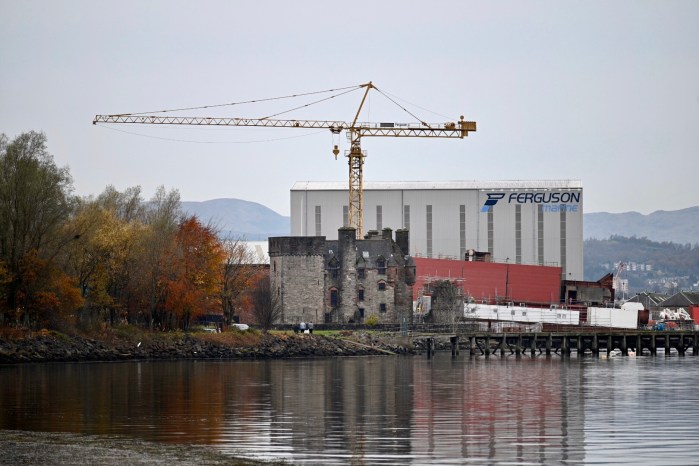
The name Port Glasgow means exactly what you might expect. It was originally a fishing hamlet called Newark which expanded because large ships were unable to navigate the River Clyde, then shallow and meandering, to the centre of Glasgow. Newark became the port for Glasgow in 1668 and was known as New Port Glasgow until this was shortened in 1775. By the 19th century Port Glasgow had become a centre for shipbuilding, but today only Ferguson Marine remains and in its shadow lies a lingering vestige of the old name, Newark Castle (c1484). It was once home to the Maxwell family, hence the initials PM on some of the windows.
This visit took place in November after the castle had closed for the winter (and the foreseeable future, as it turns out), but we had a look round the outside before setting off on our walk.


The Port Glasgow Heritage Walk has been created by the blogger The Greenockian and can be downloaded from the link. Before setting off west on her route, we walked east for a mile or so along the riverside walkway. The posts you can just see sticking out of the water, in the first picture below, are the remains of old timber ponds. At the beginning of the 18th century vast amounts of timber were imported into Port Glasgow and stored in the ponds, being seasoned by the salt water, until needed by local shipwrights or sawmills.


Once back at the castle, we started the walk proper by walking west past the gates of Ferguson Marine. Across the road is the Ropeworks Building where ropes and sails used to be made, but which was converted into housing in 2007/8.


The route then took us through Coronation Park. Points of interest included an old steam hammer, manufactured by Glen & Ross of Glasgow, and a memorial cairn to the Clyde Boating Tragedy of 1947 when 20 people died in an accident while on a pleasure cruise.


On the back wall of Fergus Monk’s garage at the West Quay are these two colourful murals by Jim Strachan. One shows fishing boats and the catch being processed on the quay, while the other shows people enjoying themselves in a non-socially-distanced way that seems but a dream now..


Looking out to the Clyde, there are two lighthouses here, Perch Lighthouse (1862) on the treacherous Perch Rock, and the taller West Quay Lighthouse built in the 1870s to guide ships using the docks.


Across a busy road from here is a large retail park (a good stop for lunch, if anything is open, I think we went to Marks and Spencer). Set into the pathway are slabs with the names of local shipyards, such as the Inch Yard. On the way out of the retail park going towards the town centre is a replica of the Comet, the first commercial steam-powered vessel in European waters (1812).


We passed two churches – St John the Baptist (left below) was built in 1854 for the growing number of Roman Catholics, many from Ireland, who came to work in the area. The current St Andrew’s Church dates from 1823, but there has been a church on the same site since 1719. You can see St Andrew’s again peeking out from behind the Old Bank Building.


Port Glasgow has had a railway since 1841. The current station building has 14 murals made by local people, each celebrating part of the town’s history. I had a hard time choosing favourites, so here’s a large selection, starting with the remembrance panel because our visit was very near Remembrance Sunday.


Opposite the station is the Star Hotel with a couple of interesting ghost signs – or are they really ghost signs if the original business is still there? Old signs anyway!


A stroll down King Street took us past the Salvation Army, then we turned down Customhouse Lane heading for the town buildings.


These date from 1816 and once included a court, a council chamber, prison and police department. Port Glasgow is now part of Inverclyde and no longer needs these things, so the building houses the public library. There are references to the town’s past with sailing ships everywhere, including the weather vane atop the 150ft steeple and on the coat of arms seen on the lamp.


Across from the town buildings are two monuments, the War Memorial and the Endeavour sculpture. The latter was created by Malcolm Robertson in 2012 and is another celebration of the town’s shipbuilding heritage.


From here, we crossed the main road again to return to our car. Port Glasgow is somewhere I drive through regularly without stopping, so I’m grateful to The Greenockian for opening my eyes to its interesting history. Linked to Jo’s Monday Walks.


 The Glasgow Gallivanter
Fascinating! My forbears were Robert Duncan (born 1776 in Saltcoats, Ayrshire) of Robert Duncan & Co. Shipbuilders, his wife Janet Dunlop and their daughter Ann, who married Thomas Harris of Greenock. Ann eventually followed her daughter to South Africa and died here.
LikeLiked by 1 person
Thank you! I’m glad you enjoyed the post. Thanks also for adding the info about your family history. It’s good to be able to look that far back.
LikeLike
What a fascinating heritage walk Anabel – I always love lighthouses. My paternal grandmother was a Maxwell – the family came down to London from Scotland in the late 1700s so I can claim kinship with the clan!
LikeLike
Maybe some of your ancestors lived here then!
LikeLiked by 1 person
Quite possibly! It sounds rather grand!!
LikeLiked by 1 person
I really liked that Remembrance Day mural as well. And the two on the back of the garage were interesting in the way that the muralist created a sense of depth in the images.
Jude
LikeLike
Yes, and I like the way you are looking at exactly the same view as is behind you. I had no idea Port Glasgow was so full of art.
LikeLike
what a wonderful walk, thoroughly enjoyed joining you on this
LikeLike
It was an unexpected treasure!
LikeLiked by 1 person
Males me wonder if I can find or develop a history walk around my new area…
LikeLike
Ooh, that would be good! Go on, go on, go on …
LikeLike
Hi Anabel – there is so much of interest to note – if we only look … and the early developments along a river highlight those changes. Love the lighthouses … while the Remembrance panel is particularly poignant – clever idea for pointing out the horror those brave men went through. All the best – Hilary
LikeLike
Thanks Hilary – the Remembrance panel and the lighthouses were the best part, I agree.
LikeLike
It’s always amazing how much history can be found in unexpected places. I’ve found myself lately seeing movies or shows on TV and thinking those people didn’t have to distance themselves from each other. I wonder if things will ever completely return to what they were without us thinking twice about how close we get to others.
LikeLike
I feel that too! I get an involuntary shudder when I see pictures of crowds.
LikeLiked by 1 person
I love weather vanes, and the ship is a good one! I found some cool gothy ones with witches and bats and things that I wanted to get for my house, but our roof isn’t very peaked, and there’s no turret or belfry or anything to stick one on, so I think it might look a bit strange.
LikeLike
That sounds good, I’ve not seen a witchy one before. John spent an entire walk photographing things on roofs a few weeks ago, so they might see the light of day at some point.
LikeLiked by 1 person
I rhink my favourite images in this post are the murals from the railway, they seem so poignant somehow. So glad that there is an Industrial Heritage Walk in Glasgow, a lot of cities and towns are in danger of forgetting their industrial past.
LikeLike
I really liked them too, but I thought it would be a bit much to post all of them! Industrial heritage is always interesting.
LikeLike
Know that area well over five decades and many changes but nice to see a heritage walk around it. I remember being highly amused that big wallet Russian tourists docking off cruise ships in nearby Greenock were very reluctant to wander round the area in case they got done in. Shows how every country usually has preconceived ideas of other areas. Like most Scots with Russia probably. There’s a 1970s video of all the shipyards coming out and thousands of workers turning that coastal main road black with coats and overalls. Hard to credit just how many folk worked in those busy docks then. Most of the three towns looked like.
LikeLike
I have family in Greenock so just tended to whizz past PG on the A8! There are also heritage trails for Greenock which we picked up when we visited the reopened James Watt Library at the end of last year, but we didn’t get a chance to do any of them before lockdown.
LikeLike
Anabel – Your walks make me yearn for stone-built structures. And that photo of the brick turreted older building with the new corrogated building behind!!! amazing – thanks for the walk – Susan
LikeLike
It’s quite a startling combination, isn’t it? Glad you enjoyed the walk, Susan.
LikeLiked by 1 person
Looks like a great walk Anabel, we love a heritage walk with loads of history at every turn. You find out so much you never had a clue about before. Always surprises around every corner aren’t there? Looks good.
LikeLike
There are surprises round every corner. I had no idea Port Glasgow was so interesting. I pass it regularly (or did when life was like that) when driving my mum to her sister’s, but never stopped.
LikeLike
Oh those joyous days walking wherever we wanted to. Loved the murals too. Fascinating heritage. Given recent events in Bristol and our mayor announcing a review of statues does Glasgow have any celebrations of our darker national past, or did you guys leave it to the duplicitous English!
LikeLike
Ah well, Glasgow’s wealth was built on slavery: tobacco and sugar. Many streets in the city centre are named after slave traders and plantation owners, and there are moves periodically to change that. Last week, some street activism resulted in alternative street names being added under the old ones. I’d be in favour of that being permanent actually, keep the old names but add explanations as to how Buchanan, Glassford etc made their money. Though we do have form in renaming – under apartheid, the square the South African consulate was on was renamed Nelson Mandela Place. No statues torn down as yet. We just belittle them by sticking traffic cones on their heads here!
LikeLiked by 1 person
I think we should embrace coning generally. Much better than all that sweat in tearing them down…
LikeLike
😀
LikeLike
Port Glasgow could be somewhere you revisit soon Anabel. Good to see the river Clyde. Lots of great architecture. X
LikeLike
It’s about a half hour drive. It would be nice to walk by a different part of the Clyde again.
LikeLiked by 1 person
What a fabulous walk! It’s so cool that this was mapped out by another blogger.
That sparks a few ideas which I may steal…err, I mean gratefully borrow!
LikeLike
Always up for the sharing of ideas!
LikeLike
Hi. On the old sign at the hotel, what does “open to non-residents” mean? Take care. Neil
LikeLike
Hi Neil, it means you can go in and use the bar without staying in the hotel.
LikeLiked by 1 person
It seems a shame to have such an ugly, modern building right next to a beautiful old castle. I love the checkerboard lighthouses… what a delight for the eyes they are!
LikeLike
It does look a bit odd, most castles being in rolling countryside! I expect at one time it would have been totally surrounded by shipyards and other industries.
LikeLike
What a great heritage walk, so glad that I tagged along!
LikeLike
Thanks Andrew, glad you enjoyed it. I admit to being surprised how interesting it was because it’s not an obviously touristy area.
LikeLike
Non touristy areas are often better. The old Grimsby docks are interesting because no one goes there.
LikeLike
True!
LikeLike
Your posts are so detailed and beautifully illustrated, Anabel. What an interesting walk. You should publish a travel guide for all the places you’ve explored.
LikeLike
Why, thank you! What a lovely compliment.
LikeLiked by 1 person
It looks like one I’d enjoy, Anabel. Just having a quick look on my phone now but I’ll come back later to share on Twitter and follow the link. Thanks hon 🤗💕
LikeLike
Thanks Jo!
LikeLiked by 1 person
So many places for you to explore close to home Anabel. And so much history too. And looking at your photos this could be now – there doesn’t seem to be a soul around!
LikeLike
It could be now! The retail park was busier, but Port Glasgow is definitely not on the tourist trail so I don’t think attracts many visitors. And it was a very cold day, so only the dedicated would go out walking …
LikeLiked by 2 people